

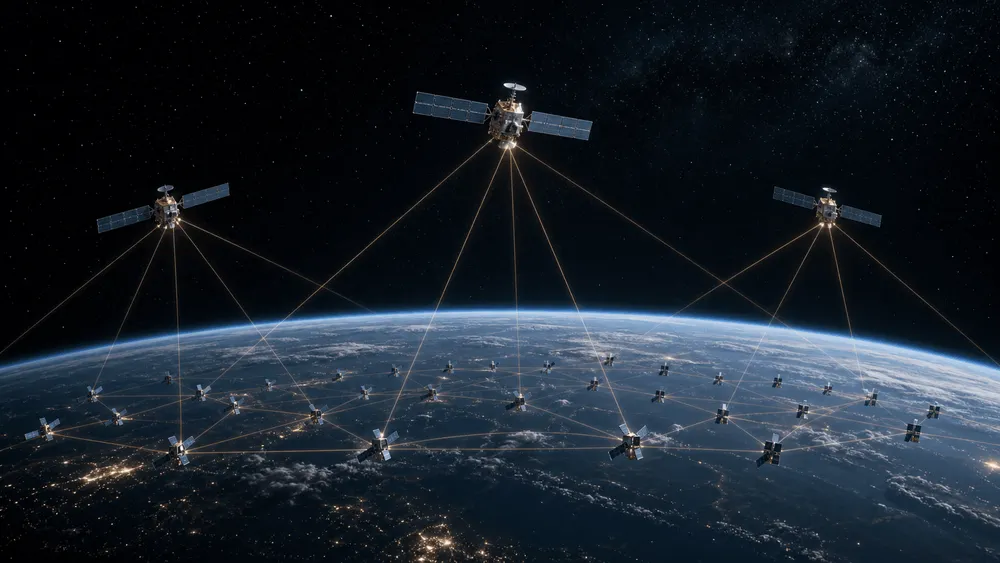
Intel's "orbital data center" is not aimed at the same goal as the massive computing facilities used to train AI models. US patent application US 2026/0230175 A1, published on August 6, 2026, describes an architecture that shifts route computation and operational decision-making for a low Earth orbit (LEO) satellite constellation—one that could grow to thousands of spacecraft—onto a small number of higher-orbit satellites. The idea is to move some of the work traditionally handled by ground-based network operations centers (NOCs) into space, keeping the LEO spacecraft themselves simple. However, what was published this time is a continuation application within a patent family that has been active since 2022; Intel has not announced any plans to manufacture or launch satellites.
The August publication is the latest step in a patent family dating back to 2022
US 2026/0230175 A1 was filed on December 29, 2025, and published on August 6, 2026. Its parent application is US application 18/111,382, filed February 17, 2023, which in turn claims priority back to a provisional application filed February 21, 2022. The parent application was published as US 2023/0208510 A1 on June 29, 2023, and granted as US 12,542,604 B2 on February 3, 2026. The inventors are Stephen T. Palermo, Valerie J. Parker, and Udayan Mukherjee, and the assignee is Intel Corporation.
So the concept of an orbital NOC did not first appear in August. What became newly public is a continuation application that Intel is pursuing to keep prosecuting the same patent family—and as of publication, it has not yet been granted. What can be confirmed is the architecture and the progress of the prosecution, not the announcement of a satellite product or commercial service. Missing this timeline risks misreading a four-year-old design concept as a new business plan.
The high-orbit NOC takes over route computation and operational decisions
Intel's patent explains that in low-latency satellite communication networks, it is common for ground-based servers to compute routing tables and control commands, then transmit them to the satellite constellation via telemetry, tracking, and control facilities. As the number of satellites grows and the relative positions and link conditions among spacecraft constantly change, route recalculation and command round-trips increase as well. To address this, the patent proposes placing a data center and NOC—equipped with greater computing resources—aboard satellites in medium Earth orbit (MEO), geostationary orbit (GEO), or highly elliptical orbit (HEO), operating them as an upper control layer over the LEO constellation.
The high-orbit NOC receives routing information and telemetry from the LEO side. It evaluates conditions such as battery level, antenna health, and synchronization status, and can take over control from the ground NOC when necessary. It handles mission planning and scheduling, and also changes the routing of inter-satellite links. This includes selecting uplink and downlink frequencies, as well as choosing among antennas positioned fore, aft, and to either side of the spacecraft. Failures, weather, maintenance calculations, and specific events are also cited as inputs that can trigger switching rules.
The transfer of control authority is not fixed at all times. The patent describes a configuration in which the ground and orbital NOCs switch roles depending on conditions, while the LEO constellation continues normal operation. This is a proposal for duplicating the control plane while preserving communication paths to the ground and failover capability. At the same time, the specification also includes a configuration in which the high-orbit side operates fully autonomously, without requiring ground control at all. The scope envisioned ranges from supplementing the ground NOC to closing the loop entirely in space.
Lightening the LEO load shifts the burden—and the risk—onto inter-orbit links
The patent document describes LEO as spanning altitudes of 160 to 1,000 km with orbital periods of roughly 90 to 120 minutes, and its figures place LEO at approximately 1,000 km, MEO at approximately 6,000 km, and GEO at approximately 36,000 km. The HEO example ranges from 2,000 to 40,000 km in altitude. Lower orbits make it easier to minimize latency to the ground, but covering the globe requires a large number of satellites. Intel's reasoning is that rather than equipping every satellite in a LEO constellation—potentially numbering in the thousands—with large onboard computers, concentrating heavy processing on a small number of high-orbit satellites can reduce the cost and complexity of the LEO spacecraft.
| Where control resides | Primary role | Design characteristics |
|---|---|---|
| Ground NOC | Route computation, operational commands, telemetry analysis | Easier to maintain equipment, but commands must round-trip to the ground |
| LEO satellites | User communication, limited onboard control | Low latency, but limited power and onboard computing resources |
| MEO/GEO/HEO NOC | Route coordination across multiple LEO satellites, planning, fault response | Can oversee a wide constellation, but depends on inter-orbit links |
What makes this division of labor work is inter-orbit communication linking HEO to MEO and MEO to LEO. The patent cites laser-based optical communication and the V-band as candidates. The high-orbit NOC needs sufficient bandwidth and availability simply to gather telemetry, compute routes, and send change commands down to the lower tier. Even if round-trips to the ground are reduced, if an inter-orbit link fails, upper-layer control along that path cannot get through. Redundancy and automated maintenance are part of the concept. However, there are no published measurements of communication latency or bandwidth, and power consumption and recovery time in the event of a failure are not disclosed either.
Distinct from orbital AI data centers, with demonstration hurdles still ahead
Orbital data centers as categorized by the U.S. Government Accountability Office (GAO) in April 2026 include concepts for moving AI training and cloud processing into space, with most envisioning deployment in LEO. Intel's patent, by contrast, is primarily focused on operating the satellite network itself, and what it places in high orbit is a NOC responsible for route computation and coordination. The specification does touch on AI and machine learning processing of data generated in space, but the central claims deal with control of the LEO constellation. This distinction matters for the scale of computation required and the nature of the data sent to the ground.
Intel does have a track record of running computation in space. PhiSat-1, deployed to an altitude of roughly 530 km in 2020, used a Myriad 2 VPU to filter out cloud-covered observation images, saving roughly 30% of downlink bandwidth. This is a demonstrated case of processing observation imagery aboard a LEO satellite.
Space-BACN is a separate effort. This program, in which Intel Labs participates, aims to develop low-cost optical communication terminals for linking different satellite constellations. PhiSat-1 represents on-orbit computation, and Space-BACN represents inter-satellite communication—two related but distinct technologies—but neither has been tied to an announced implementation of a high-orbit NOC.
The published document does not specify the onboard processor or its computational performance. Power and heat-sink specifications are absent, and radiation-hardened design and spacecraft mass remain unknown. No launch provider or customer is named, and no test mission or deployment timeline has been set. The GAO notes that dissipating waste heat is difficult in space, and that radiation-induced data corruption, equipment degradation, and on-orbit maintenance also pose challenges. At the same time, it assesses that smaller-scale facilities handling data generated in space are closer to practical deployment than large-scale AI training facilities.
The point at which Intel's design can be judged to have moved forward is not when another patent number is added. It is when a high-orbit node actually receives telemetry from real LEO satellites, takes over control from the ground, and safely recovers after a failure of an inter-orbit link. If such a flight demonstration discloses latency, power consumption, and recovery time, the orbital NOC will have taken a step from patent drawings toward becoming an operational foundation for satellite internet.