

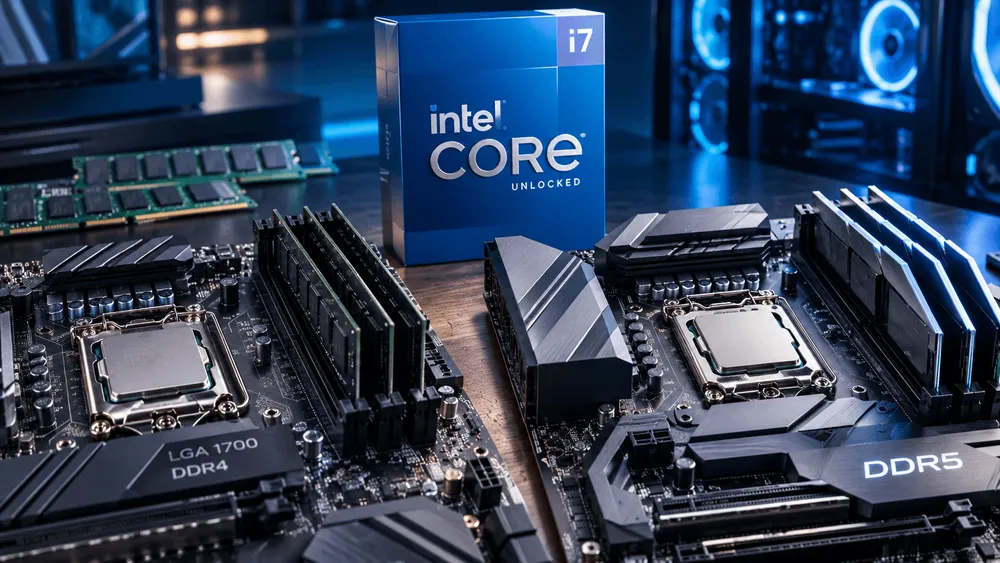
Intel has revealed that it plans to keep Raptor Lake-generation CPUs, which use DDR4 and LGA 1700, in its lineup for "the next few years," working to smooth out supply and pricing. The remarks came from the company's Robert Hallock, who explained that demand for affordable DDR4-compatible hardware has flowed unexpectedly into Alder Lake/Raptor Lake.
This is not a formal announcement of a new CPU. Even so, it carries practical implications for anyone already running an LGA 1700/DDR4 setup, since moving to Intel's current DDR5-only desktop platform would require replacing both memory and motherboard. Meanwhile, there are reports that a "Raptor Lake Next" will arrive in the first half of 2027, but Intel has not commented on them. The official name, specifications, SKUs, and pricing remain unconfirmed.
What Hallock confirmed was a supply policy for existing products. Treating Raptor Lake Next or a "third refresh" as an actual product plan, on the other hand, currently rests solely on media reports.
A sudden surge in demand can't immediately change CPU supply plans
According to Hallock, Intel had not anticipated such a sudden surge in demand for low-cost DDR4-compatible hardware. CPU supply decisions—when to start wafers, when to ship assembled products to market—are made over long planning horizons. That means retail stock and pricing can't be adjusted instantly the moment demand appears.
He referred to it as the "10nm product"—Raptor Lake, which corresponds to Intel 7 under the current process naming—and said Intel plans to keep offering it as one of the pillars of its lineup for the next few years, smoothing out supply and pricing to match demand for LGA 1700 and DDR4. What this confirms is an intent to keep supplying based on demand rather than phasing out the older generation in the short term. "A few years" is not a guaranteed supply window for any specific SKU. Intel has not disclosed CPU model numbers or shipment volumes, and the exact restock dates and retail prices remain unknown.
The phrase "smoothing out pricing" is also not a promise that street prices will fall. Even if Intel manages to increase supply, there's no guarantee that the memory and motherboard supply environment will improve at the same pace. When making a purchasing decision, watching CPU price movements alone isn't enough.
Reports of Raptor Lake Next and what Intel has actually said are two different things
Raptor Lake was announced as the 13th Gen Intel Core series on September 27, 2022. Intel then announced its 14th Gen desktop lineup on October 16, 2023, with sales beginning the following day, October 17. This 14th Gen also maintains compatibility with 600/700 series chipsets and support for DDR4/DDR5.
According to Intel's compatibility information, 12th, 13th, and 14th Gen desktop CPUs use LGA 1700 and are compatible with 600/700 series chipsets. The 13th and 14th Gen support DDR4-3200, DDR5-4800, or DDR5-5600 depending on the SKU configuration. Choosing a DDR4-compatible CPU doesn't mean you can swap between DDR4 and DDR5 on a single motherboard—the supported memory standard is determined by each board's design, and cross-generation upgrades may require the latest BIOS.
Tom's Hardware reported at Computex 2026 that it had obtained the name "Raptor Lake Next" and a rough timeframe of the first half of 2027 from multiple sources. However, Intel declined to comment when the outlet reached out. Neither the official name nor the specifications have been confirmed. It's also unclear whether Intel would boost stock of existing SKUs, introduce a new price tier, or release entirely different SKUs.
Therefore, at this stage, it cannot be stated definitively that "Raptor Lake Next will launch in the first half of 2027." Nor can Hallock's remarks about continued supply be reinterpreted as an official preview of a new product. What's confirmed is a policy of keeping existing Raptor Lake-series products in the supply plan; the reports should be treated as unconfirmed information layered on top of that.
Total platform cost differences matter for those who can keep LGA 1700
The current Core Ultra 200S Plus series uses LGA 1851 and 800 series chipsets, supporting DDR5-7200. Intel announced this series on March 11, 2026, with sales beginning on March 26. For example, the Core Ultra 7 270K Plus supports LGA 1851 and DDR5-7200, and is listed on Intel's ARK as a product launched in Q1 2026.
This means that moving to LGA 1851 would require replacing the motherboard along with the CPU and preparing DDR5 memory. Aside from the value of choosing a new generation for its performance, anyone who already owns an LGA 1700 motherboard and DDR4 memory could consider an upgrade path that preserves existing components, thanks to continued supply of the Raptor Lake series. Individual compatibility among CPU, BIOS, and motherboard needs to be verified before purchase.
This difference isn't about Raptor Lake serving as a substitute at the top performance tier. What Intel is trying to preserve is an entry point at the budget tier built around DDR4 and LGA 1700. Those buying new memory and a new board won't benefit the same way—rather, it's the supply situation on the legacy standard's side that will determine the total cost.
For new purchases, being able to obtain the CPU and being able to build an affordable DDR4 system are separate conditions. The continued-supply policy for the Raptor Lake series works in one's favor only for those who can reuse existing assets, or who can assemble the CPU, a compatible board, and DDR4 memory at a reasonable price.
Supply constraints remain on the DDR4 side too—CPU supply alone won't solve it
DDR4 supply can't simply be assumed to be cheap and stable just because it's an older generation, the same way CPU supply can't. Tom's Hardware, citing more than six sources at Computex 2026, reported that at least two motherboard makers plan to increase production of DDR4-compatible products from late 2026 through 2027. While the two companies haven't commented on Raptor Lake Next, moves anticipating LGA 1700/DDR4 demand are also emerging on the board side.
However, according to the outlet, some high-performance DDR4 dies have already ended production, and many of the kits being reintroduced are expected to top out at around DDR4-3600. Memory makers see wafer allocation as the constraint on the DDR4 side. Even with reports of increased production of DDR4-compatible motherboards, that doesn't necessarily mean the full range of memory speed options will return.
Pricing pressure also remains. TrendForce forecast that for Q1 2026, contract prices for conventional DRAM would rise 90-95% quarter-over-quarter, with PC DRAM rising more than 100%. The firm further forecast that Q3 conventional DRAM contract prices would rise 13-18% quarter-over-quarter, explaining that production allocation toward server-grade memory is squeezing PC DRAM supply. It also notes that increased DDR4 production by Taiwanese makers has not been enough to offset the volume lost from major manufacturers exiting the market.
Intel's policy preserves a CPU option for demand that wants to keep using LGA 1700. Whether it actually functions as a low-budget upgrade path depends on which SKUs Intel releases and at what price, how widely available LGA 1700-compatible motherboards remain, and how DDR4 street prices move. Checking these three conditions is more directly useful for purchasing decisions than the CPU's announcement date.