


When marine biologists pinpoint a whale's location, they triangulate from the differences in arrival times of its calls at multiple underwater microphones (hydrophones). The method has been standard for decades. But John L. Spiesberger and colleagues, acoustic scientists at the University of Pennsylvania, noticed that in some cases it produces errors ranging from hundreds of meters to several kilometers.
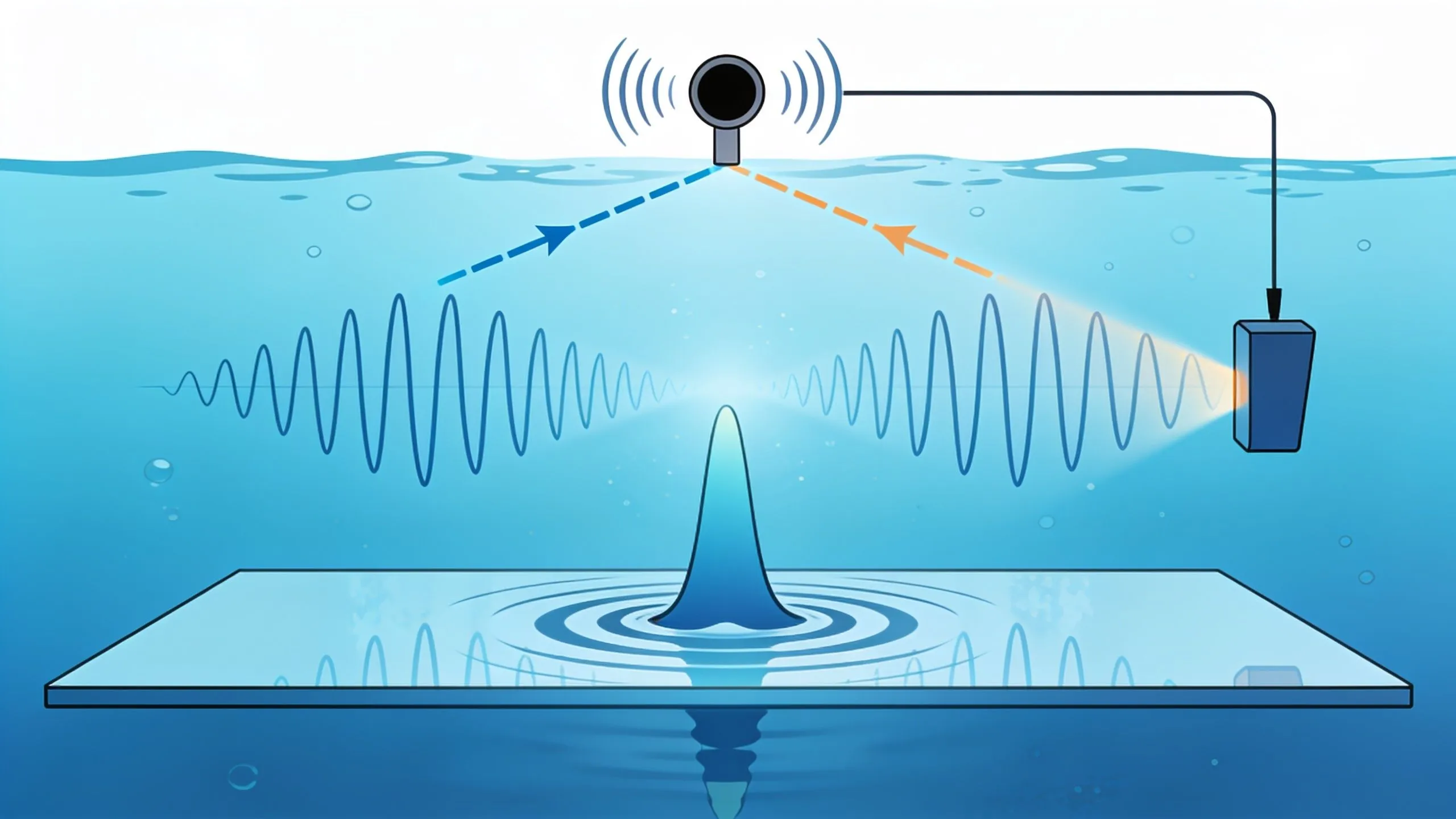
The cause lay at the sea surface. When a whale calls near the surface, the sound reaches the hydrophone by two paths: a direct path, and a path that reflects off the underside of the surface first. When the two waves overlap at the receiver, interference shifts the position of the combined wave's peak. A 2025 paper by Spiesberger and colleagues in the Journal of the Acoustical Society of America (DOI: 10.1121/10.0039367) showed that this interference can make sound appear "slower." Because the peak of the received wave arrives later than the peak of the direct wave alone, the speed of sound is misjudged as lower than it really is.
Up to that point, it was a practical correction problem in ocean acoustics.
When interference reverses: the condition that turns "slowing" into "speeding up"
When Spiesberger tried a wider range of more realistic pulse shapes, he found that interference can also work in the opposite direction. When the timing of the direct and reflected waves meets certain conditions, the energy peak of the combined wave appears earlier than the peak of the direct wave alone. The wave seems to arrive faster than it actually travels.
The condition for this effect is clearly formulated: the source and receiver must be close to each other, and at least one of them must lie within a distance of of the reflecting boundary. Here $c$ is the phase velocity in the medium, and is the minimum time interval at which the two paths first interfere. In other words, when either the source or the receiver is close enough to the reflecting surface, the time difference between the direct and reflected waves becomes comparable to the pulse's duration, and interference reshapes the pulse.
The direction of this reshaping depends on the pulse shape and the time difference between the two paths. Under some conditions the peak shifts later (apparent slowing); under others it shifts earlier (apparent speeding up). The 2025 paper dealt with the former, and the new paper deals with the latter.
Sound at 1,500 m/s arriving at 2,782.5 m/s: what the simulations show
Spiesberger and Eugene Terray, an oceanographer at the Woods Hole Oceanographic Institution, tested the effect with numerical simulations. With the speed of sound in water set to 1,500 m/s, they calculated the interference between the direct and reflected paths. The energy peak of the received wave (the "c3d velocity," defined from the spacing of peaks in the absolute value of the Hilbert transform) reached 1,694.5 m/s for the pulse corresponding to symbol "0" and 2,782.5 m/s for the pulse corresponding to symbol "1."
The latter is about 1.86 times the speed of sound in the medium, in ordinary water with no dispersion.
| Metric | Direct wave only | With interference (symbol 0) | With interference (symbol 1) |
|---|---|---|---|
| Apparent speed of energy peak | 1,500 m/s | 1,694.5 m/s | 2,782.5 m/s |
| Ratio to speed of sound | 1.00 | 1.13 | 1.86 |
| Information speed | ≤ 1,500 m/s | ≤ 1,500 m/s | ≤ 1,500 m/s |
The key point of this table is the gap between the apparent speed of the energy peak and the speed of information.
A question dating to 1914: what in a wave carries information?
This is not the first time a wave has seemed to travel faster than light (or sound). But each time, physicists have been troubled by the distinction between "apparent speed" and "information speed."
The distinction goes back to 1914, when Arnold Sommerfeld and Léon Brillouin proved that the front of an electromagnetic pulse propagating through a dispersive medium always travels at or below the vacuum speed of light, $c$. Even when a pulse's peak or group velocity exceeds $c$, the front, which carries the information, does not. This Sommerfeld-Brillouin precursor theory has served for more than a century as the framework that keeps special relativity consistent with wave optics.
Still, experiments showing "apparent superluminality" have continued. In 1992, Enders and Nimtz reported microwaves tunneling through a waveguide below its cutoff frequency at 4.7$c$. In 1993, Steinberg and colleagues measured single-photon tunneling times and showed an apparent speed of 1.7±0.2 $c$. In 2000, Wang, Kuzmich, and Dogariu used anomalous dispersion in cesium atomic gas to produce a pulse peak that emerged from the medium before entering it, with a group velocity index of , published in Nature.
All of these experiments require special media (anomalously dispersive media, tunnel barriers). Producing an apparent superluminal effect had to rely on the dispersive properties of the medium or on quantum-mechanical effects.
A new mechanism for superluminality with zero dispersion
What fundamentally distinguishes the proposal by Spiesberger and Terray from earlier superluminal phenomena is that it requires no special properties of the medium. No anomalous dispersion, no tunnel barrier, no gain medium. All that is needed is a reflecting boundary with a source and receiver located near it.
The paper conjectures that the mechanism also applies to electromagnetic waves. If light propagating in vacuum passes near a reflecting surface such as a mirror, interference between the direct and reflected waves could make the energy peak appear to move faster than the speed of light.
"If the direct plus reflected path effect exists for electromagnetic waves, it would offer a mechanism for superluminal propagation distinct from microwave tunneling, quantum tunneling, and anomalous dispersion," Spiesberger and Terray write in the paper.
If the conjecture is confirmed experimentally, a single reflecting surface would be enough to produce an apparent superluminal effect. In terms of experimental simplicity, that is a lower barrier than any existing superluminal phenomenon.
Information does not exceed the speed of light: the structure of the proof
So can this effect actually send information faster than light? Spiesberger and Terray proved theoretically that it cannot.
The outline of the proof is as follows. Suppose the sender transmits one of two signals (symbol 0 or symbol 1). The two signals are identical up to a certain time (time zero), at which the sender switches to either 0 or 1. This switching point marks the moment new information is created.
Examining the first time at which the receiver can distinguish 0 from 1, they find it is no earlier than the arrival of the non-analytic point (the rising edge of the pulse) of the wave that traveled the direct path at the speed of light, $c$. Even if interference shifts the energy peak forward, the information the receiver needs to decide whether a 0 or a 1 arrived rides on the wave that came along the direct path at or below the speed of light. Interference changes the shape of the pulse, but it cannot create new information out of nothing.
This proof is consistent with the principle Sommerfeld and Brillouin established in 1914: the front velocity does not exceed the speed of light. What appears superluminal is the energy peak, that is, the shape of the pulse envelope, not an information transfer that violates causality.
There was one unexpected result, however. With interference, the information speed is slightly faster than with the direct path alone. Interference accentuates the difference between symbols 0 and 1, allowing the receiver to tell them apart sooner. Spiesberger and Terray themselves write in the paper that they do not understand why ("We do not understand why").
The road to experimental verification and remaining questions
The work remains at the stage of theory and simulation. At the end of the paper, the authors state explicitly that experimental verification with acoustic or electromagnetic waves is needed. For electromagnetic tests, they propose a setup in which a beam splitter divides light into two paths, one directed at a mirror and the other sent directly to the receiver, where the two interfere. Using a laser would eliminate attenuation from spherical spreading, allowing a larger contribution from the reflected path.
The authors also raise the question of whether the effect has an analog in the quantum world. "Classical physical effects sometimes have counterparts in quantum mechanics. It may be worth examining whether the direct plus reflected path effect has an analogy in the quantum world," they say.
The open issues come down to three. First, there has been no experimental confirmation with electromagnetic waves. The conjecture is theoretically consistent, but without measurement it cannot join the ranks of "apparent superluminality." Second, it is unclear why interference makes the information speed slightly faster. This is an intriguing unexplained point for probing the limits of causality. Third, whether the effect extends to quantum systems is entirely unexplored.
Research that began as an attempt to explain errors of hundreds of meters in locating whales has opened a new window onto the boundaries of special relativity. A reflecting surface, an utterly ordinary structure, can make a wave's energy peak appear to run past the speed of light without breaking the principle that Sommerfeld and Brillouin laid out more than a century ago: information does not exceed the speed of light. What lies beyond that window is something the next experiment will tell us.