


The sunscreen cream you apply on your skin at a summer beach, or the sweet-and-sour raspberries piled on a plate. These substances woven into our daily lives contain a tiny sugar molecule called erythrulose. A research team led by Izaskun Jiménez-Serra of the Centro de Astrobiología (CAB) in Spain pointed an array of ultra-sensitive radio telescopes toward the center of the galaxy and, for the first time in the world, confirmed that this four-carbon sugar drifts through the frigid depths of interstellar space.
Life's Sweet Dilemma──The "Synthesis Limit" Facing the Early Earth
At the core of DNA and RNA, the blueprints of life, sugars such as ribose are incorporated as structural backbones. Modern life on Earth efficiently synthesizes these sugars using highly optimized enzyme systems within living organisms. But on the barren primordial Earth roughly 4 billion years ago, the question of how sufficient sugar accumulated to give rise to life has stood as an enormous unresolved wall in the field of biochemistry. Laboratory experiments that mimic prebiotic conditions have only ever produced trace amounts of simple sugars.
The discovery of organic compounds such as ribose in carbonaceous meteorites and samples from the asteroid Bennu has strongly supported the hypothesis that at least some of Earth's sugar arrived from space. Efforts to trace its origin to interstellar space—the clouds of gas and dust spanning the space between stars—have continued for many years, yet a genuine sugar molecule had never once been directly detected from an interstellar molecular cloud itself. Only speculation prevailed that sugar must have been produced somewhere in space before the parent bodies of meteorites even formed.
Moreover, the conventional theoretical models that have dominated the field of astrochemistry were built on the premise that "complex organic molecules grow through the sequential addition of carbon atoms, one at a time, to smaller molecules." If this gradual growth process holds true, then for a sugar with four carbons to form, a large abundance of a preceding three-carbon sugar (such as glyceraldehyde) would need to exist as a precursor—otherwise the numbers simply don't add up. Scientists had long been searching for the whereabouts of this missing "three-carbon sugar" and for the true mechanism behind the birth of complex sugars.
A Molecular Cloud 26,000 Light-Years Away Reveals the Origin of the "Carbon Skeleton"
Where, and through what chemical reactions, did the complex sugar molecules that drive life on Earth actually form? Jiménez-Serra and colleagues presented decisive evidence answering this question by analyzing broadband observational data from the Yebes 40m radio telescope and the IRAM 30m telescope, both in Spain. Their target was G+0.693−0.027, a molecular cloud located near the center of the Milky Way, approximately 8,200 parsecs (26,745 light-years) from Earth. This region is known as a "cosmic chemical factory," where collisions between molecular clouds generate massive shock waves reaching speeds of 20 kilometers per second, releasing into gas form the chemical substances that had been trapped in ice on the surfaces of dust grains.
The research team meticulously examined spectra spanning a vast frequency range from millimeter to centimeter waves and identified 12 distinct sets of radio emission lines attributable to erythrulose (). The probability that these signals arose from a mere coincidental overlap of noise is only 0.2 percent, firmly establishing the genuine presence of sugar in space.
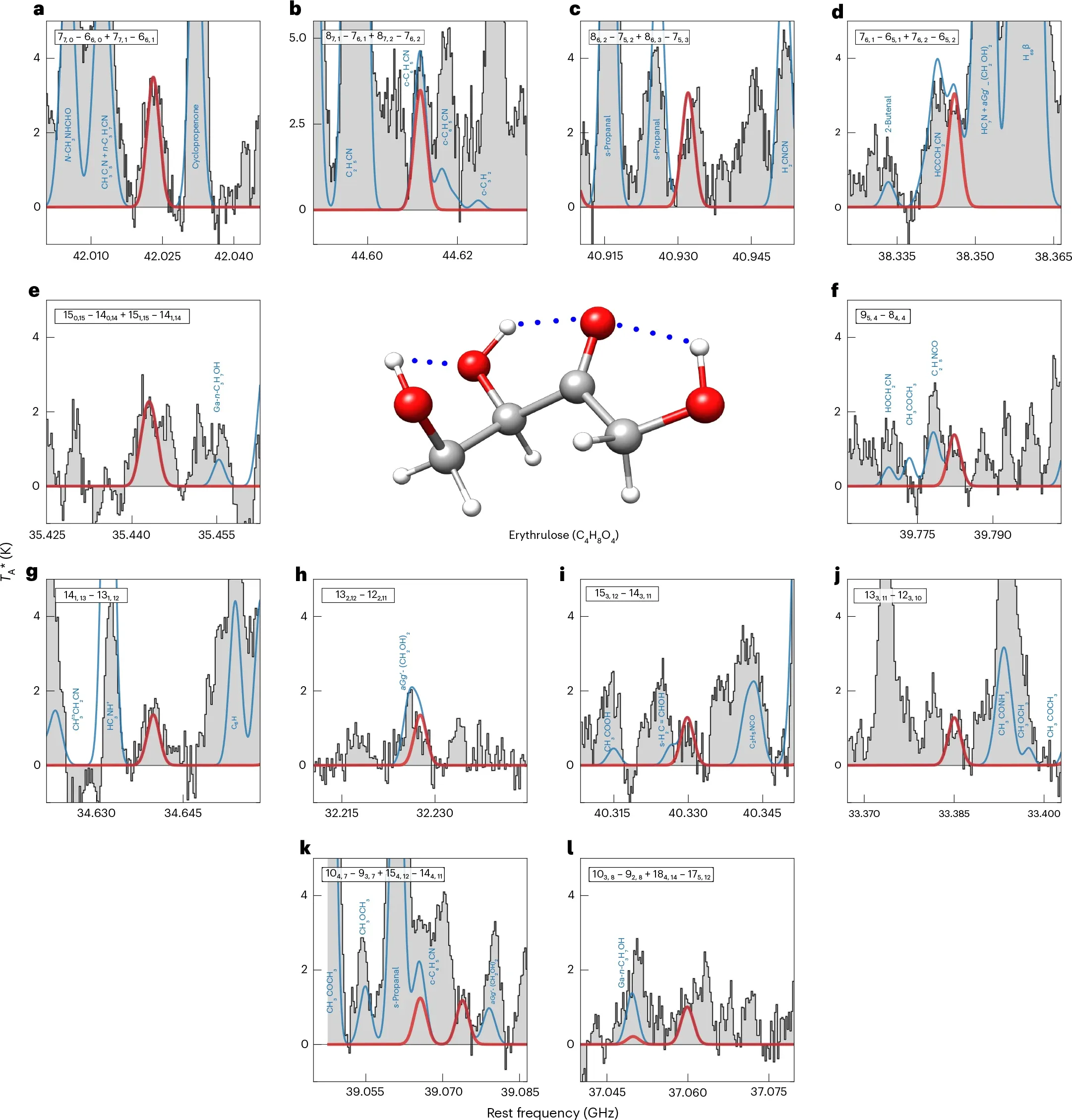
Erythrulose is composed of 14 atoms and contains four oxygen atoms within its structure, making it the largest acyclic molecule ever identified in interstellar space. No matter how sensitively the same molecular cloud was searched, three-carbon sugars such as glyceraldehyde were not detected at all. Working backward from the observational detection limits, the team found that erythrulose exists at a concentration at least 8 to 17 times higher than that of three-carbon sugars. This completely deviates from the commonsense distribution in which small molecules are abundant and large molecules exist only in small quantities.
A Prefabricated Construction Method on Ice That Overturns Conventional Wisdom
How, then, was a four-carbon sugar synthesized in such abundance in interstellar space without passing through a three-carbon sugar? Using advanced quantum chemical calculations and a time-evolution simulation method known as kinetic Monte Carlo (KMC), the research team presented a new synthesis route that occurs on ice particles at the extreme cold of 20 Kelvin (minus 253°C).
This resembles a prefabricated construction method in architecture. Rather than erecting pillars one by one on-site (adding carbon atoms one at a time), two large modules already assembled at the factory are directly connected together. Without assuming this "2+2" reaction pathway, it is physically impossible to explain the anomalous abundance of the four-carbon sugar in the G+0.693 molecular cloud.
| Comparison Axis | Conventional Molecular Growth Model | New Model Proposed by This Study |
|---|---|---|
| Premise of the reaction | Carbon atoms are added one after another, sequentially | Already-formed two-carbon molecules bond with one another |
| Precursor conditions | Large accumulation of three-carbon sugars (e.g., glyceraldehyde) required | A composite of a two-carbon alcohol and aldehyde |
| Behavior on ice particles | Sequential growth through stepwise chemical evolution | Radical recombination and intersystem crossing of spin states |
| Consistency with observational data | Decisively contradicts the fact that three-carbon sugars were not detected | Accurately explains the observed abundance in G+0.693 (abundance of the four-carbon sugar) |
On the surface of ice within the molecular cloud, where cosmic rays rain down intensely, hydrogen atoms are stripped from simple two-carbon organic compounds (glycolaldehyde and ethylene glycol), generating highly reactive radicals. When these radicals come into close proximity, a quantum mechanical phenomenon known as "intersystem crossing"—in which the electron spin state flips with a certain probability—occurs, instantaneously forming a robust carbon-carbon bond. The simulation results confirmed that under harsh conditions where cosmic ray intensity reaches 100 to 1,000 times the standard level found in typical regions of the Milky Way, the observed molecular composition ratios could be most accurately reproduced.
Within the simulation, the rate at which cosmic rays and ultraviolet light cause molecular destruction (photodissociation) is described by the following equation:
This equation shows the probability with which a four-carbon sugar molecule incorporated into an ice particle will break down when exposed to the penetration of ultraviolet light () or the impact of cosmic rays (). The greater a molecule's internal degrees of freedom, the more easily it can disperse any excess energy received as vibrations throughout the entire molecule. This is the mathematical expression of the physical background explaining why the larger four-carbon sugar is less prone to destruction than the smaller three-carbon sugar, and it supports the reason why erythrulose selectively survived under such a harsh radiation environment.
A Meteor Shower That Carried a Prototype of Nucleic Acid
The discovery of erythrulose synthesized in space opens up another important dimension in unraveling the origin of life. Erythrulose is a chiral molecule, making it only the second chiral molecule ever identified in interstellar space. It may offer a clue to solving the mystery of "homochirality," the phenomenon whereby life on Earth uses only specific chiral molecules.
From a biochemical perspective, erythrulose, which possesses a ketone group, has the property of rapidly isomerizing into aldose sugars (such as threose) upon contact with liquid water. The pre-RNA world hypothesis, which is currently gaining favor, holds that on the early Earth before the emergence of present-day RNA, a simpler polymer known as "threose nucleic acid (TNA)" carried early genetic information. While ribose (a five-carbon sugar), the backbone of RNA, is extremely difficult to synthesize in early environments, the erythrulose discovered this time is a prototype that leads directly—given nothing more than water—to this fundamental information-recording medium of TNA.
From roughly 4.1 billion to 3.8 billion years ago, the early Earth experienced the "Late Heavy Bombardment," a period in which asteroids and comets collided with the planet one after another. Based on calculations working backward from the average water content and total organic matter found in meteorites, the research team estimates that at least 500,000 to 50 million tons of erythrulose were delivered to Earth's surface during this period. By the time the oceans cooled and an environment capable of sustaining chemical reactions was established, an enormous quantity of sugar delivered from space would have been waiting for the sprouting of life.
How did the sugar born on ice particles escape into the gas phase without decomposing, and how was it then incorporated into the parent bodies of meteorites? With expansion plans for the ALMA telescope and the full-scale operation of the next-generation Very Large Array (ngVLA) now coming into view, it may become possible to pick up signals from even more complex five-carbon sugars (ribose)—signals that have so far eluded detection—from the center of the galaxy. Improving the observational precision of deep space is not merely a matter of raising astronomy's resolution; it holds the potential to rewrite the fundamental paradigm of life science regarding where we came from and how we were assembled.