

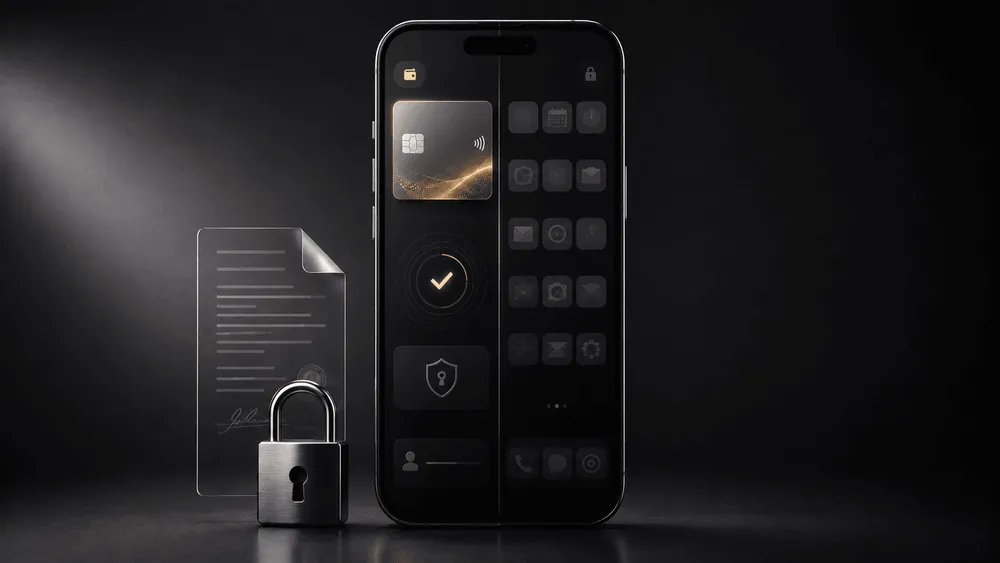
Built into the iOS 27 beta is a mechanism that lets the OS restrict iPhones enrolled through the settings of an authorized financing carrier. The related system services and entitlements remain even in Beta 4, which Apple released on July 20, 2026. Cross-referencing strings extracted from the firmware with 9to5Mac's code analysis shows that a financing carrier can check payment status and, if the balance isn't paid by the deadline, lock the device out of most apps. Phone, Settings, and payment methods remain accessible, but the design keeps the finance-related lock in place even if the device is wiped.
What's new isn't the basic idea of remotely restricting a device for non-payment. Rather, it's the way the carrier's app, per-app Restricted Mode, and Activation Lock tied to Find My are unified into a single control system. That said, the names inside the code don't identify a specific carrier, and Apple has not announced this feature or the new program with Klarna that has been reported. The design present in the beta and the actual contracts that get offered need to be considered separately.
From Contract Status Checks to Restricted Mode
The entry point is AppManagedFeatures, added in iOS 27. A device is enrolled via an authorized financing carrier's app, and that app continuously checks the contract status. The wording in the Settings screen states that the carrier's app will remain on the device until payment is completed, and that software updates may be required and installed to address critical security issues.
If a payment problem occurs, the carrier can switch the iPhone into Restricted Mode. What the OS is watching for here isn't a generic count like "one missed payment." The on-screen text says "if the balance is not paid in full by the deadline specified in the contract," and 9to5Mac also reported that the timing of activation is determined by the carrier's own policy. So it's not a system that necessarily triggers restriction after a single failed deduction — the final conditions, including any grace period or reminders, depend on the individual contract.
Enforcement is handled not by a regular App Store app but by an Apple system service. Beta 4's appmanagedfeaturesd manages whether apps can be installed, updated, or removed, and can apply device-level restrictions. It also holds entitlements to reference the serial number and IMEI. When a restricted app is opened, a dedicated screen appears showing the carrier's name and contact information. It's a structure in which a financial carrier's decision gets translated into on-device state by iOS.
The Privacy Boundary That Keeps Phone and Payment Methods Available
Restricted Mode doesn't turn the iPhone into a complete brick. Screens within the beta list Phone, Settings, and Wallet as available apps. In addition to the App Store and Health, Clock, Passwords, and Magnifier also remain. Messages, Home, and medical/safety apps that handle critical notifications can also be exempted, and users can still reach payment apps designated by the carrier. It's a design meant to preserve a path for users to complete payment and seek support.
At the same time, a clear line is drawn around what information the carrier's app can obtain. The enrollment screen states that access to sensitive personal information such as the photo library or location cannot be requested. The framework also includes logic that rejects a carrier app if it declares prohibited items, including location-usage descriptions. The OS handles device identifiers and app restrictions, but it isn't designed to let the carrier monitor a user's photos or current location.
One easily overlooked point concerns App Store subscriptions. According to 9to5Mac, Restricted Mode does not automatically pause or cancel subscriptions for blocked apps. Apple's developer documentation also states that auto-renewable subscriptions continue to renew as a rule until the user cancels them. That means billing can continue even during a period when an app can't be opened. The App Store and Settings remain accessible as a route for completing payment, and they're also necessary for users to manage ongoing subscriptions.
Partner Finance Lock, Which Survives Even After a Wipe
Paired with the app restriction is Partner Finance Lock, added inside Find My. The published code analysis includes code that records the type of finance lock to NVRAM and preserves that Activation Lock information even during processes that wipe other state. Code has also been prepared to verify a one-time password used for unlocking, and to remove a device from a financing contract. This is designed so that simply resetting the device and deleting the carrier's app isn't enough to exit the contract.
The regular Activation Lock that Apple publicly documents also persists after a device is wiped, requiring a certificate from Apple's servers upon reactivation. On managed, supervised devices, a device management service can also enable the lock from the server side. Additionally, Apple restricts calibration on another device for compatible parts removed from an iPhone that was in Lock or Lost Mode.
9to5Mac reports that Partner Finance Lock's purpose — persisting even after a wipe or restore — is to prevent resale and parts harvesting. The connection to Find My exists to maintain the lock state, not to hand location data over to the carrier. However, it hasn't been disclosed exactly which parts the finance lock extends to, or through what procedure it gets released after full payment or a mistaken restriction. If a finance-specific path is being added on top of the shared foundation used by the standard Activation Lock, the certainty of release deserves equal weight.
A 24-Payment Loan and the Reported Lease-Style Program
The current U.S. iPhone Upgrade Program fully pays off the device's retail price and AppleCare+ through a 24-month, 0% APR loan from Citizens One. Paying 12 installments lets you return the old device and move to a new 24-month loan, and completing all 24 payments pays off the loan and lets you keep the device. The published terms make no mention of any mechanism where iOS restricts apps due to late payment.
| Item | Current iPhone Upgrade Program | Reported Apple Upgrade |
|---|---|---|
| Financial partner | Citizens One | Klarna |
| Contract term | 24 months for iPhone | 24 months for iPhone/Apple Watch, 36 months for Mac/iPad |
| Monthly payment concept | Fully repays device price and AppleCare+ at 0% APR | Reportedly offers a lower monthly payment, with return/buyout/upgrade options at term end |
| AppleCare | Included in monthly payment | Reportedly not included |
| Launch status | Currently available | Bloomberg reports it will launch in the U.S. on July 28 |
According to Bloomberg, Apple plans to launch Apple Upgrade, with Klarna as the financial partner, at U.S. retail stores and online, while the current iPhone payment program will stop accepting new enrollments. The new program is also said to allow early buyout or mid-term upgrades, and returning the device would lower the monthly payment. However, neither Apple nor Klarna responded to inquiries from Reuters, and the contract terms have not yet been published.
Klarna has previously offered Upgrade Financing for Apple products covering iPad, Mac, and Apple Watch. Those terms state that, effective May 13, 2026, new purchases were halted and upgrades at term end became unavailable. While the timeline — a new Apple-branded program being reported after the old program ended — suggests a transition, the code alone doesn't allow us to conclude that AppManagedFeatures is specifically intended for Klarna.
Finance-Based Locking Already Shipped on Android
Restricting a device based on payment status is already a shipped feature on Android. Google's Device Lock Controller is an app that lets a credit provider remotely restrict a device if the user fails to pay, while keeping emergency calls and Settings accessible. The Android Management API also has a state called DEACTIVATED_BY_DEVICE_FINANCE that indicates a device locked by a financial carrier. This isn't a mechanism Apple invented.
The design in iOS 27 goes further, finely defining which apps remain usable during restriction, isolating the carrier's app from personal data, and unifying it with Activation Lock. That also means the impact is larger if a mistaken determination occurs. If access to banking, work apps, or authentication/transit services is cut off, the very act of resolving the non-payment can become difficult. Keeping emergency functions available doesn't make the operational risk disappear.
If reports are accurate, Apple Upgrade will launch on July 28, but 9to5Mac was unable to find the same code in the preceding iOS 26.6 RC. The launch of the new program and the introduction of the device restriction won't necessarily happen at the same time. What needs to be confirmed in the official terms is: after how many days or missed payments does restriction kick in; is there advance notice and a grace period; who resolves a mistaken restriction and within what timeframe; and does the lock reliably disappear after full payment or return of the device. The contract terms on July 28, and whether this mechanism remains in the shipping version of iOS 27, will be the dividing line for evaluating what's currently just a concept in code as an actual service.