

Since late September, a figure has been widely reported about Apple's iPhone Duo, which goes on sale October 23: an assembly yield in the "60% range."
The source is an article published at 10:00 a.m. on September 21 by the Chinese outlet Jiemian News. Citing information obtained on September 17 from a person in Foxconn's supply chain, the paper reported that the assembly yield for finished iPhone Duo units was only in the 60% range.
For the display, meanwhile, The Elec reported on June 22 that Samsung Display had achieved a final yield above 80% at its back-end process in Vietnam and had received Apple's approval for mass production.
The "60% range" and "above 80%" figures cannot be compared directly, however. They cover different processes and were measured at different times.
Sorting out what each number represents shows that the iPhone Duo's production pace depends on more than the supply of components such as displays and hinges. It also depends on how quickly the finished-device assembly line can be stabilized, and on how Apple handles its current quality criteria.
The "60% range" is the assembly yield for finished iPhone Duo units
In an article published at 10:00 a.m. on September 21, Jiemian News reporters Liang Baoxin and Li Jiaqi reported, based on information obtained on September 17 from a person close to Foxconn's supply chain, that the "whole-device yield" (整機良率) for the iPhone Duo that Foxconn assembles remains in the 60% range.
The Chinese term "整機良率" here refers to the yield of the finished-device assembly process. It is not the yield of the display alone or the hinge alone.
According to the paper, initial production volume is small, and it could take six months to a year for assembly yield to reach a mature level under the quality standards Apple has currently set.
Neither Apple nor Foxconn has officially confirmed this information.
The person Jiemian News spoke with explained that the low yield does not necessarily mean a specific technical problem remains unsolved.
This is Apple's first mass production of a foldable iPhone, and equipment, processes and various parameters must be adjusted repeatedly while the production line is actually running.
The source also said the supply chain is currently waiting for Apple's decision, and that revising some quality requirements could speed up large-scale mass production.
What "revising quality requirements" specifically means has not been made clear, however. It is unknown whether it refers to cosmetic tolerances, pass/fail criteria in the manufacturing process, or items affecting how the product feels in use.
It therefore cannot be read as meaning that "Apple is considering lowering product quality itself."
For a foldable iPhone, ramping up the production line is itself difficult
In Chinese manufacturing, the process of gradually raising yield and capacity after mass production begins is called "爬坡" (literally "climbing a slope").
In English, "production ramp-up" is the more natural expression.
Even when a product's design and manufacturing equipment are complete, starting actual volume production requires adjusting a wide range of conditions, including fixture pressure, adhesive curing time, the orientation of parts during transport, and the tolerance range accepted at inspection.
Manufacturers confirm at which process and for what reason defects occur, and tighten conditions one by one.
For the iPhone Duo, such adjustments must also be made in the finished-device assembly process.
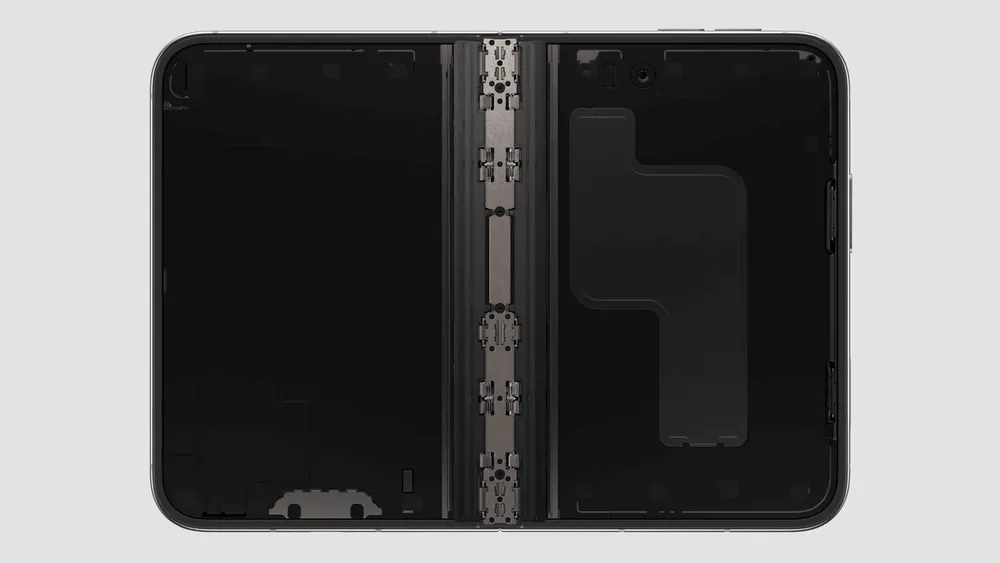
According to Apple's official specifications, the iPhone Duo is 5.2 mm thick when open, 11.3 mm when closed, and weighs 254 g. It packs a hinge made of more than 100 parts, two OLED displays, and dual batteries split between the left and right sides into a thin body.
If a finished device fails final inspection, the display, hinge, battery and other components already built into it cannot be shipped as a finished product either.
As a result, even a change of a few percentage points in finished-device assembly yield makes a large difference in how many shippable products come out of the same number of input parts.
Yield is also not determined by manufacturing technology alone.
It also changes with the quality standards that define how much dimensional or cosmetic variation is tolerated and where the line for a defective product is drawn.
This is likely the background to the Jiemian News source saying the supply chain is "waiting for Apple's decision."
The 60% figure should therefore be seen not as a limit of manufacturing technology but as the yield currently reported under present manufacturing conditions and quality criteria.
Display yield reportedly above 80% as of June
For the foldable OLED display, on the other hand, a relatively high yield has already been reported.
On June 22, The Elec reported that Apple had approved Samsung Display's mass production of foldable OLED modules, and that the company had achieved a final yield above 80% on its back-end line in Vietnam.
According to the report, Apple's threshold for approving mass production was 70% or higher, and Samsung Display won approval by raising its yield above 80%.
Initial 2026 supply is reportedly about 3 million panels, and Samsung Display is also reported to have signed a three-year exclusive supply contract for Apple's foldable OLEDs.
All of this is based on industry sources, not figures announced by Apple or Samsung Display.
The important point is that the display's "final module yield" and Foxconn's "finished-device assembly yield" measure different processes.
The former shows the share of OLED displays completed as modules that passed inspection. The latter shows the share of finished iPhone Duo units that passed inspection after the display, hinge, battery and other parts were assembled into the body.
It is therefore not possible to simply compare them and say "the display is at 80% but the finished device is only at 60%."
Multiplying 80% by 60% would give 48%, but in actual manufacturing the denominators of each yield, the inspection stages, and the treatment of rework may differ. That figure therefore cannot be taken as a cumulative yield from materials to finished device.
Furthermore, the display's 80%-plus figure is from June and the finished device's 60% range is from September, a gap of about three months. How Samsung Display's yield changed in the interim has not been disclosed.
At this point there is no basis for concluding that "the mass-production bottleneck has fully shifted from the display to finished-device assembly."
Jiemian News itself cites the delivery pace of foldable OLED displays and hinge-related parts as a reason the iPhone Duo's launch is later than that of regular iPhones.
These parts reportedly suffered insufficient yields, delivery delays and specification changes in the past, and upstream delays shortened the time Foxconn had to adjust its assembly line.
The paper also cites a report published September 3 by Mizuho Securities, which said hinge specifications and issues with the display crease are slowing production progress.
It is more appropriate to view component supply and the ramp-up of the finished-device assembly line not as separate problems but as ones that affect each other.
Separating Apple's official information from manufacturing reports in Chinese media
It is also necessary to sort out what Apple has officially disclosed.
The iPhone Duo's inner display is a 7.6-inch OLED with a resolution of 1878×2670 at 430 ppi. It uses a Nano-texture finish.
The outer display is a 5.4-inch, 1398×2034, 460 ppi OLED.
The chip is the A20 Pro, and the front uses Ceramic Shield 2.
Apple explains that the hinge is made up of more than 100 parts.
As for 3D printing, what Apple officially states is a "3D-printed hinge cover made of 100% recycled titanium."
In other words, what Apple officially says is 3D printed is the hinge cover, not the entire hinge.
On September 23, the Chinese outlet MyDrivers (快科技) reported that the hinge has a multilayer composite structure, that the forces on each layer are simulated with AI algorithms, and that structurally complex titanium alloy parts are manufactured by 3D printing.
However, this account names no specific source, and the article itself takes as its starting point a post by the Weibo blogger "定焦数码."
Because Apple has not disclosed the manufacturing method for every part, it cannot be ruled out that methods not described on its official pages are used.
What matters is distinguishing the scope Apple has officially confirmed from the scope Chinese media report based on supply-chain information.
Apple explains that more than 100 parts in the hinge control the opening and closing motion and support the central portion of the display, and that a structure combining magnets adjusts the feel when closing.
It also says internal reinforcing structures and an antenna section using ceramic fiber increase the rigidity of the body.
The only part Apple officially states uses 3D printing, though, is the hinge cover.
Adjustments for the hinge and special glass may have continued until just before mass production
Jiemian News also reports that the hinge material was still under consideration until shortly before mass production.
Apple reportedly tested using liquid metal for some hinge parts at one point, but reevaluated it before mass production.
According to an analyst the paper cited, changing a material or manufacturing process can force other related suppliers to redo prototyping, validation and production preparation.
Even when a new supplier joins, it may not be able to supply large volumes right away.
In other words, a single design change can delay the mass-production ramp-up of a seemingly unrelated process.
New information has also emerged about the glass for the inner display.
In a September 7 article, XenoSpectrum discussed, based on patent analysis, the possibility that UTG (Ultra Thin Glass) with differing thickness in the center and at the edges is used.
Jiemian News later reported that Lens Technology (藍思科技) developed custom UTG that makes the crease less noticeable.
In briefings for institutional investors, the company has said it supplies UTG, CPI film, UTG support plates, 3D glass covers and other parts for a major customer's foldable devices.
Lens Technology itself, however, does not name Apple as that customer. The connection with Apple is based on information from supply-chain sources Jiemian News interviewed.
An analyst the paper cited explained that Apple adopted a UTG design whose thickness varies by location, thinning the central bending area while keeping strength on both sides.
Beyond glass, several Chinese companies have also been reported as suppliers.
Lingyi iTech (領益智造) is said to supply precision structural hinge parts, display support plates and ultra-thin vapor chambers, and Zhuhai CosMX (珠海冠宇) the battery cells.
Qiangrui Technology (強瑞技術) is also reportedly involved in developing, prototyping and validating the inspection equipment and precision fixtures used on the assembly line.
Note that all of these are reports based on supply-chain sources and are not a supplier-by-supplier division of manufacturing that Apple has published.
6 million, 8 million, 5 million: why the numbers differ
Several figures have also been reported for the iPhone Duo's production and sales scale.
Three kinds of numbers mainly circulate: a global stocking target of 6 million to 8 million units, Apple sales guidance of more than 5 million units, and analyst Jeff Pu's 2026 production and shipment forecast of 6 million units.
These do not, however, measure the same thing.
What Jiemian News heard from supply-chain sources was that the target number of units to secure for the global market is 6 million to 8 million.
What a sales-channel source told the paper, on the other hand, was that Apple expects to sell more than 5 million units.
Jeff Pu is reported to have cut his 2026 iPhone Duo supply outlook from the previous 7 million units to 6 million in a September research report.
In other words, separate indicators are mixed together: an inventory-securing plan, a production and shipment forecast, and a sales target.
There is no point in adding or averaging them.
For example, a company may secure more inventory than its sales target so as not to miss sales opportunities. A production forecast, meanwhile, can be revised down if assumptions about component supply or yield change.
That all three figures fall within roughly 5 million to 8 million units offers a rough sense of scale, but they cannot be compared as the same metric.
None of them has been officially announced by Apple, either.
Comparison with conventional iPhones is also useful for gauging scale.
According to Jiemian News, the flagship iPhone Pro and Pro Max run at a scale of 20 million to 30 million units per model per product cycle.
By comparison, the iPhone Duo's reported stocking target of 6 million to 8 million units is considerably smaller.
Jeff Pu forecasts a combined scale of 72 million units for the iPhone 18 Pro and Pro Max.
The iPhone Duo's 6 million is a production and shipment forecast, while the Pro series' 72 million is described as a sales forecast, so a strict comparison is not possible. Even so, it shows that Apple is not trying to supply the first-year Duo at the same scale as its flagship Pro series.
44 days from announcement to release, a longer preparation period than regular iPhones
The iPhone Duo's schedule from announcement to release also differs greatly from that of regular iPhones.
Apple announced the iPhone Duo on September 9 U.S. time. Preorders begin October 16, and it goes on sale October 23.
That is 37 days from announcement to the start of preorders and 44 days to release.
Jiemian News counts from September 10 Beijing time and gets 36 and 43 days respectively. The one-day difference is due to the time difference; the schedule it refers to is the same.
According to the paper, for the main autumn iPhones of the past five years, the average was about three days from announcement to the start of preorders and about ten days to release.
This average, however, is Jiemian News's own tally, and it does not list the models included in the calculation.
Apple has not disclosed why it left more than six weeks before the iPhone Duo's release.
It therefore cannot be asserted that "the launch was delayed because of low yield."
Still, given the report that Foxconn's finished-device assembly yield is still in the 60% range and the information that initial production volume is small, the longer-than-usual period does serve as breathing room for the production ramp-up.
In Japan, the 256GB model costs ¥364,800 and the 2TB model ¥574,800.
Preorders begin at 9 p.m. on October 16, with release on October 23. The iPhone Duo is an eSIM-only model worldwide and does not support physical SIM cards.
How much initial supply is actually secured can be gauged in part by changes in estimated delivery dates shown after preorders open.
Seven years on, foldable phones remain a small part of the global market
Seven years have passed since Samsung launched the Galaxy Fold in 2019, and foldable smartphones are still a small category in the overall smartphone market.
According to data Omdia released on August 20, global foldable smartphone shipments in 2025 were 18.2 million units, with year-on-year growth slowing to 6%.
In the first half of 2026 they fell further, to 5.1 million units, down 21.6% from a year earlier.
Flip-style models, which fold vertically, fell 47%. Book-style models, which open sideways, held roughly flat and accounted for 69% of foldable smartphone shipments in the first half of 2026.
Huawei and Samsung alone account for 75% of this book-style market.
Omdia nevertheless forecasts that full-year 2026 foldable smartphone shipments will exceed 22 million units, returning to growth of more than 22% year on year.
Shipments are expected to rise to 36 million units in 2028 and 45 million in 2030.
Even so, Omdia expects foldables to remain under 3% of the global smartphone market in 2030.
Laying the iPhone Duo over this market size shows how large a figure 5 million units is.
The reported Apple sales target of more than 5 million units is roughly 20% of the more than 22 million global foldable smartphone shipments Omdia forecasts for 2026.
However, Omdia's 22 million-plus is a forecast of "shipments," while the 5 million-plus is described as "sales guidance" heard by Jiemian News from a sales-channel source.
Because they are not on the same basis, this does not mean Apple will definitely capture 20% of the market.
The 5 million-plus is also merely a target reported at this point, not actual sales.
How many can actually be sold depends not only on demand but also on production capacity.
Samsung leads in thinness and lightness
Competing products are already on the market.
Samsung announced the "Galaxy Z Fold8 Ultra" in July and released it in Japan on August 7.
The Galaxy Z Fold8 Ultra is about 4.1 mm thick when open, about 8.9 mm when closed, and weighs about 215 g.
The iPhone Duo, by comparison, is 5.2 mm open, 11.3 mm closed, and 254 g.
At least in body thinness and lightness, Samsung is ahead.
In the U.S., the Galaxy Z Fold8 Ultra starts at $2,099 and the iPhone Duo at $1,999, both in the roughly $2,000 premium range.
Thinness and weight are not the only factors that decide foldable smartphone sales, however. OS and app support, cameras, durability, brand, and integration with the devices and services existing users already own all play a part.
So it is not a simple contest over whether "Apple can sell 5 million units despite being thicker and heavier than Samsung."
What matters is how much demand Apple can generate with its first foldable iPhone, and at the same time whether it can build a manufacturing system that stably supplies at the 5-million-unit scale.
What to watch first: after preorders open on October 16
Material for judging the state of production will increase in October.
Whether Apple will change its quality criteria or keep the current ones has not been disclosed.
The outcome, however, may ultimately show up in initial supply volume and the length of estimated delivery dates.
Will delivery estimates slip rapidly right after preorders open on October 16? Will supply improve after the October 23 release? Can enough units be allocated to the additional 28 countries and regions where sales begin on October 30?
Following such information makes it possible to infer, to some degree, the actual supply capacity.
A lengthening of delivery dates alone cannot prove a drop in yield, though. The same phenomenon would occur if demand exceeded expectations.
What Apple faces with the iPhone Duo is not a stage of proving technically whether it can make a foldable device at all.
It is a mass-production problem: whether a new structure, including a hinge of more than 100 parts, a foldable OLED and a thin body, can be produced stably at the scale of millions of units while maintaining the quality Apple demands.
The "assembly yield in the 60% range" reported by Jiemian News matters because it suggests that ramp-up may still be under way.
How quickly supply grows after the October 23 release will be the next focus for Apple's first foldable iPhone.