

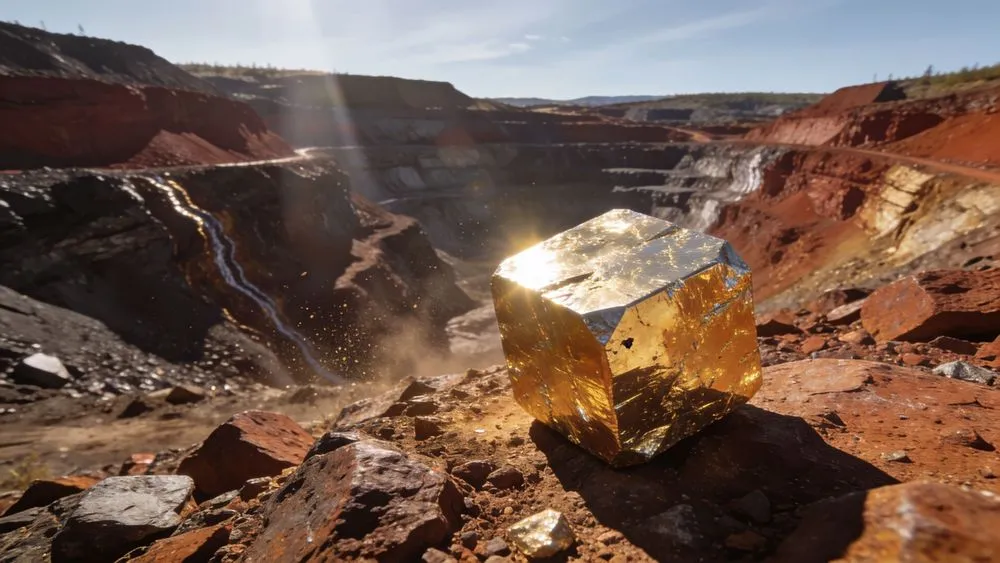
In Minnesota's Iron Range, in the northern part of the state, iron ore mining has continued since the 1890s. In 2024, approximately 34.6 million tons of taconite pellets were produced, with the state accounting for about 75% of total U.S. iron ore production. Annual sales exceed $4 billion. These figures reflect the region's status as a raw material supplier for the steel industry.
That same ore could become a starting point for semiconductor materials. A team led by Professor Chris Leighton (Department of Chemical Engineering and Materials Science) at the University of Minnesota Twin Cities has succeeded in converting low-grade iron ore taken directly from the Iron Range into semiconductor-grade pyrite single crystals—without any additional purification steps. The paper was accepted by Physical Review Applied on July 7, 2026.
40 Years of Pyrite Research Built on the Assumption of "High Purity"
Pyrite () is known as "fool's gold." Its golden luster evokes gold, but it is actually a semiconductor with a bandgap of about 0.95 eV. Its light absorption coefficient is extremely high, around cm⁻¹, allowing a 100 nm-thick film to absorb more than 90% of incident light. Composed solely of iron and sulfur, it is abundant in the Earth's crust and non-toxic. Because it contains no rare or toxic elements—unlike silicon or gallium arsenide—its appeal as a solar cell material was recognized early on.
In 1984, Germany's Ahmed Ennaoui and Helmut Tributsch first reported a solar cell using pyrite. The conversion efficiency was less than 1%, but the theoretical limit was estimated at around 25%, drawing attention to its potential as a low-cost material. However, despite more than 35 years of subsequent research, pyrite solar cell efficiency has never exceeded 2.8%. A fundamental problem stands in the way: the open-circuit voltage () cannot exceed 200 mV.
Separate from the efficiency problem, there were also constraints in material synthesis. It had long been believed that producing semiconductor-grade pyrite single crystals required starting materials of 99.998% pure iron and 99.9995% pure sulfur. The Leighton lab itself had grown crystals using chemical vapor transport (CVT) with these high-purity reagents, achieving record results for pyrite: room-temperature Hall electron densities of $10^{15}$–$10^{16}$ cm⁻³ and electron mobilities of up to 2,100 cm²V⁻¹s⁻¹ at low temperature. Semiconductors are sensitive to impurities—this was the shared assumption underlying the field.
"Why Did Something That Shouldn't Have Worked, Work?"
The Leighton team's idea was simple. Was that high-purity feedstock really necessary in the first place?
The research team obtained three types of iron ore from the Iron Range, reduced each to iron, sulfidized it into , and grew single crystals using the CVT method. No additional purification was performed at any stage. The ore is crushed, reduced with hydrogen gas, reacted with sulfur, and the crystal is grown in a sealed quartz tube using iodine as a transport agent. The process itself is nearly identical to the conventional high-purity route—only the starting material differs.
The results were unexpected. Pyrite single crystals obtained from Direct Reduced Grade Taconite (one of the most common grades in Minnesota) showed a room-temperature Hall electron density as low as $10^{16}$ cm⁻³, with electron mobility exceeding 100 cm²V⁻¹s⁻¹. These values are "surprisingly close" to those of crystals grown from high-purity reagents.
Why is this possible? The paper identifies two synergistic effects. First, very few elements can efficiently dope (supply electrons or holes to) the crystal lattice. Impurities found in iron ore, such as silicon, aluminum, and manganese, remain electrically "silent" even when incorporated into the pyrite lattice. In ordinary semiconductors such as silicon, the presence of boron or phosphorus at just one part per million dramatically changes electrical conductivity. This does not happen in pyrite. Only a limited number of elements can substitute into the iron and sulfur sites in the lattice, and many of these create deep levels that do not supply carriers.
Second, the sulfidation and crystal growth processes themselves have an unexpected purifying effect. Trace element analysis and consideration of thermodynamic parameters revealed that many impurities are removed as volatile compounds during the sulfidation step, or are excluded without being incorporated into the solid phase during crystal growth. In other words, impurities in the ore are naturally screened out during the process—before they can enter the lattice and disrupt electrical properties. This dual defense mechanism enables the growth of high-quality crystals from low-grade feedstock.
In a university press release, Leighton stated, "There are all sorts of reasons why you would think this would not be possible," adding, "Low-grade iron ore was readily converted to semiconductor-grade pyrite without additional purification. We now understand fairly well why that is."
What's Different Between High-Purity Reagents and Iron Ore?
| Item | Conventional high-purity reagent route | This study (iron ore route) |
|---|---|---|
| Starting material purity | Fe: 99.998%, S: 99.9995% | Taconite ore (iron content ~25–30%, numerous impurities) |
| Additional purification step | Purified at the raw material stage | Not required |
| Room-temperature Hall electron density | $10^{15}$–$10^{16}$ cm⁻³ | Minimum $10^{16}$ cm⁻³ |
| Room-temperature electron mobility | ~40 cm²V⁻¹s⁻¹ (lightly doped) | Over 100 cm²V⁻¹s⁻¹ |
| Low-temperature peak mobility | Up to 2,100 cm²V⁻¹s⁻¹ | Not reported |
| Feedstock cost | High-purity reagents are expensive | Existing mining infrastructure can be utilized |
As the table shows, room-temperature electrical properties are comparable to—or in terms of mobility, somewhat superior to—those obtained via the high-purity reagent route. While crystals made from high-purity iron (99.998%) had a room-temperature mobility of about 40 cm²V⁻¹s⁻¹, crystals made from taconite ore with only 25–30% iron content exceeded 100 cm²V⁻¹s⁻¹. Despite a difference of more than two orders of magnitude in feedstock purity, the electrical quality of the resulting crystals is inverted. Low-temperature peak mobility remains unreported, and whether crystal integrity (defect density) is fully equivalent requires further verification.
Implications for the Iron Ore Industry
Minnesota's iron ore industry has long been subject to fluctuations in steel demand. In 2025, pellet production fell by about 17%, from 34.6 million tons in 2024 to approximately 28.55 million tons, due to Cleveland-Cliffs' indefinite idling of the Minorca Mine and partial idling of Hibbing Taconite. The potential for supplying materials for uses beyond steel—particularly clean energy technologies—could become a new revenue stream for this industry.
Taconite has a low iron content of 25–30%, and in conventional steelmaking it must first undergo crushing, magnetic separation, and pelletizing before it can be fed into a blast furnace. If it can be used directly as a semiconductor feedstock, a new supply chain could be envisioned that skips some of these pretreatment steps. Of course, at this stage only the synthesis of bulk single crystals has been demonstrated, and much process development remains before industrial-scale deployment is possible.
The research was funded by the Minnesota Environment and Natural Resources Trust Fund (ENTRF). The fact that funding flowed from a state fund dedicated to natural resource conservation into semiconductor materials research itself reflects the regional policy positioning of this theme.
Remaining Questions and Next Steps
What this research solved is the "feedstock problem." The path to device applications remains far off.
First, the current results are limited to bulk single crystals. What solar cells and electronic devices require are thin films, and the team plans to next work on fabricating thin-film samples. Whether the impurity tolerance demonstrated in bulk crystals will be maintained during thin-film growth is not self-evident, given differences in lattice mismatch with substrates and growth temperature.
Second, the fundamental causes behind pyrite solar cell efficiency plateauing at 2.8%—such as surface conduction, deep donor levels caused by sulfur vacancies, and leakage at internal p-n junctions—remain unresolved issues separate from feedstock purity. Even if the feedstock becomes cheaper, practical application will not follow unless device efficiency improves.
Third, the Iron Range contains ore of varying grades, and reproducibility with ore types other than Direct Reduced Grade Taconite has not been tested. Whether the same results can be obtained with ore of different impurity composition will determine the generality of this method.
Leighton stated, "Pyrite is really different from a typical semiconductor. It's surprisingly immune to impurities." Whether the principle behind this "immunity" can be generalized to other material systems will determine the reach of this discovery. The story of iron ore becoming semiconductor material has only just finished its first chapter.