


Forschungszentrum Jülich in Germany and eleQtron, a startup spun out of the University of Siegen, held an official launch ceremony on September 3, 2026, at the Jülich Supercomputing Centre (JSC) for their jointly developed ion-trap quantum computer, JION. The system, which controls trapped ytterbium ions in a vacuum using microwaves, has been formally integrated into JSC's unified quantum infrastructure, JUNIQ, and deployed into a live operational environment linked with some of Europe's most powerful supercomputers.
The launch is aimed at overcoming the optical complexity that has long limited conventional ion-trap systems, enabling practical hybrid computing. Moving beyond lab-scale proof-of-concept demonstrations, the platform is now positioned to let industry and academic institutions feed real-world problems—in materials engineering, computational chemistry, and logistics optimization—directly into the system. At the ceremony, leadership from the German state of North Rhine-Westphalia (NRW) gathered to announce approximately €50 million in new funding aimed at future scaling.
How MAGIC Technology Eliminates the Need for Laser Targeting
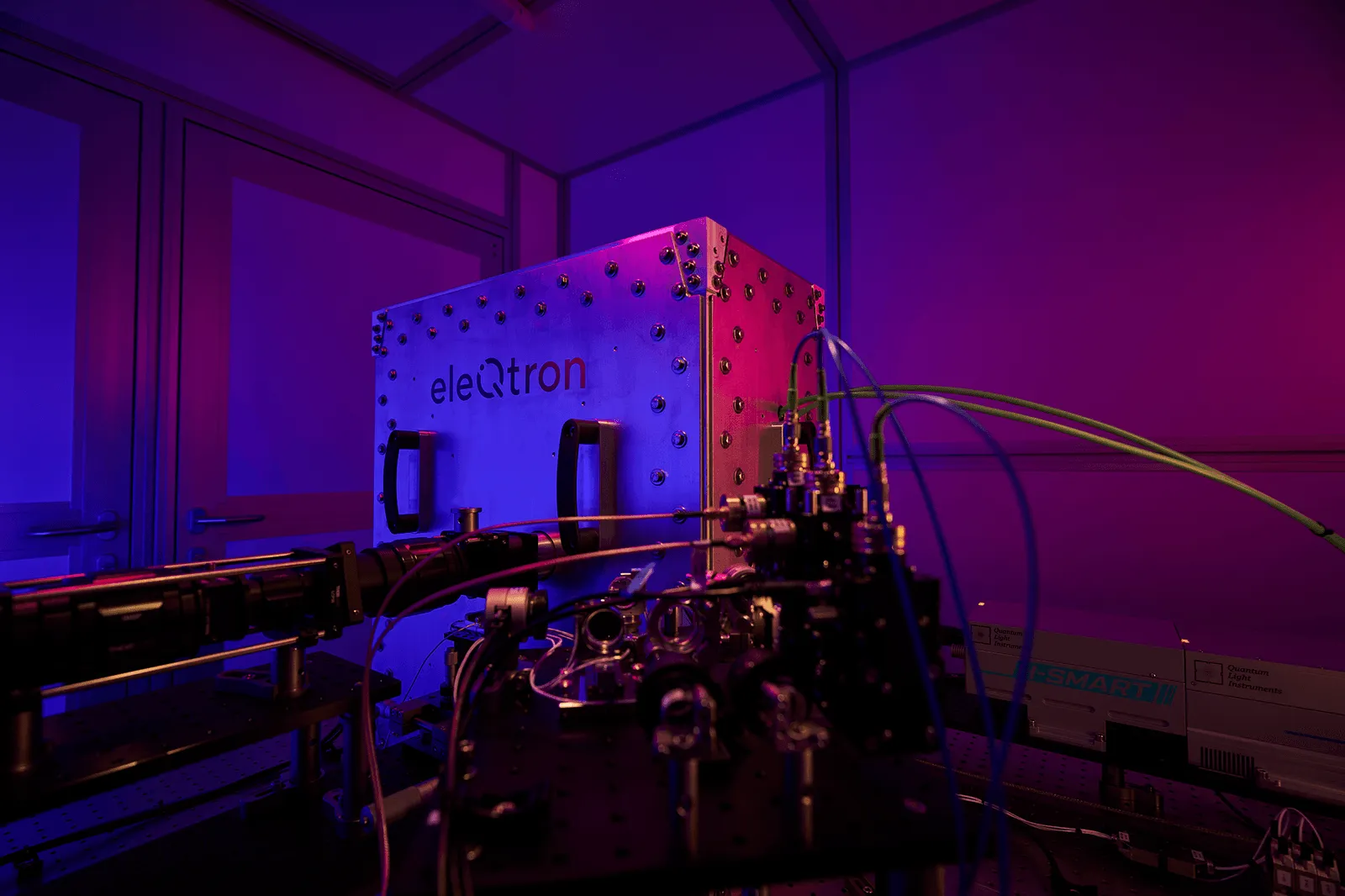
Ion-trap systems use the internal energy levels of charged atoms (ions) isolated in a vacuum by electromagnetic fields as qubits. Because individual qubits are inherently uniform, offer long coherence times, and support full connectivity—direct interaction between any two qubits—this approach has long been considered a strong candidate for fault-tolerant quantum computing. However, conventional designs require precisely focused laser beams aimed at individual ions, and as qubit counts grow, the arrangement of optical components, beam-positioning stability, and optical crosstalk become serious physical bottlenecks.
JION addresses this challenge using "MAGIC" (Magnetic Gradient Induced Coupling), a technology developed by eleQtron based on research from the University of Siegen. MAGIC deliberately creates a static magnetic field gradient across the trapping region. The spatial variation in field strength produces a unique resonance frequency shift for each ytterbium (171Yb+) ion arranged in the trap. As a result, any single qubit can be selectively manipulated simply by switching the frequency of microwave pulses broadcast across the entire device—no individual laser targeting required.
MAGIC also uses the magnetic gradient to directly couple ions' internal spin states with the crystal's collective vibrational modes (phonons). This allows two-qubit entangling gates to be driven using microwave pulses alone. This approach avoids spontaneous-emission errors associated with photon scattering, and it allows the control system to be built using the highly reliable high-frequency electronic components already established in mobile communications and radar technology.
This control architecture also brings major differences in cooling requirements. Superconducting qubits require dilution refrigerators to maintain millikelvin-level temperatures near absolute zero to eliminate thermal noise, but JION's vacuum trap core operates at room temperature as-is. Freedom from refrigeration infrastructure constraints offers a notable advantage for future scaling and deployment in data centers.
From Standalone Prototype to HPC Platform Directly Linked with JUPITER
The significance of JION's launch lies less in the completion of the physical hardware itself and more in its full integration into JUNIQ (Jülich UNified Infrastructure for Quantum computing), the modular quantum infrastructure operated by Forschungszentrum Jülich. JUNIQ is an integrated platform designed to connect diverse quantum hardware with JSC's high-performance computing (HPC) clusters over low-latency links, accessible through a unified environment.
JSC currently operates JUPITER, known as Europe's first exascale supercomputer. JION has been placed right alongside this world-class massively parallel computing platform, enabling hybrid workflows in which a classical supercomputer orchestrates an entire job while offloading only specific computationally intensive kernels to the quantum processor. For algorithms such as the Variational Quantum Eigensolver (VQE) and the Quantum Approximate Optimization Algorithm (QAOA), which iterate between classical and quantum computation to refine solutions, a directly linked architecture that minimizes network latency is an essential prerequisite.
The realization of this system is the result of EPIQ (Entwicklungspartnerschaft Ionenfallen-Quantencomputer in NRW), a joint development partnership launched in March 2024. The NRW Ministry of Culture and Science invested approximately €21 million (about $24.39 million) in public funding, advancing a four-and-a-half-year plan to bridge research and industry. This collaborative framework, which grew out of the EIN Quantum NRW network, has now shifted with JION's launch from research and development into a fully operational phase that includes providing computing services and training to users.
At the ceremony, Professor Astrid Lambrecht, chair of the board of directors at Forschungszentrum Jülich, said that linking a quantum computer developed within the state to Jülich's HPC infrastructure has created the conditions needed to move toward solving concrete problems in research and industry. Professor Kristel Michielsen, head of JSC, emphasized that adding an ion-trap system to JUNIQ enables performance comparisons and benchmarking across diverse quantum computing approaches.
Additional €50 Million Targets Industrial Implementation
At the September 3, 2026 launch ceremony, alongside the unveiling of JION, two major public funding awards were approved with an eye toward the next phase of scale-up. Together totaling up to approximately €50 million (about $58 million), the funding clearly reinforces the push by Europe and Germany to establish quantum technology sovereignty and transform regional industry.
The first funding award goes to SQALING (scalable quantum computing from NRW), a proprietary development project led by eleQtron itself. Based on a funding approval handed directly to the company by NRW Minister-President Hendrik Wüst, up to approximately €25 million (about $29 million) will be provided from the European Regional Development Fund (ERDF) and the Just Transition Fund (JTF). SQALING's goal is to evolve the MAGIC technology demonstrated in JION into a scalable quantum processor platform integrated on flat semiconductor chips. By moving from three-dimensional bulk electrode structures to chip-based traps, the project aims to improve industrial mass-producibility and integration density.
The second funding award goes to Q-STAR.NRW, a new project led by JSC. This project will likewise receive up to approximately €25 million (about $29 million), drawn from structural transition funds for the Rhenish mining region under the Coal Regions Investment Act (InvKG) and from the state budget. Q-STAR.NRW aims to procure a scalable semiconductor-based quantum computer with up to 200 qubits and integrate it into the JUNIQ environment.
The combined roughly €50 million in funding for these two projects carries a strong policy intent: revitalizing the Rhenish mining region (Rheinisches Revier), which is moving away from lignite mining, into a hub for advanced high-tech industry. Minister-President Wüst said that NRW, having achieved an initial breakthrough in quantum hardware, can lead in global competition by linking cutting-edge research with a strong startup ecosystem. Mona Neubaur, the state's Minister for Economic Affairs, Industry, Climate Action, and Energy, also made clear her support for establishing core technologies that will benefit key industries such as chemicals, pharmaceuticals, and logistics, with an eye toward building a sovereign Europe.
Engineering Hurdles Remain in Chip Integration and Qubit Scaling
The launch of JION and the accompanying wave of major investment signal that European quantum hardware development has taken a step from the laboratory toward real-world implementation. However, significant engineering hurdles remain before truly industrially useful quantum advantage can be achieved.
One important caveat is that the announcement did not disclose detailed performance figures for the current JION system, such as physical qubit count, quantum volume, or gate fidelity. The "up to 200 qubits" target cited for Q-STAR.NRW refers to a separate semiconductor-based quantum machine procurement goal and does not directly indicate JION's current scale. The computational capability and error rates of the current system will be subject to rigorous benchmarking as it becomes available to external users through JUNIQ going forward.
There are also technical trade-offs to consider. While microwave-driven ion-trap systems dramatically reduce optical complexity compared to laser-excitation approaches, two-qubit gate operations generally tend to run slower. Longer gate operation times increase exposure to ion decoherence and external environmental noise, making it a key technical focus to determine how much gate fidelity can be improved through steeper magnetic field gradients and precisely engineered high-power microwave circuitry.
Furthermore, the shift toward chip-based architectures targeted by SQALING will require advanced semiconductor microfabrication techniques to stably levitate ions above fine electrode structures while suppressing thermal noise and patch-potential fluctuations from densely packed wiring layers. As two-dimensional array configurations advance—involving ion transport and shuffling—reducing RF electrode crosstalk and maintaining uniformity across the chip will become increasingly challenging.
Significant software-layer challenges also remain in coordinating with classical HPC systems, including optimizing schedulers and compilers to synchronize massively parallel systems like JUPITER with quantum processors, as well as implementing quantum error mitigation algorithms. The success of Germany's quantum ecosystem will depend on how far it can leverage the hardware simplicity afforded by room-temperature operation and microwave control while accelerating chip integration and the validation of practical algorithms.