

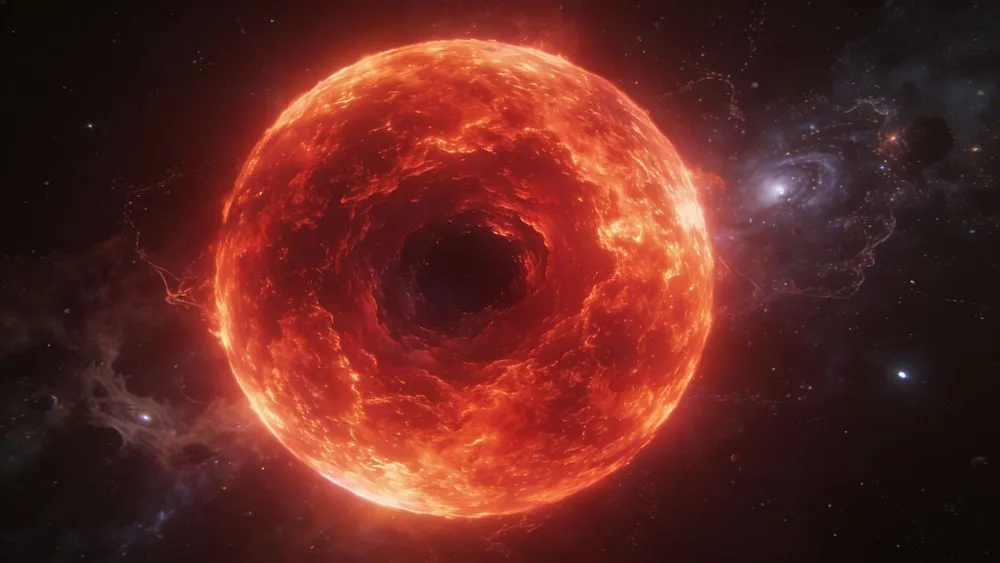
In a universe roughly 660 million years after the Big Bang, there exists a crimson object about the size of the solar system that emits 100 billion times the energy of a known star. For years, astronomers have sought to explain why unaccountably massive black holes already existed in the early universe. How did black holes achieve growth so rapid it seems to defy the limits of physics? A single strand of anomalous light captured by the James Webb Space Telescope (JWST) is now working to fill in that blank chapter of history.
The "Time Deficit" Paradox Troubling Cosmology
One of the heaviest challenges facing modern astrophysics is the origin of supermassive black holes in the early universe. Observing deep space far from Earth is equivalent to peering into the universe's past. Observational networks including the Hubble Space Telescope have confirmed that, in an era only a few hundred million years after the Big Bang, black holes with masses hundreds of millions to billions of times that of the Sun already existed.
The Eddington Limit, Where Gravity and Radiation Pressure Balance
Here a rigorous physical contradiction arises. There is a theoretical upper limit—known as the Eddington limit—on the speed at which a black hole can grow by swallowing surrounding matter. As matter falls toward a black hole, intense friction and compression generate extremely powerful radiation. The Eddington limit is the point at which this light's radiation pressure (the outward pressure produced when photons collide with matter) balances the gravity pulling matter inward.
If a black hole attempts to swallow matter fast enough to break this balance, the intense radiation pressure blows the surrounding matter outward, ultimately halting growth. Even while adhering to this upper speed limit, for a black hole left behind at the end of a star's life—several to several dozen solar masses—to grow to billions of solar masses would require far more time than the age of the universe itself. The giant black holes of the early universe simply do not have enough time, physically speaking, to have grown this large.
The Hypothesis of a Massive "Seed" to Compensate for the Time Deficit
To resolve this time-deficit problem, researchers have long proposed several hypotheses. A prominent one is the direct collapse model, in which, rather than resulting from the collapse of a star, a massive gas cloud undergoes direct gravitational collapse without passing through a stellar phase, being born from the outset as a colossal "seed" tens of thousands to hundreds of thousands of times the mass of the Sun. The conditions under which a gas cloud in the harsh environment of the early universe could collapse as a single massive lump without fragmenting are extremely limited, and direct observational evidence supporting this scenario had long remained elusive. The process of black hole formation in the early universe had remained a major theoretical blank space.
A Contradictory Spectrum Hidden in a "Little Red Dot"
JWST, which began science observations in 2022, started depicting the era known as cosmic dawn with unprecedented precision, thanks to its overwhelming light-gathering power and resolution in the infrared. In the course of this exploration, a group of mysterious objects collectively called "Little Red Dots" immediately caught astronomers' attention.
These objects shared a common feature: they were spatially extremely compact yet emitted anomalously bright red light. Light from the early universe is stretched in wavelength by the expansion of space itself, so that original visible or ultraviolet light is observed as infrared. These point sources—barely visible in JWST's blue filters yet shining intensely in red filters—came to be seen as clues that could push back the observational limits of the distant universe.
An Extreme Absorption Feature That Cannot Be Explained by a Stellar Atmosphere
An international research team led by Rohan Naidu of the Massachusetts Institute of Technology (at the time of the observations), while conducting a project to investigate the properties of galaxies in the early universe, focused on the strange behavior of one such red dot, named "MoM-BH*-1." Calculations based on the observational data indicate that this object existed at an extremely ancient epoch, roughly 660 million years after the Big Bang.
When the research team performed detailed spectroscopic observations, breaking down MoM-BH*-1's light by wavelength, a fact emerged that directly clashed with conventional models of celestial objects. Normally, when analyzing the light of stars or star clusters, one observes a sharp drop in the continuous spectrum called the "Balmer break." This phenomenon occurs when electrons in hydrogen atoms, residing in the second energy level, absorb photons of sufficiently high energy to become ionized. Once a photon's wavelength becomes shorter than about 364.6 nanometers (corresponding to an energy of about 3.4 eV), it is efficiently absorbed by hydrogen atoms, causing a discontinuous drop in light intensity at that point.
The spectrum of MoM-BH*-1 exhibited an extremely deep Balmer break—more than three times as strong as that of even the reddest known stellar populations. It was a depth that could not be physically produced by the atmosphere of an ordinary star.
An Anomaly Revealed by 100-Billion-Fold Brightness and a Lack of Heavy Elements
An even more serious contradiction lay in its absolute brightness. The energy emitted by this object was an extraordinary 100 billion times that of any known star. Meanwhile, the chemical composition traced in the spectrum showed an environment almost devoid of heavy elements such as metals, composed of nearly pure hydrogen and helium. Despite far exceeding the physical limits of a star powered by nuclear fusion, its outward behavior was exactly that of a giant star with a thick atmosphere.
Gravity Wrapped in a Garment of Light
Anomalous brightness, combined with a deep absorption spectrum that behaves like a star—to explain these two seemingly incompatible features in a unified way, the research team arrived at the proposal of an unknown structure they call a "black hole star." This model, published in the journal Nature, is built on the combination of two extreme physical states.
A Pseudo-Photosphere in Which a Gas Cloud Converts X-rays into Visible Light
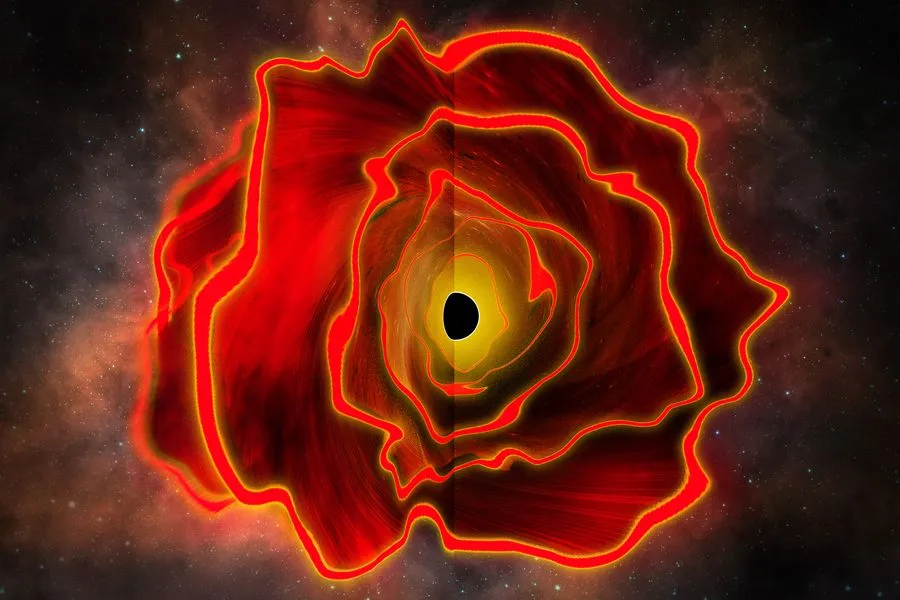
At the center of the structure sits an active black hole reaching 100,000 solar masses. Around the black hole, an accretion disk forms, and as matter is drawn toward the event horizon, enormous gravitational energy is released as light and heat. Up to this point, the mechanism is the same as that seen in the active galactic nuclei commonly observed in the distant universe. The decisive difference is that this region is entirely enveloped by an extremely dense layer of hydrogen gas, spanning a volume large enough to encompass the entire solar system.
The intense X-rays and ultraviolet radiation generated near the black hole cannot pass straight through this thick envelope of hydrogen gas. High-energy photons repeatedly scatter and interact with the ultra-dense hydrogen atoms and free electrons, gradually transferring their energy to the surrounding gas. In this process, the entire gas layer becomes extremely heated.
Ultimately, the internal energy is released outward from the surface of the envelope as relatively long-wavelength visible light. The outer layer of the giant gas cloud itself functions as a thermal converter, transforming the gravitational energy generated inside into a stellar-like surface temperature. Viewed from the outside, even though it is gravity that produces the enormous energy at the center, the object takes on strong characteristics of thermal radiation from hydrogen gas, causing it to appear as an extraordinarily bright, giant star.
| Feature | Massive Star | Quasar (Active Galactic Nucleus) | Black Hole Star (MoM-BH*-1) |
|---|---|---|---|
| Primary energy source | Nuclear fusion reactions in the core | Release of gravitational energy | Accretion energy from the central black hole |
| Emission mechanism | Thermal radiation from the photosphere | Intense X-rays and ultraviolet from the accretion disk | Pseudo-photosphere in which the outer hydrogen gas layer absorbs and re-emits radiation |
| Balmer break | Observed, but relatively weak | Not usually seen | Anomalously deep, far exceeding that of stars |
| Main constituent elements | Hydrogen, helium, trace heavy elements | Contains a variety of heavy elements | Nearly pure hydrogen and helium |
The Path from a Cradle of Gluttony to Supermassive Status
The existence of MoM-BH*-1 provides an extremely weighty piece of the puzzle for resolving the time-deficit problem of black holes in the early universe.
A Sealed Environment That Suppresses Radiation Pressure Accelerates Growth
In the environment of a black hole star enveloped by a thick gas layer, the enormous gas pressure holds back the radiation pressure that would otherwise escape outward, allowing matter to be drawn in steadily at a rate near, or even exceeding, the Eddington limit. This creates an ideal sealed environment that enables a sustained, massive supply of matter to the central black hole.
This beautifully embodies an intermediate stage of the rapid growth phase, in which a black hole voraciously swallows surrounding matter over a mere few hundred million years after the birth of the universe. The research team speculates that many of the objects JWST has captured as "little red dots" may in fact be objects in this black hole star stage. If this hypothesis is correct, it would mean that the supermassive black holes lurking at the centers of the giant galaxies seen in today's universe once spent a period of rapid growth inside just such a thick gaseous cradle.
Hydrogen Gas Lacking Heavy Elements Sustained the Giant Structure
A remaining major mystery concerns the initial conditions—what kind of environment gave rise to this peculiar object. Was it formed by the direct collapse, without fragmentation, of a giant gas cloud with tens of thousands to hundreds of thousands of solar masses? Or was it the result of numerous stars rapidly merging repeatedly at the center of an extremely dense star cluster, ultimately collapsing as a single giant star?
When stars form, heavy elements contained within a gas cloud normally act as a coolant, radiating away heat and causing the cloud to fragment into small clumps. It is considered highly likely that the poor cooling efficiency of pure hydrogen gas—nearly devoid of heavy elements, a characteristic feature of the early universe—prevented the gas cloud from fragmenting finely, helping it maintain its giant structure.
This result, obtained from the detailed analysis of a single object, has added an entirely new species to the map of early-universe evolution. Going forward, further spectroscopic observations using JWST will be needed to quantitatively assess how commonly objects of the same kind as MoM-BH*-1 exist, and what kind of spatial distribution they show. The origin of this gravitational monster, quietly nurtured in the early universe, is only now beginning to reveal its outline.