

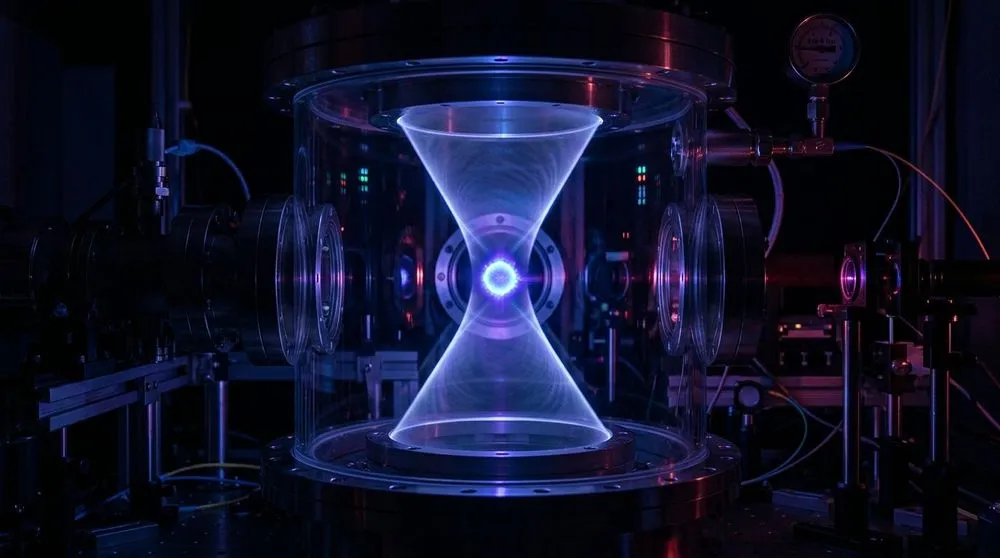
In physics, the attempt to measure minute forces has always been a battle against heat. In a room-temperature world, air molecules constantly collide with measuring instruments, causing every object to vibrate chaotically. To eliminate this thermal noise, researchers have developed techniques to place measurement apparatus in ultra-high vacuum environments and cool it to near absolute zero.
Severing All Contact: Nanoparticles Create the Ultimate Isolated System
As long as an apparatus remains in physical contact with any external object, a trace amount of heat will inevitably be transferred. The technology that emerged to fundamentally solve this problem is one that uses the force of light to hold an object suspended in mid-air. Optical tweezing, devised in the 1970s and later recognized with a Nobel Prize in Physics, captures minute objects by harnessing the momentum carried by laser light. When this technique is applied in a vacuum environment, contact with any substrate or support structure can be completely eliminated. A levitated nanoparticle, having no pathway for heat to flow in from its surroundings, becomes an ideal isolated system for sensing weak external forces.
This field, known as optomechanics, which explores the interaction between light and mechanical motion, has advanced significantly over the past decade. A research team at the University of Tokyo—including Project Researcher Mitsuyoshi Kamba, Project Assistant Professor Sosuke Otabe, and Associate Professor Kiyotaka Aikawa—used this approach to levitate a particle roughly 300 nanometers in diameter in vacuum. This is comparable in size to a virus, a macroscopic aggregate composed of hundreds of millions of atoms. The team confined this particle within an optical potential created by laser light and cooled its motional state to near the quantum ground state, its lowest energy level. It appeared that the ultimate quiet environment for measuring faint gravitational acceleration had been established.
The Unavoidable Tremor Imposed by the Uncertainty Principle
Even after eliminating classical thermal noise, a fundamental limit of physics stands in the way. No matter how perfectly cooling is performed and temperature is brought close to absolute zero, the particle never comes to complete rest in space. In the realm of quantum mechanics governed by Heisenberg's uncertainty principle, position and momentum cannot be simultaneously determined with precision. This principle, expressed mathematically as , states that the product of the fluctuation in position () and the fluctuation in momentum () cannot fall below a certain constant (Planck's constant divided by the circle constant). If one attempts to fix the particle's position as being at rest, its location becomes indeterminate anywhere in the universe.
The Wall of Zero-Point Fluctuations That Remains Even After Cooling
This fundamental fluctuation, known as zero-point motion, never vanishes even when thermal energy is depleted. What happens if laser power is increased in an attempt to precisely fix the particle's position, thereby strengthening the spatial confinement of the optical potential? In the harmonic oscillator model used in physics, the stronger the confinement, the smaller the positional uncertainty of the particle becomes—but inversely, the uncertainty in momentum rises sharply. As a result, the overall energy floor of the system is raised, and zero-point motion becomes more intense.
To measure acceleration, one must accurately read the displacement in the particle's position caused by an external force. Under ultra-low temperature conditions, the nanoparticle's own quantum tremor was too large. The shift caused by minute acceleration became completely buried within that tremor. Precise measurement had always presupposed keeping the system in a stable steady state—a paradigm of fixing the environment, waiting for noise to settle, and only then reading the signal. This very fixation on the steady state was precisely what prevented researchers from overcoming the wall of zero-point motion. To measure weak forces, it was necessary to overturn the conventional wisdom of maintaining stillness itself.
Breaking Down the Walls of the Bowl: A Shift to Non-Equilibrium Dynamics
Rather than forcibly suppressing the tremor, the research team chose a path of deliberately destabilizing the system. What they developed was a technique to rapidly lower the intensity of the laser light trapping the nanoparticle, starting from its ultra-low temperature state.
This operation, known in physics as a quantum quench, originally derives from the term "quenching" in metallurgy, but in modern physics it refers to an operation that rapidly shifts a system from one stable state to another, triggering non-equilibrium dynamics. Through the quench, the particle is abruptly severed from the environment it had grown accustomed to, and exhibits transient motion as it attempts to adapt to the new environment.
Relaxing the Optical Potential Amplifies Minute Displacements
Imagine a small ball, cooled to ultra-low temperature, sitting at the bottom of a steep bowl. Even without possessing heat, the ball continues to tremble finely due to zero-point motion. If an external acceleration is applied and the entire bowl tilts slightly, the amplitude of the ball's own tremor is so large that distinguishing the movement caused by the tilt becomes nearly impossible.
Now, suppose the walls of the bowl are rapidly flattened out. The force that had been confining the ball suddenly weakens, and even a slight tilt causes the ball to begin rolling significantly. The distance the ball rolls down the slope clearly exceeds the magnitude of its tremor.
The research team deliberately shallowed the bowl of the optical potential by reducing laser power, artificially amplifying the nanoparticle's displacement due to acceleration. It is an inverted approach: by breaking the steady state, they instead pulled a minute signal out of a sea of noise.
The Optimal Timing for Amplifying Displacement
Through this dynamic approach, the research team succeeded in slipping past the constraints of zero-point motion. Immediately after the quench lowers the laser light intensity, the nanoparticle begins to move within the new optical potential. Position is measured at the optimal timing—after displacement has been amplified, but before the particle escapes the potential entirely.
When evaluating long-duration measurement data, physicists use a metric called Allan deviation. This is a measure also used in evaluating atomic clocks, designed to identify the trade-off between noise on short timescales and drift caused by environmental fluctuations on long timescales. Experimental results demonstrated that at the point where this Allan deviation is minimized, detection of a faint acceleration of 1.2 was achieved. This represents a force roughly 1/8000th of Earth's gravitational acceleration. Compared to conventional methods that keep laser intensity constant, the sensitivity of acceleration detection improved by two orders of magnitude (100-fold).
| Comparison Item | Conventional Static Sensing | Dynamic Sensing in This Study |
|---|---|---|
| Measurement paradigm | Measure while maintaining steady state | Exploit non-equilibrium state by rapidly lowering light intensity |
| Control of optical potential | Fix intensity at a constant level | Rapidly reduce intensity to amplify displacement |
| Handling of zero-point motion | Signal is completely obscured by fluctuations | Extract displacement exceeding the fluctuation amplitude |
| Acceleration detection sensitivity | Baseline | Two orders of magnitude improvement over conventional method |
The Quantum Langevin Equation Corroborates the Transient Dynamics
As theoretical support for this phenomenon, Professor Takahiro Sagawa and colleagues conducted simulations using the quantum Langevin equation. This is an equation that extends into the framework of quantum mechanics the description of Brownian motion—the irregular movement of pollen particles struck by water molecules, first formulated in the 19th century. This mathematical formula simultaneously describes the random quantum fluctuations a system receives from its surroundings and the dissipation of energy.
The simulation faithfully reproduced the particle dynamics observed in the experiment, accurately incorporating the time-varying optical potential and the effects of residual gas colliding with the nanoparticle in the vacuum. In an ultra-low temperature environment near the quantum ground state, dynamically controlled sensing was proven both theoretically and experimentally.
A Next-Generation Pendulum for Measuring the Invisible Universe
This new sensor, using a particle 300 nanometers in diameter, becomes a tool for exploring uncharted territories confronting physics. The faint collisions as dark matter—believed to constitute the majority of the universe's mass—passes through a detector; recoil caused by neutrinos; or the minute force exerted when high-frequency gravitational waves distort spacetime. To capture these phenomena, what was needed was not an infinitesimally small mass like a single atom, but a pendulum possessing macroscopic mass—an aggregate of hundreds of millions of atoms—while still retaining quantum mechanical sensitivity. The greater the mass, the more readily it absorbs the change in momentum caused by an external collision, making a detectable signal more likely to arise. The levitated nanoparticle is poised to fulfill that role.
Reconciling Enormous Mass with Quantum Sensitivity Opens Up Uncharted Territory
At the same time, this technology is directly connected to major open questions in fundamental physics. Quantum mechanics, which governs the microscopic world, and general relativity, which governs the macroscopic world, have yet to be fully unified. If we can precisely measure how a nanoparticle with macroscopic scale interacts with gravity, we could obtain crucial data toward constructing a theory of quantum gravity that bridges the two frameworks.
Many conditions still remain to be verified. To further push down the detection limit for acceleration, the influence of residual gas within the vacuum chamber must be thoroughly eliminated. Simulations have shown that even slight differences in mass—such as whether the residual gas is hydrogen or nitrogen—directly affect measurement sensitivity. How far can the noise from gas molecules colliding with the particle be suppressed, and how long can measurement stability be maintained? Having mastered quantum fluctuations, the research team's next target is directed toward improving the quality of the vacuum itself.