


1,480 meters beneath Lead, South Dakota, at the bottom of rock once excavated as a gold mine, a detector filled with 10 tons of ultra-pure liquid xenon has been waiting for invisible particles raining down from the cosmos. On September 1, 2026, at the international conference TeV Particle Astrophysics (TeVPA 2026), held in Tendo City, Japan, the international collaboration LUX-ZEPLIN (LZ) reported an extraordinarily unusual single observation.
Sam Eriksen of the University of Bristol, who leads the analysis, announced that the team had detected one candidate nuclear recoil signal in a high-energy region far beyond the standard search window—one that cannot be explained by background radiation. The paper has been posted as a preprint on LZ's official website, and submission to the arXiv preprint server as well as peer review at Physical Review Letters are underway. As of the announcement, peer review had not yet been completed.
Rick Gaitskell of Brown University, co-spokesperson for the LZ experiment, commented cautiously on the finding: "We are not claiming to have discovered dark matter. But we have witnessed an extremely interesting event that we felt we should share with the scientific community for scrutiny." LZ is an international collaboration led by the U.S. Department of Energy's Lawrence Berkeley National Laboratory, bringing together more than 250 researchers and engineers from 39 institutions worldwide. This announcement marks the opening of a physical question confronted as the detector's sensitivity reaches its extreme limits.
Dark matter searches conducted deep underground require thoroughly shielding against cosmic-ray muons and radiation emitted from the surrounding rock. When an unknown particle collides with a xenon nucleus, the recoiling nucleus produces minute flashes of light and ionized electrons. Capturing this signal has long been the strategy for probing the nature of the invisible mass that fills the universe. Today's observation represents an unusual data point obtained right at that frontier.
Inside the Detector That Extended Its Search Window to 270 Kiloelectronvolts
Weakly interacting massive particles (WIMPs), long pursued as the leading dark matter candidate, interact with ordinary matter only exceedingly rarely. Because surface laboratories are swamped by cosmic-ray noise, detectors are installed deep underground behind thick rock. At the core of the LZ detector is a dual-phase time projection chamber (TPC) that combines liquid and gaseous xenon.
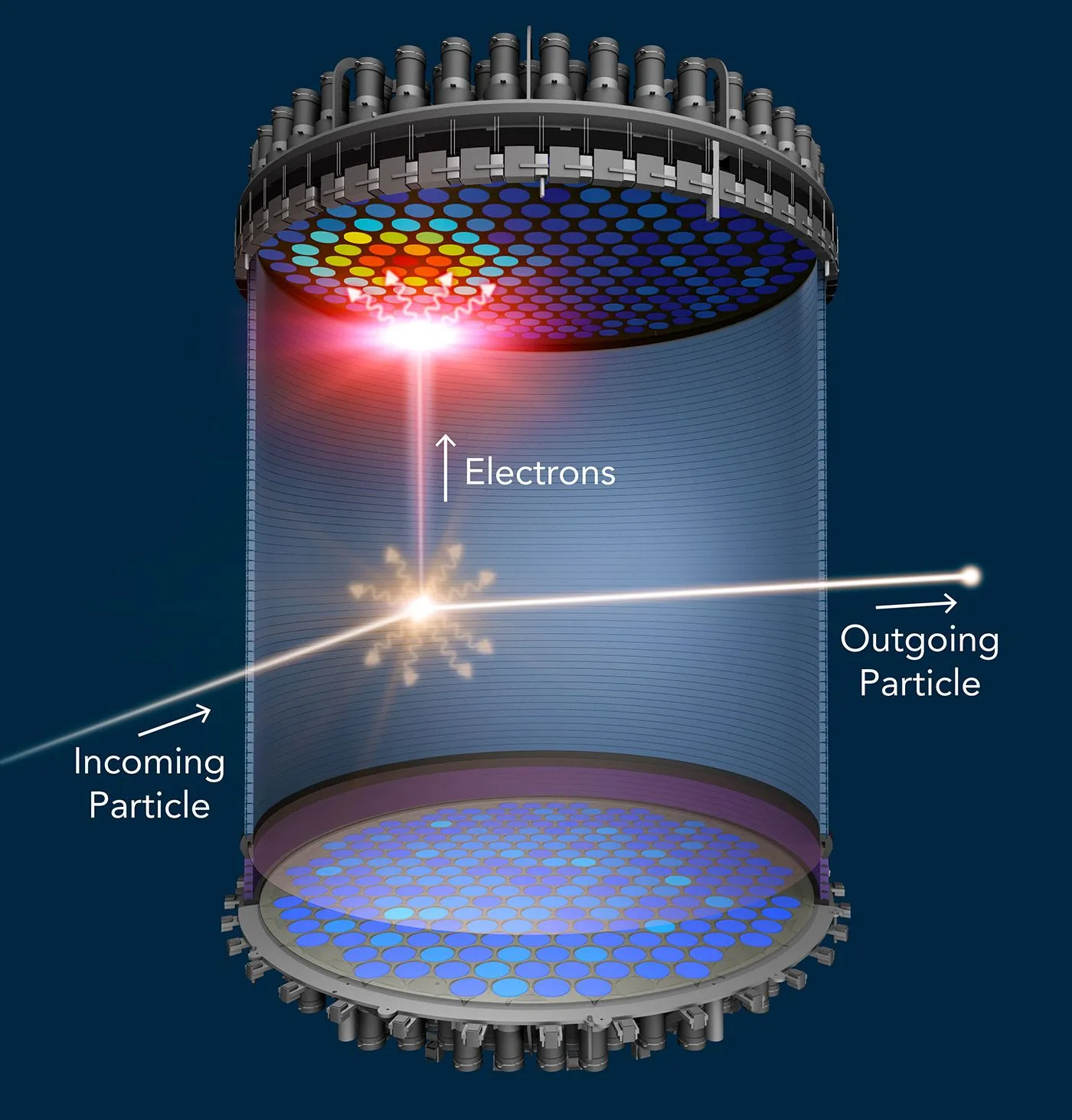
When a particle strikes and recoils off a nucleus in the liquid xenon, it produces a very faint scintillation light pulse (the primary signal, S1). At the same time, the knocked-out ionized electrons drift upward through a strong applied electric field into the gas layer above, where they emit an intense electroluminescence pulse (the secondary signal, S2). The time difference between these two signals pinpoints the depth (Z-coordinate) of the collision to millimeter precision, while the light pattern captured by the photomultiplier tubes determines the horizontal position (XY-coordinates). This positioning capability, combined with differences in the S1-to-S2 ratio between electron recoils (from gamma rays or beta particles) and nuclear recoils (from neutrons or dark matter), allows the experiment to strip away noise to the greatest extent possible.
The analysis presented is based on 220 days of live data collected between March 2023 and April 2024. Of the detector's full 10 tons of liquid xenon, the central 5.5 tons least affected by noise were defined as the fiducial mass, yielding a total exposure of 2.84 ton-years.
The conventional flagship analysis has focused on the low-recoil-energy region of roughly 5 to 55 keV (kiloelectronvolts) to capture the typical scattering expected from standard WIMPs. In this low-energy window, the LZ team has previously found no excess dark matter signal, setting the world's most stringent limits.
In this new study, the search region was substantially extended to a high-energy boundary of about 270 keV. Using the framework of non-relativistic effective field theory (NR-EFT), the team comprehensively examined not only the standard spin-independent interaction but a broad range of models—including vector-type, axial-vector-type, and electric or magnetic dipole couplings—that raise the probability of higher-energy recoils.
To ensure objectivity in the analysis, the research team employed a rigorous blinding technique known as "salting." In the early stages of analysis, an artificial set of simulated signals ("salt") with an unknown number and energy distribution was deliberately injected into the dataset. Researchers built their noise-rejection algorithms and selection criteria without knowing which events were real and which were artificial. After all analysis conditions were completely frozen, the salt was removed in a process called "unsalting," leaving a single event within the search region.
The team exhaustively reexamined every conceivable known background process. Spontaneous fission, cosmic-ray-induced neutrons, solar and atmospheric neutrinos, combined gamma-ray interactions (Gamma-X) originating from trace radioactivity in detector materials, and even double electron capture (DEC) in xenon-124 nuclei were cross-checked against detailed simulations and calibration data. However, no known radiation source could account for the characteristics of the observed high-energy event.
A 248-Kiloelectronvolt Recoil Event and a 2.6-Sigma Statistical Assessment
The detected event was recorded on June 16, 2023. Based on its signal characteristics, the reconstructed nuclear recoil energy was —clearly situated in the high-energy region even accounting for statistical and systematic uncertainties.
At an exposure of 2.84 ton-years, the number of known background events expected in this recoil-energy region was well below one. In what should have been an empty darkness, a single, remarkably clear trace of a nuclear recoil emerged.
In particle physics, rigorously evaluating statistical significance is essential when discussing the existence of a new phenomenon. The unit sigma (), representing multiples of the standard deviation in a normal distribution, quantifies the probability that a phenomenon arose by chance from statistical fluctuations in the background.
Detailed statistical analysis using a profile likelihood ratio test found that the local significance for the individual dark matter models tested reached as high as 3.4. However, because the search extended across a wider energy range and simultaneously tested multiple interaction operators, the probability that a random fluctuation would coincidentally match a particular energy or operator increases. This is known as the "look-elsewhere effect" (LEE).
After correcting for this effect, the global significance was calculated to be 2.6. A value of 2.6 indicates that the probability of this event arising purely from a chance background fluctuation is about 0.5%, or roughly 1 in 200.
By general consensus in the physics community, establishing "evidence" of an anomaly requires 3 (a chance probability of about 0.27%, or roughly 1 in 370 or lower). Declaring a definitive "discovery" demands an even more stringent threshold of 5 (a chance probability of about 1 in 3.5 million or lower).
The 2.6 result reported here does not even meet the statistical threshold for evidence. A clear line separates the excitement generated by a single event from the caution demanded by scientific rigor.
| Analysis Category / Criterion | Exposure | Search Energy Range | Observed Events | Expected Background | Significance | Status |
|---|---|---|---|---|---|---|
| Standard Low-Energy WIMP Search | 2.84 ton-years | 0 (no excess) | Multiple (model-dependent) | N/A | Updated upper limits on dark matter | |
| Prior High-Energy EFT Search (2024) | 5.5-ton fiducial mass, 60 live days | 0 (no excess) | Less than 1 | N/A | Limits set due to insufficient statistics | |
| Current Extended EFT Search (2026) | 2.84 ton-years (220 days) | 1 | Less than 1 | 2.6 (global) / 3.4 (local) | Anomalous event, under peer review | |
| Physics "Evidence" Threshold | Not applicable | Not applicable | Not applicable | Not applicable | 3.0 | Background fluctuation probability |
| Physics "Discovery" Threshold | Not applicable | Not applicable | Not applicable | Not applicable | 5.0 | Background fluctuation probability |
The Limits of Standard Theory and the Possibility of Inelastic Scattering Models
If this event were caused by dark matter, the simplest theoretical model would collapse immediately. In the standard spin-independent WIMP model—where a point-like particle elastically scatters off a nucleus—the scattering cross-section (interaction probability) increases exponentially as the recoil energy decreases. If a cross-section large enough to produce a single recoil event at 248 keV existed, then thousands of recoil events should have cascaded through the sensitive low-energy window of 5 to 55 keV.
The solid observational fact of zero events in the low-energy region completely rules out an interpretation based on simple elastic-scattering WIMPs. To resolve this contradiction, theoretical physicists are examining non-standard dark matter models.
One prominent candidate is the "inelastic dark matter" (iDM) model. In this scenario, when a dark matter particle collides with a xenon nucleus, it transitions to a slightly heavier excited state (an endothermic scattering process).
For scattering to occur, the relative kinetic energy of the dark matter must exceed the mass difference (the splitting energy, ). Slow-moving dark matter or small momentum transfers lack the energy needed to trigger this excitation, kinematically forbidding the scattering altogether. As a result, low-energy recoils are completely suppressed, and only heavy dark matter particles with velocities near the galactic escape velocity can scatter, producing high recoil energies.
JiJi Fan, a theoretical physicist at Brown University, notes: "There are well-motivated theoretical extensions—such as inelastic scattering or momentum-dependent elastic scattering—that could explain a single high-energy event."
These models require dark matter particles with a mass of at least 200 , potentially reaching as high as 1,000 . The picture under discussion is one in which dark matter possesses internal structure and interacts with matter by changing internal states, much like atomic excitation.
The date the event was detected—June 16, 2023—has also sparked theoretical discussion. As theoretical physicist Neal Weiner of New York University has previously proposed, inelastic dark matter models predict that the probability of high-speed collisions spikes in early summer (around June), when the orbital motions of the Sun and Earth combine to send us head-on into the galactic dark matter wind. The June detection date is temporally consistent with this expected seasonal variation. However, it is statistically impossible to verify a periodic seasonal pattern from a single observed event, and at this stage this remains no more than circumstantial evidence.
Notably, a prior study (arXiv:2512.05850) by research teams from Tsinghua University, Columbia University, and Peking University combined public data from LZ, PandaX-4T, and XENONnT into a total exposure of 8.8 ton-years, and suggested that applying velocity-dependent or inelastic models could push local significance as high as 3.5. However, that same study noted that uncertainty in the charge yield associated with double electron capture in xenon-124 in the low-energy region substantially affects the results, and that under certain conditions the significance could drop below 1. This is a third-party theoretical reinterpretation and should not be conflated with the 2.6 global significance reported in LZ's official analysis presented here.
The History of False Alarms and the Caution Experts Are Calling For
The history of direct dark matter detection is littered with anomalous signals that eventually faded away. The DAMA/LIBRA experiment at Italy's Gran Sasso National Laboratory has long claimed to observe a seasonal-variation signal, but other high-sensitivity experiments have repeatedly ruled out the same parameter space.
In the past, the liquid xenon experiment XENON1T reported an excess of low-energy electron recoil events in 2020, sparking major discussion about the possible presence of axions or new particles. However, follow-up analyses by the successor experiments XENONnT and LZ explained the excess as being due to trace tritium contamination or statistical convergence as detector sensitivity improved, and the interpretation as a signal of new physics has since receded.
Aaron Manalaysay of Berkeley Lab, who chairs the LZ Executive Board, remarked: "In every experiment I've been involved with, this is the first time an anomaly has appeared that looks legitimate from every angle we've examined. Of course, we are still racking our brains to check whether there is some extremely rare background mechanism we might be overlooking."
Jianglai Liu, spokesperson for China's PandaX experiment, has also cautioned that ordinary explanations must be thoroughly exhausted before linking this event directly to WIMPs. As detectors grow larger and more sensitive, the risk increases that subtle, previously unknown physical phenomena—such as unidentified trace radioactive contamination in structural materials, extremely rare synchronized noise in photomultiplier tubes, or localized electric field distortions caused by fluid dynamics—could mimic the appearance of a genuine signal.
Australian physicist Oliver Fruth has also pointed out that the possibility of an extremely rare, unknown background event triggering the detection still cannot be ruled out. Jayden Newstead, a researcher at the University of Melbourne, observed: "This isn't how we originally expected dark matter to show up," arguing that the greatest caution is warranted precisely because the result deviates from standard expectations.
An earlier high-energy EFT analysis based on LZ's first 60 days of data (with a 5.5-ton fiducial mass), published in Physical Review D in 2024, found no significant excess events whatsoever. This single event only emerged after the exposure accumulated to 2.84 ton-years, and the possibility that a statistical fluctuation happened to cross the detection threshold must always be kept in mind.
The Path Forward to Determining Whether the Signal Is Real
The path to determining whether this 248 keV trace is the offspring of some unknown cosmic ray, the mischief of an exceedingly rare background event, or genuine dark matter is clearly laid out.
The first avenue of verification is analysis of additional data already held by the LZ experiment itself. Beyond the 220-day dataset (2.84 ton-years) used in this paper, the LZ collaboration has already collected substantially more observational data (the exact number of additional live days has not yet been made public). Analysis of the high-energy region using this additional data is currently proceeding under strict blinding conditions.
If similar events accumulate in the additional data, the significance could increase. However, the ultimate level reached will depend on the analysis, including background rates and event distributions. Conversely, if this was a statistical fluctuation or transient noise, significance will decline as exposure increases, and the signal will be swallowed back into the background. LZ has committed to continuing underground observations at least through 2028, so the accumulated statistics will only grow.
The second avenue of verification is independent confirmation by competing experimental teams. The XENONnT experiment operating at Gran Sasso in Italy possesses a liquid xenon detector of comparable scale to LZ and has the capability to search the same high-energy region with similar sensitivity. Meanwhile, an upgrade to the next-generation PandaX detector is underway at the Jinping Underground Laboratory in China.
Newstead of the University of Melbourne estimates that it will take several months to about a year before other experiments can re-examine their own data and compare independent results. Complex nuclear processes such as double electron capture in xenon-124 are predicted to make an extremely small contribution to background above roughly 100 to 300 keV, making this high-energy window a comparatively low-noise region for cross-experiment verification.
A trace of heat and light amounting to just 248 kiloelectronvolts, captured in the silence 1,480 meters underground. Is it the first whisper of the invisible mass that fills the universe, or merely a new illusion conjured from the depths of detection technology? The rigorous verification process of experimental physics will provide the answer.