


On November 24, 2026, Anthropic announced the availability of four extensions to the Model Context Protocol (MCP), the standard that connects AI agents to external systems, in an official article. "Skills over MCP," which delivers business procedures, is now in public beta. "Tasks," which enables asynchronous processing, and "Elicitation," which asks users for confirmation, are now generally available (GA). The file-transfer feature "File Uploads" is planned for release soon. Two years after its release on November 25, 2024, MCP has evolved from a specification for calling external tools into a foundation for delegating multi-step work and long-running processes to external servers.
From Tool Connections to Procedure Delivery and Asynchronous Processing
When Anthropic open-sourced MCP on November 25, 2024, the release centered on the protocol specification, SDKs, local server support in Claude Desktop, and reference implementation repositories. Traditional tool definitions told the AI what a server could do mainly through tool names, descriptions, and input/output specifications.
The four new extensions deepen the collaboration between AI agents and MCP servers. Skills over MCP lets a server deliver the procedures for carrying out multi-step work. Tasks lets a server run time-consuming processing asynchronously, so Claude can retrieve the results later. Elicitation asks the user for additional information or approval partway through a process, and File Uploads lets files be passed to external tools without being loaded directly into the model's context window.
Anthropic's announcement presents use cases from partner companies but offers no independent evaluation data on processing quality, latency, reliability, or security. Comparing the announcement with the related specifications and Claude Code documentation, the availability and requirements of each feature are as follows.
| 機能 | 主な機能 | 2026年11月24日時点の提供状況 | プラン・管理者設定 | プロトコル・クライアント要件 | ドキュメント上の注意点 |
|---|---|---|---|---|---|
| Skills over MCP | 業務手順の自動配信・更新。個別インストールが不要 | パブリックベータ(Claude、Claude Code) | Pro、Max、Ultraは既定で有効。Teamは管理者による有効化が必要。Enterpriseは近日対応 | io.modelcontextprotocol/skills、Claude Code v2.1.331以降 |
Claude Codeの機能一覧ではTeamとEnterpriseの双方で管理者による有効化が必要と記載 |
| Tasks | 長時間の処理やエージェントループの非同期実行 | 一般提供(Claude、Claude Code) | Pro、Max、Ultraで利用可能。Team、Enterpriseは展開中 | プロトコル2026-07-28、Claude Code v2.1.304以降(端末版) | クラウド版・チャット版は対応コネクタや利用環境に制限あり |
| Elicitation | 課金や削除などの操作前にフォームやURLを通じてユーザーに確認 | 一般提供(Claude、Claude Code) | Pro、Max、Ultraで利用可能。Team、Enterpriseは展開中 | プロトコル2026-07-28(Multi Round-Trip Requests対応) | 従来のelicitation/createから実装方式が変更された |
| File Uploads | PDF、表計算ファイル、画像などをモデルのコンテキストを介さずに転送 | 近日提供予定(Claude、Claude Code) | Pro、Max、Ultraおよび対象となるTeam、Enterprise | 実験的拡張io.modelcontextprotocol/files(2026-07-28以降) |
SEP未提案の実験段階であり、互換性を損なう仕様変更の可能性あり |
Skills over MCP Delivers Business Procedures Automatically
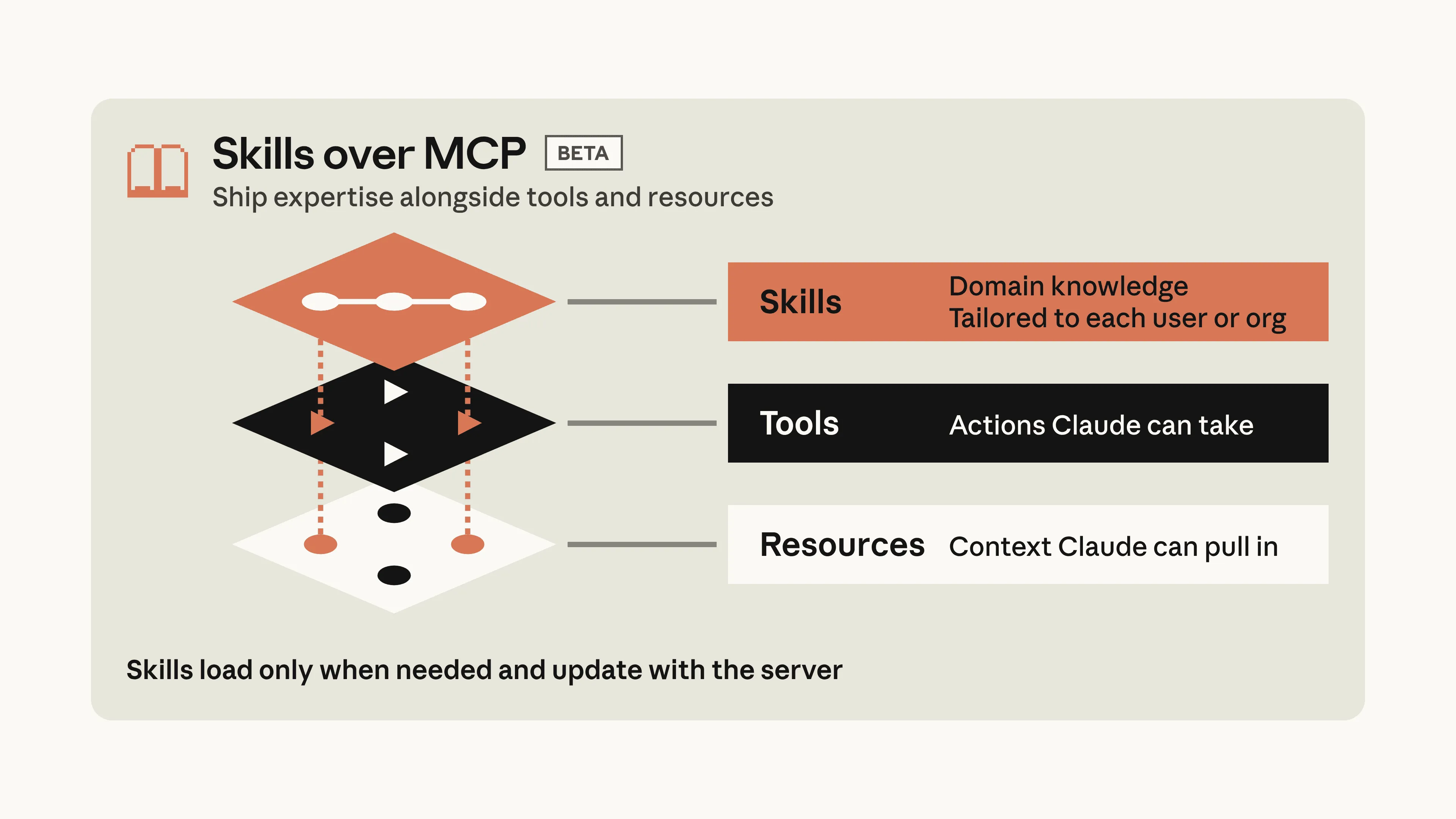
Skills over MCP has entered public beta in Claude and Claude Code. At the time of the announcement, it is enabled by default on the Pro, Max, and Ultra plans, while the Team plan requires an administrator to enable it. Enterprise support is described as coming soon, but the current Claude Code feature list states that administrator enablement is required for both Team and Enterprise, suggesting availability may have been updated after the announcement.
Under this mechanism, Claude loads a skill only when it is needed, which reduces context consumption. And because a skill updated on the server is reflected on the user side, there is no need to install or update business procedures individually.
On the implementation side, a compatible server declares the resources capability and the io.modelcontextprotocol/skills extension, implements skills/list and skills/get, and serves SKILL.md through resources/read. The skill manifest includes the URIs, byte sizes, and SHA-256 digests of SKILL.md and its related files. Before using a skill, the host verifies the file bytes and the front matter.
The important point is that file integrity and the safety of the skill itself are separate issues. A saved approval is tied to the entire combination of URIs and digests, so adding, removing, or changing even one file requires re-approval. Under the specification, skill content is treated as untrusted data, and execution or granting of permissions on the host side requires explicit approval for each skill. SHA-256 can confirm that files match what the manifest describes, but it cannot guarantee the safety of the business procedure itself.
Using skills from an MCP server in Claude Code requires v2.1.331 or later. Claude Code also ignores permission-specifying fields such as allowed-tools, which are used in local skills, for MCP skills, and does not automatically grant tool execution permissions. As a partner example, Anthropic cites Shopify, which supports merchants end to end, from designing their online stores to updating them.
With Skills over MCP, an MCP server can deliver not only a tool's functions but also how to use it and how the work should proceed. For companies adopting it, beyond the safety of the tool APIs, the content of the delivered procedures and the management of approvals at update time also become important.
Tasks Enable Long-Running Asynchronous Processing, With Compatibility Challenges
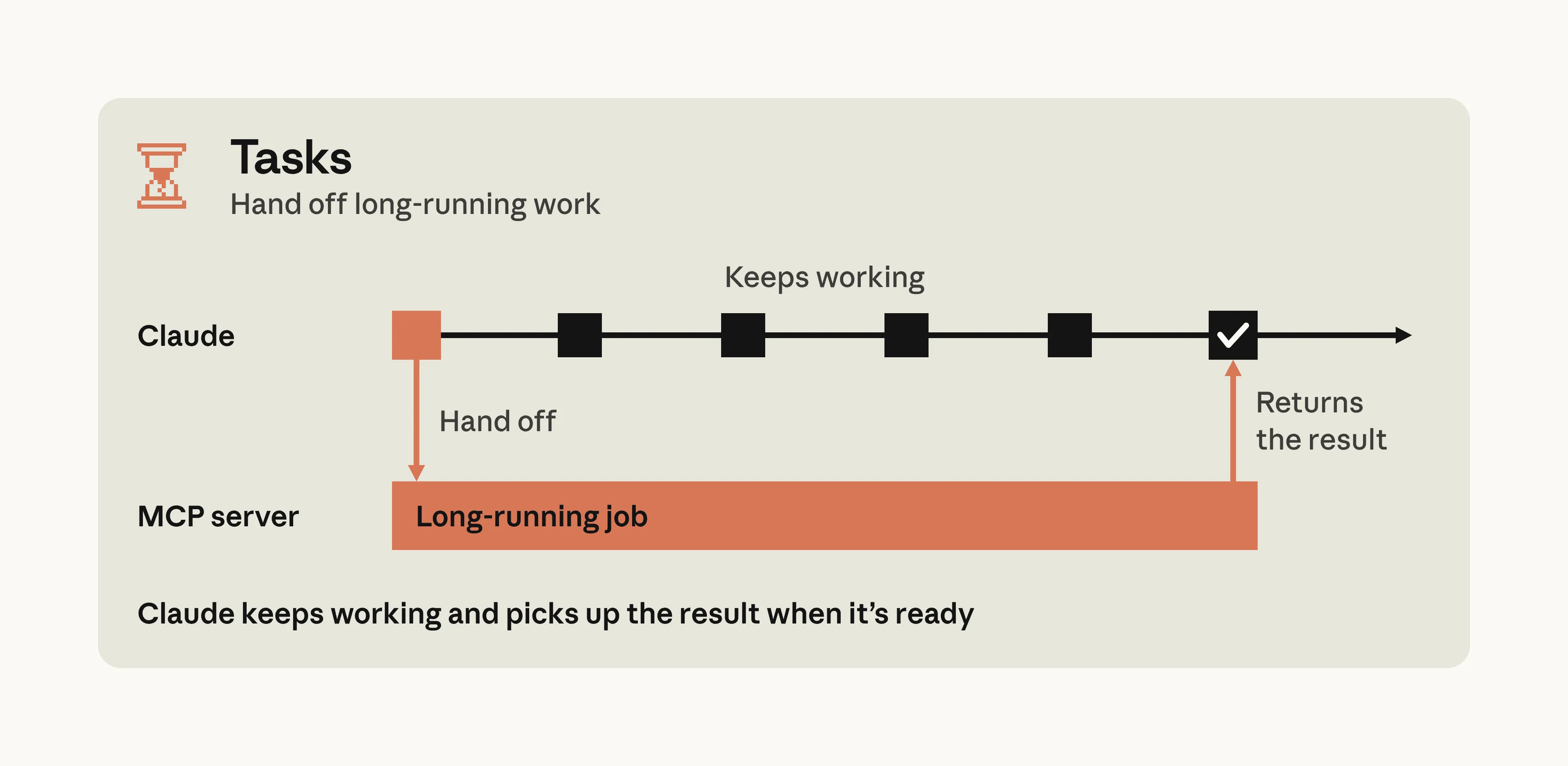
Tasks is generally available for Pro, Max, and Ultra at the time of the announcement, with rollout to Team and Enterprise also under way. The server decides whether to start asynchronous processing. In response to tools/call, instead of immediately returning a final result, the server can return a task handle that identifies the asynchronous task. The client retrieves the processing status with tasks/get and, as needed, sends tasks/update or tasks/cancel.
A task has five states: working (in progress), input_required (awaiting input), completed, failed, and cancelled. The final result and any error information are also held in the task. The server must generate a task ID for each request and persist the task so it can be retrieved by that ID before returning the handle.
The ttlMs value, which indicates a task's expiration, may change dynamically, and the server may discard the task after it expires. On the client side, persisting task IDs is recommended so that polling for status can resume after a crash or restart. For security, task IDs must be hard to guess, and authentication and authorization are required for every task-related request. The same trust model as ordinary Elicitation and Sampling applies to input requests that arise mid-task.
Compatibility with existing implementations is a point to watch when adopting it. According to SEP-2663, the experimental Tasks included in protocol 2025-11-25 and the new extension are not compatible at the wire level. To support both, an implementation must switch between the old and new approaches depending on the protocol version and capabilities agreed between client and server.
Using MCP tasks in the terminal version of Claude Code requires v2.1.304 or later and support for protocol 2026-07-28. Additional conditions apply to session types and background execution. Use in the cloud and chat versions is likewise limited to supported environments, such as claude.ai connectors that support the protocol and the new unified chat for Pro, Max, Ultra, and Team.
Anthropic says ZoomInfo, which provides research services on companies and contact information, is using Tasks for research work that previously required multiple prompts. No specific comparison data on improvements in processing time or quality has been published.
Elicitation Asks Users for Confirmation Mid-Process
Like Tasks, Elicitation is generally available for Pro, Max, and Ultra, with rollout to Team and Enterprise under way. It lets a server ask the user for consent or additional input partway through a process, and it offers two modes: form input and URL-based interaction. Once the server receives the user's response, it can resume the interrupted process, so Claude no longer has to guess at missing information and proceed.
The specification requires the client to clearly show which server is making the request and to give the user a way to decline or cancel. A user interface that lets users review and edit their input before submitting a form is also required.
Form mode and URL mode are clearly distinguished by the kind of information they handle. Requesting sensitive information such as passwords, API keys, access tokens, and payment details in form mode is prohibited; URL mode is used for entering these and for authorizing transactions. The client must display the full destination URL and obtain the user's explicit consent before opening it. Automatic URL prefetching is also prohibited, and the content of protected interactions must be isolated so that neither the client nor the AI model can access it.
In protocol 2026-07-28, the earlier server-initiated elicitation/create approach is deprecated and replaced by Multi Round-Trip Requests, which combine multiple requests and responses. The server requests additional information through an InputRequiredResult, and the client retries the original operation with inputResponses attached.
According to Anthropic, Supabase uses Elicitation to ask users for confirmation before creating paid projects or running destructive SQL operations. GitHub has also introduced a mechanism that has users type the name of the target repository before an AI agent deletes it.
File Uploads Transfer Files Directly, but the Spec Is Still Experimental
Of the four features, File Uploads is the one that had not yet launched at the time of the announcement. Anthropic plans to release it soon for Pro, Max, and Ultra, as well as eligible Team and Enterprise plans. It will let PDFs, spreadsheets, images, and other files be passed directly to an MCP server without being loaded into the model's context window. As a use case, Carta is cited as creating and issuing equity-related documents based on uploaded files. The specific release date, Claude's file size limits, and the timing of rollout completion for each plan have not been disclosed.
The File Uploads specification is currently experimental. The developer repository labels it "experimental"; it is not part of the core MCP specification and has not been submitted as a Specification Enhancement Proposal (SEP). The draft specification targets protocol 2026-07-28 and later and is designed around the io.modelcontextprotocol/files extension, but backward-incompatible changes may be made in the future.
The draft defines two transfer methods: inline base64 transfer for small files, and out-of-band upload for everything else. Only out-of-band upload can fully exclude file bytes from both the model's context and JSON-RPC messages. Before an out-of-band transfer, the host must obtain the user's approval or permit transmission to designated storage under the organization's operating policy. The server side, too, must verify that the actual received size and file type conform to its limits rather than relying solely on client-declared metadata.
Two Years On, SDK Downloads Reach 5 Billion in Total
Anthropic says the four features are based on the open MCP specification or extensions, so compatible servers can be used with any compatible client. MCP was donated on December 9, 2025, to the Agentic AI Foundation (AAIF) under the Linux Foundation. Mike Krieger, Anthropic's Chief Product Officer (CPO), said at the time that the donation to the Linux Foundation would let MCP remain an open, neutral, community-driven standard even as it grows into critical AI infrastructure.
Anthropic says MCP SDKs now see more than 700 million downloads per month, and that MCP connectors for Claude number more than 10,000. A retrospective on MCP's second anniversary published on November 24, 2026, reports more than 2,500 contributors and 5 billion cumulative SDK downloads, of which more than 4.5 billion came in the past year alone. However, download and connector counts are not direct indicators of production deployments or the number of adopting organizations, and they do not reflect support for the new extensions.
On efficiency, Anthropic says that in setups using multiple MCP servers, the context occupied by tool definitions can be reduced by more than 85%. The announcement gives no specific token counts before and after the comparison, and the reduction rate varies with configuration and usage conditions. Claude Code's security documentation also states that, while Anthropic reviews conformance to its criteria when listing servers in its directory, it does not conduct security audits of or manage third-party MCP servers.
Stateless Communication and the Growing Complexity of Server-Side State Management
MCP's architecture is also changing significantly. Protocol 2026-07-28 removes the protocol-level session management based on the earlier Mcp-Session-Id and initialize handshake, moving communication toward statelessness.
Meanwhile, business processing that uses Tasks and Elicitation still requires state management. In place of traditional session management, processing is managed through server-issued task handles, retries of operations in response to input requests, task retention periods governed by TTL, and per-request authentication and authorization. The implementation burden is relatively small for short-lived idempotent tools or environments where the SDK handles lifecycle management, but servers handling long-running asynchronous processing need a design that accounts for task persistence, recovery from failures, and permission management.
The four features announced differ in maturity: general availability, public beta, and experimental. Even for features based on open specifications, whether they can actually be used depends on the client version, the subscription plan, administrator permission settings, and protocol support. For MCP to spread as a foundation for automating a wide range of business work, it will be important to ensure compatibility across clients and to put in place fallback handling for unsupported environments along with consistent permission management.