

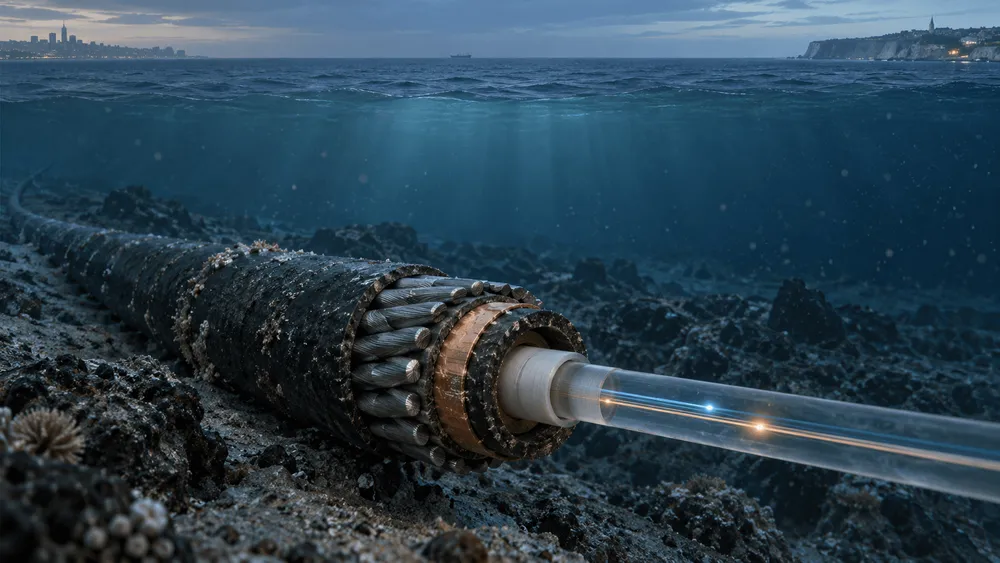
On September 21, Meta announced a new subsea fiber-optic cable called "Petal," connecting the United States and France. Spanning roughly 7,000 km, the cable targets a design capacity of 1 petabit per second (Pbps, or 1,000 Tbps) when it enters service in 2029. That's roughly double the capacity of its predecessor, "Anjana"—but Meta isn't doubling the number of fibers to get there. Instead, the plan creates two separate light paths within a single fiber, and drives the many repeaters required over a ~7,000 km cable within the constraints of existing power-feed equipment.
Joining Meta in the announcement are NEC, which is designing and laying the system, and Sumitomo Electric, which is supplying the dual-core fiber. Meta is funding the project itself and will own and operate the finished cable. On the French side, Orange is supporting the landing. Once a subsea cable is laid, its repeaters and fibers are difficult to swap out. What makes Petal technically interesting isn't the "1 Pbps" figure itself, but the fact that it doubles the number of independent optical signals that can be carried while keeping the same 24-fiber-pair structure—and extends that doubling all the way through amplification and power feeding.
Doubling capacity while keeping 24 pairs
The earlier Anjana system used 24 fiber pairs and claimed a maximum of 0.5 Pbps. Petal also uses 24 pairs—48 fibers in total. However, each fiber contains two cores through which light travels inside the glass, bringing the total number of signal paths to 48 core pairs. Among the alternatives Meta considered were increasing the fiber count to 48 pairs, or widening the optical wavelength band used. Petal instead chose to increase the number of paths within a single strand.
Converting the published design figures into capacity per spatial channel, both Anjana and Petal work out to about 20.8 Tbps: Anjana's 500 Tbps divided across 24 fiber pairs, and Petal's 1,000 Tbps divided across 48 core pairs. NEC published the Anjana figure in 2021, while Meta and Sumitomo Electric published the Petal figure in 2026. Each number represents the total design capacity of a transatlantic-class system divided evenly by the number of independent optical paths—it does not reflect the measured speed of any individual core. Even so, it offers a way to interpret what the doubled headline figure actually means. Rather than raising the published capacity of each individual path, the design increases the number of paths carried within a cable of the same diameter.
Meta lists both expanding to 48 fiber pairs and widening the wavelength band as options it considered. But adding more fibers also means more optical paths and amplifiers to manage inside each subsea repeater. Expanding the wavelength band, meanwhile, requires amplifiers and terminal equipment that can handle that wider band. Petal opted to increase the number of optical paths without increasing the cable's cross-section, by placing two paths within a single fiber. The published cost data isn't enough to say which approach is generally cheaper.
Putting two cores inside a fiber with a 125-micrometer outer diameter raises concerns about signal loss and crosstalk—interference leaking into the neighboring core. According to Meta, Sumitomo Electric addresses this using high-purity silica materials, precise control of the refractive index around each core, and a design that sends the two signals in opposite directions. Simply adding a second core doesn't automatically double capacity; the signal quality must remain distinguishable at the receiving end across the full ~7,000 km span.
Amplifying 96 cores' worth of signal undersea
Over transatlantic distances, light signals weaken along the way. Meta explains that a cable of roughly 7,000 km typically requires around 100 repeaters. Petal's 24 pairs times 2 cores requires amplification paths for a total of 96 cores, counting both directions. Making the fiber dual-core alone doesn't increase capacity unless the undersea amplifiers can also handle both cores.
In the repeater design NEC developed, light entering from the dual-core fiber is temporarily split into two single-core paths, amplified separately, and then recombined back into the dual-core fiber. This split-and-recombine junction bridges the new fiber type with conventional single-core amplification technology. The 96 amplification paths are packed into a single housing, sharing pump light used for amplification. The technical challenge lies in keeping the losses introduced by this conversion low enough to stay within the power that can be delivered undersea.
Meta describes Petal as designed to operate within 18kV, the upper limit of existing power-feed equipment. Sumitomo Electric's joint announcement adds that the design densely packs 48 amplifier pairs and can even operate on power fed from just one landing station. This is meant to leave room for continued operation if power feed is lost from one side. However, single-side power feeding does not mean communication can continue if the undersea fiber itself is physically severed. A power-feed fault and a physical cable break are separate types of failure.
If this configuration works as planned, it could reduce the amount of cable material and the number of undersea repeaters needed compared with laying two separate 0.5 Pbps-class cables. Meta claims this could reduce resource use and carbon emissions, but the announcement includes no quantitative lifecycle comparison between Petal and two conventional systems under equivalent conditions. For now, this should be read as a stated design goal for energy efficiency, not a verified outcome.
What it takes for 1 Pbps to reach users
1 Pbps is not the volume of traffic Petal is actually carrying as of 2026—it's the design capacity of the entire system, scheduled to enter service in 2029. Subsea cables don't necessarily use their full capacity the moment they open; terminal equipment is built out and wavelength-based circuits are activated progressively. Petal's initial opening capacity, the configuration of its terminal equipment, its actual operating power, and the terms under which capacity will be made available have not been disclosed. Nor is it accurate to assume that individual households' or businesses' connection speeds will simply double. The design capacity of the undersea segment is a different quantity from the connection speed determined by access lines, terrestrial switching equipment, and the servers being connected to.
Capacity and latency should also not be conflated. Increasing the amount of data that can be carried per second does not shorten the time it takes light to physically travel roughly 7,000 km. Since the exact routing and any terrestrial detours have not been finalized, it's not possible to assess how much Petal will change round-trip response times between the US and Europe. What the announcement commits to is the system's overall transport capacity—not application response speed.
It's also worth considering who actually owns that capacity. According to Sumitomo Electric, Meta is funding Petal and will own and operate it. TeleGeography, a telecom market research firm, has found that content providers hold 93% of deployed transatlantic capacity, and that this capacity doesn't readily flow into the wholesale market. Capacity that a content company allocates to its own inter-data-center traffic must be counted separately, in market terms, from capacity that telecom carriers can sell to third parties. For Petal, whose investor is Meta, it isn't clear what proportion the company will use internally versus make available externally. TeleGeography's 93% figure doesn't describe Petal's specific sales policy, but it illustrates that even as total undersea capacity grows, the bandwidth telecom carriers can purchase—and its price—won't necessarily change by the same proportion.
And making one cable thicker doesn't add a separate physical route. Meta says Petal is intended to improve the reliability of connectivity to Europe, but the benefits of route diversity also depend on landing points, distance from existing cables, and connections into terrestrial networks. While Orange will support the landing and connection into Europe's network on France's Atlantic coast, the specific landing site on the US side and the full route have not been confirmed in this announcement. Where the terrestrial network connects after landing also matters for actually using the undersea segment's capacity. Even if there's ample capacity undersea, the usable bandwidth will be constrained if the connecting infrastructure beyond the terminal station is limited.
What Petal demonstrates is a path toward expanding optical signal paths into two cores within a fiber, and integrating that into a commercial system—including undersea repeaters and power feeding. Once the actual opening capacity, single-side power-feed operation, and degree of route diversity are shown in 2029, it will be possible to judge how much of that designed 1 Pbps translates into real network capacity.