

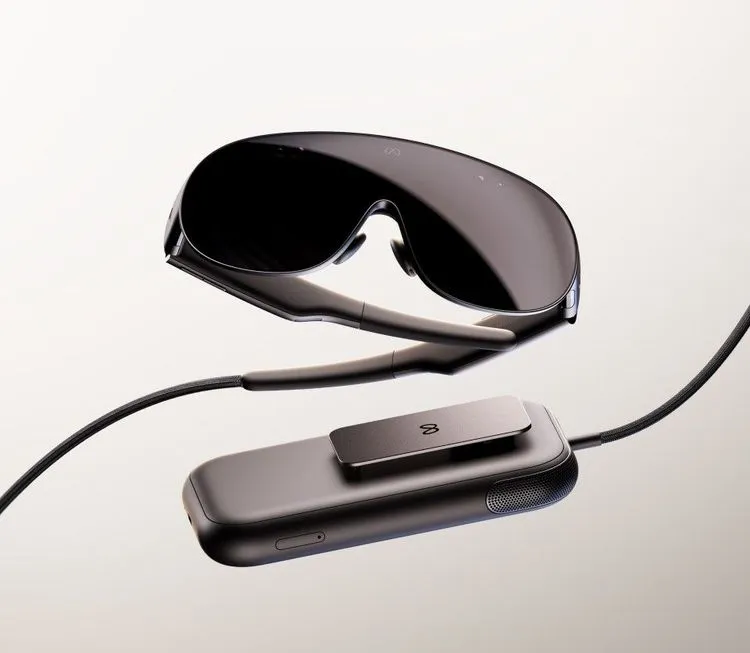
On September 23, 2026, Meta announced "Meta VR Glasses," a device featuring a display and cameras for viewing your surroundings. The glasses themselves weigh about 100 grams. The design moves the compute unit and battery away from the face and into a small separate puck connected via a fiber-optic cable. The product is slated to launch in spring 2027 at $1,299.99.
Meta is promoting the device as delivering experiences like a portable movie theater, a portable work setup, and a portable game console. However, if you interpret this product merely as "a VR headset that now weighs 100 grams," you risk missing the full picture. Exactly what portion weighs about 100 grams? And in exchange for high-resolution display quality, how much field of view did Meta trade away? These two questions need to be considered together.
The 100 grams refers to the glasses alone — the compute unit and battery are separate
According to Meta's announcement, the glasses house the display and sensors, while compute processing, battery, and storage have been moved to a separate unit that fits in a pocket or bag. The glasses and the separate unit are connected by a fiber-optic cable.
This is a reasonable approach for reducing the weight resting on your face, but it doesn't mean the offloaded components have disappeared. According to Road to VR's reporting on the specs, the separate unit weighs about 300 grams. However, this approximately 300-gram figure does not appear in Meta's official announcement text.
In other words, the roughly 100-gram figure refers only to the weight of the glasses portion — in actual use, you'll also be carrying the separate unit and the fiber-optic cable.
Similarly, Meta's stated display sharpness of 37 PPD needs to be considered alongside the 70-degree horizontal field of view reported by Road to VR.
When it comes to weight, there's a difference between "weight resting on your head" and "weight carried in a pocket or bag." When it comes to display quality, there's a difference between "how finely detailed the image appears" and "how wide the field of view is." These factors can't simply be combined into a single overall number.
The total system weight, including cables and accessories, also cannot be confirmed from the materials available at this time.
| What to check | What the announcement and reporting reveal | Points to keep in mind |
|---|---|---|
| Weight on the head | The glasses alone weigh about 100g and house the display and sensors | This is not the total system weight |
| Separate unit | Houses compute, battery, and storage, connected via fiber-optic cable. Road to VR reports its weight at about 300g | Cable routing and how the unit is carried affect usability in ways weight alone doesn't capture |
| Display sharpness | Meta states 37 PPD. Road to VR reports per-eye resolution of 2412×2288 pixels | PPD alone doesn't tell you how wide the field of view is |
| Field of view | According to Road to VR, 70 degrees horizontal, 66 degrees vertical | How narrow this feels depends on the use case |
Meta describes the device as "one-fifth the weight" of Quest 3, but this comparison applies specifically to the glasses portion.
For sitting on a couch watching a movie, the reduced pressure on the face could be a significant advantage. On the other hand, for games that involve standing and moving your body, or for work that involves moving between seats, comfort will also depend on how the pocketed separate unit and its cable are managed.
These are evaluation points that can be inferred from the specifications — they are not conclusions already demonstrated through extended real-world use.
High-resolution 37 PPD display and wide field of view are separate performance metrics
The display Meta calls the "5K Infinite Display" uses micro-OLED panels paired with compact pancake lenses.
Meta's stated figure is 37 PPD (pixels per degree) — meaning 37 pixels are displayed per degree of field of view. Road to VR reports a per-eye resolution of 2412×2288 pixels, with a field of view of 70 degrees horizontal, 66 degrees vertical, and 88 degrees diagonal.
Rather than simply looking at the "5K" label, it's easier to picture real-world use by separating PPD — which indicates how finely detailed the image is — from field of view, which indicates how much of your surroundings you can see.
PPD measures how many pixels are packed into each degree that your line of sight shifts. A higher value means finer rendering of text and lines at the same apparent size.
However, concentrating pixels into a limited field of view can raise PPD without necessarily widening the overall field of view.
In its comparison with Quest 3, Road to VR reports that Meta VR Glasses achieves higher pixel density but a narrower field of view. In other words, Meta hasn't simultaneously achieved both higher resolution and a wider field of view.
In Road to VR's brief hands-on with the device, the outlet praised the black-level reproduction and image sharpness, while noting that the 70-degree horizontal field of view is noticeably narrower than Quest 3's.
For use cases like watching a movie head-on or reading text across multiple virtual displays, the high level of detail could prove valuable. On the other hand, for games that rely on peripheral vision while moving, the narrower field of view could become a noticeable drawback.
However, exactly how much this matters for which use cases will require testing with the retail version once it launches.
Gaze- and hand-based controls, but comfort assessments remain based on brief trials
Meta demonstrated a mode of interaction where users select targets with their gaze and control the device using hand gestures or voice commands.
The device also supports full-color passthrough video for viewing your surroundings, allowing virtual screens to be overlaid on desks or smartphones. Being able to select a movie or move a virtual work screen without holding a dedicated controller fits well with the design goal of minimizing the size of the head-worn unit.
According to Road to VR, a Touch Plus controller designed for Quest can also be used separately if needed.
The outlet's reporter noted that while seated, downward-facing sensors recognized hands resting on the lap, and that gaze-based selection combined with finger gestures felt natural to use.
Regarding color passthrough, the reporter noted no visible seams in the video feed, no noticeable lag, and no significant distortion of nearby objects.
However, these impressions are all based on a brief demo experience at the event venue, not on measured performance across varied lighting conditions and applications.
The same hands-on report also highlighted the importance of choosing the right size.
The reporter found the larger size comfortable, but reported that the smaller size felt tight around the temples and tended to slip off the nose. According to Road to VR, the product will be sold in two sizes, with interchangeable nose pads also available.
Even though the glasses portion weighs the same roughly 100 grams, comfort will vary depending on face width, nose shape, and how well the nose pad fits.
Since the trial lasted only about 30 minutes, it remains unclear whether the device stays comfortable through an entire feature-length film, or whether it can be used continuously for hours of work.
Movies, work, and gaming each demand different conditions
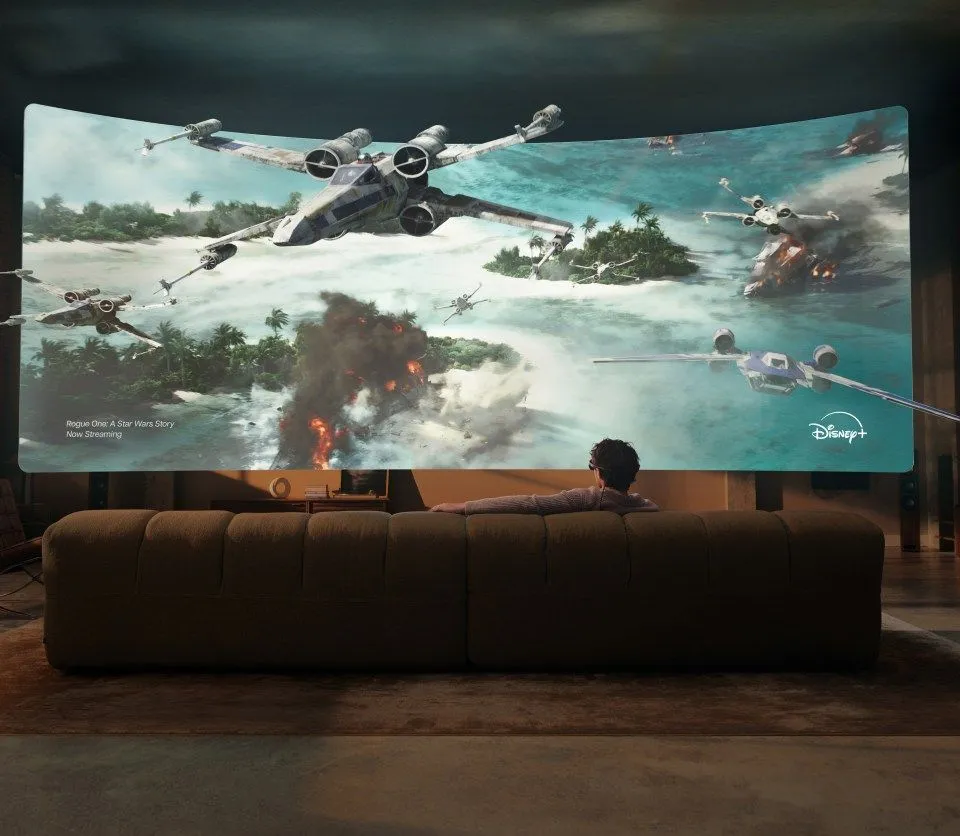
The use case Meta is emphasizing most strongly is a personal movie theater experience.
Meta announced IMAX Enhanced certification along with support for Dolby Vision and Dolby Atmos. Disney+ plans to stream some 3D films starting in November 2026 in select regions, but this is a service plan that begins before the glasses even launch — it does not guarantee that the same titles will be available for viewing in Japan.
For ILM's "Disney Immersive Cinema," not only the film itself but also the surrounding virtual environment is said to change to match the content.
It's important to distinguish between simply watching a movie on a giant screen and an immersive experience where even the space surrounding the film has been designed as part of the presentation.
For sports, Meta is promoting immersive live-streaming video, stating plans to offer more than 100 immersive live broadcasts per year following the glasses' launch.
However, this does not mean 100 broadcasts are already available to watch on this device right now. The actual value will depend on which sports are covered, which countries get the broadcasts, and whether additional subscriptions or fees are required.
For both movies and sports, what matters isn't just display performance but the actual depth and availability of content you can watch.
For work use, Meta has highlighted features for displaying multiple virtual monitors and for turning flat surfaces into virtual keyboards or touchpads.
Road to VR also reports on features for mirroring Mac, PC, and smartphone screens, as well as a wired video input function compatible with DisplayPort-equipped devices.
However, specifications alone can't tell you how accurately you can type on a virtual keyboard, how many hours you can comfortably read fine text, or how practical it is to move between seats while staying connected via cable.
For gaming, Meta says it will offer more than 75 titles playable using hand tracking alone at launch, along with support for cloud gaming.
According to Road to VR, users can also access existing titles from the same store used for Quest, and titles requiring a physical controller can use the separately sold Touch Plus.
However, "more than 75 titles playable with hand tracking alone" is not the same as "every existing Quest game playable with the same control scheme." The number of supported titles alone cannot tell you how well this functions as a game console overall.
What to verify before the spring 2027 launch
Meta's stated battery life is "up to 3 hours of continuous high-resolution media playback," and the device supports 45W fast charging.
However, this figure does not represent battery life during continuous hand-tracking gameplay or while working with multiple virtual screens displayed at once.
Whether you can watch an entire movie also depends on more than just the film's length — it depends on how much you're using passthrough and audio features, and whether you're in an environment where you can charge while watching. Road to VR reports that the device can be used while charging.
The launch is planned for spring 2027, with a US price of $1,299.99.
Japan is among the regions Road to VR reported as planned launch markets, but Meta's official announcement does not yet specify a Japan launch date or a yen-denominated price.
Which movies and sports streams will be available in Japan, and what accessories will be included at the point of sale, will need to be confirmed through an official announcement specific to that market.
The true value of this product's defining "about 100 grams" feature will ultimately become clear only once people use the retail version for extended periods.
Will it remain comfortable through an entire feature film? And beyond that — factoring in the separate unit reported at about 300 grams, along with the fiber-optic cable — can the whole system be used comfortably in everyday life?
Evaluating the lightness of Meta VR Glasses requires looking not just at the weight of the glasses themselves, but at the usability of the system as a whole.