


On October 27, 2026, US-based Tesseract Ventures announced plans to develop "Synthetic Brick Technology Kits," which integrate interlocking wall blocks with purpose-specific equipment. Working with wall-material maker Lok-N-Blok, the company aims to serve uses such as drone bases and construction-site facilities. This is not an announcement of a finished product going on sale.
Instead of converting shipping containers or existing buildings, the concept designs walls, power, communications and other systems together from the start. The idea is to pack components compactly, carry them to a location, assemble them near the point of use, and disassemble and redeploy them as needed.
Storing and launching drones requires different equipment than managing entry and exit at a construction site. The aim is to combine the same structural material with different functions for each use, but two things need to be checked separately: whether the walls can be reassembled, and whether a site that includes equipment still works after being relocated.
Designing a site around its use, not retrofitting a box
According to Tesseract's announcement, Lok-N-Blok would supply the structural material, while Tesseract would handle customer-specific design, equipment and software integration, deployment, and subsequent lifecycle management. The concept targets defense, construction, critical infrastructure and agriculture, starting with small surveillance and access-control installations and expanding from there.
The company wants to combine standard structural material with technology packages to reduce full redesigns for each project. Candidate payloads include sensors and cameras, on-site data processing, signal shielding, and drone storage and launch functions. These are options matched to the application, not a promise that everything will come as standard.
According to the company's description, NOMAD, its drone operations platform, combines power and communications with storage and launch functions for the STRIKER unmanned aircraft. NODE, by contrast, is aimed at construction-site entry and exit management. The company also cites Site Manager, a digital-twin software that maps people, equipment and sensors to geographic information.
In July of the same year, Tesseract announced that it had been selected for a prototype project by the US Defense Innovation Unit (DIU) for CADDS, a containerized autonomous drone delivery system. At that time it described NOMAD as a containerized mobile platform and planned to take part in demonstrations to verify operational performance. The new concept does not amend that contract or replace the container approach entirely.
Even Lego-like walls need foundations and wiring
The walls are made from Envion, Lok-N-Blok's proprietary composite based mainly on polypropylene. According to the product description, the blocks interlock side to side and are stacked to follow the shape of the receiving block. They can be assembled without mortar or adhesive, but they must be anchored to an engineered foundation with anchor bolts, and the top of the wall must be secured.
The Lego comparison alone obscures this anchoring step. The concept also includes routes inside the wall material for wiring and piping, so the process of fitting equipment after the structure is erected has to be considered as well.
Tesseract proposes packing digitally designed components compactly and shipping them on pallets. Rather than moving a finished box, the idea is to carry the needed structural material and equipment and assemble near the site. The aim is to ease the burden of transport and construction, but no measured figures on how much these kits would reduce it have been published.
Between reconfigurable walls and a usable site
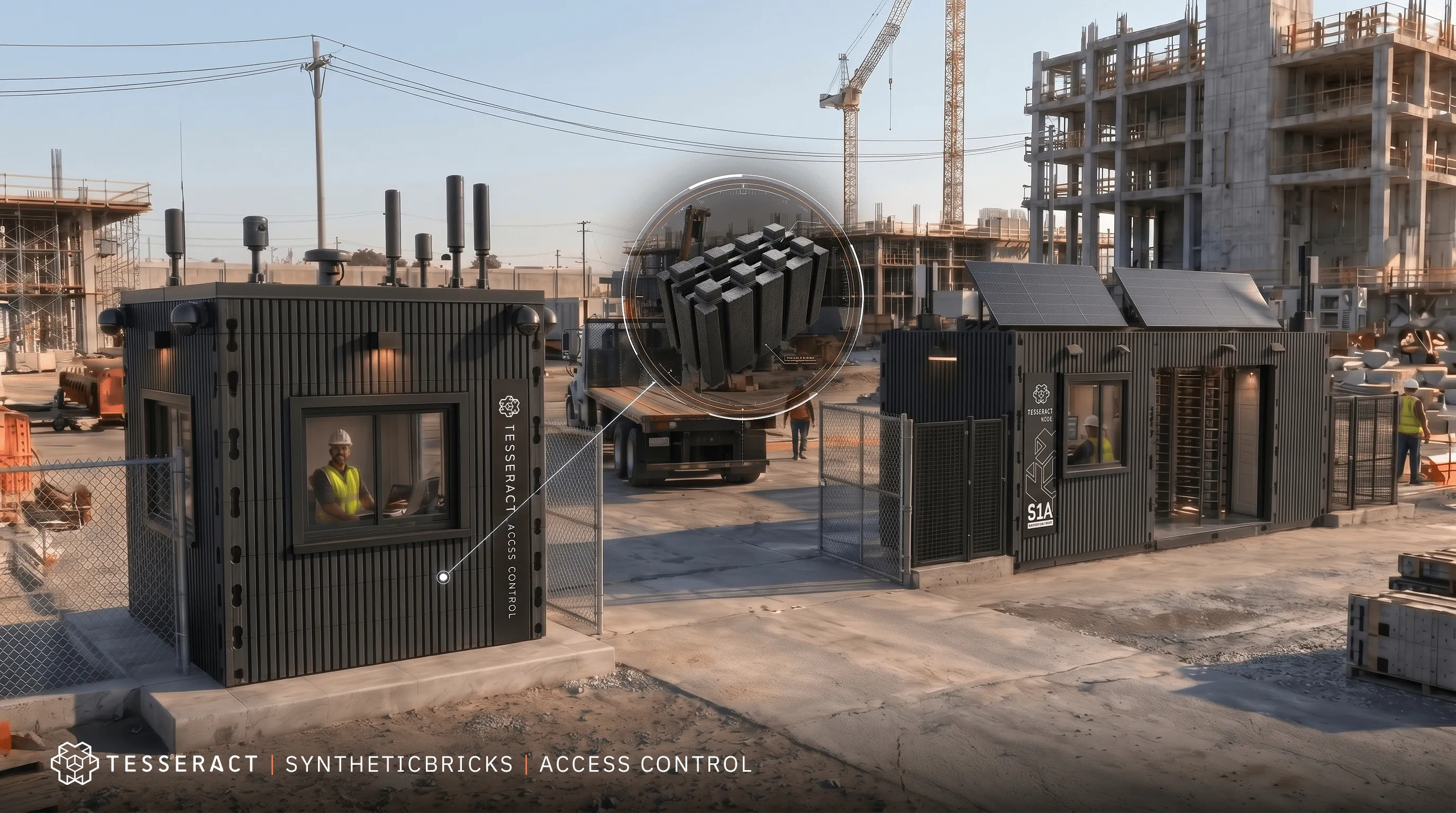
Testing whether walls can be reassembled is a different verification from showing that a relocated site loaded with equipment performs the same way.
The table below organizes company-published materials as of October 2026 into wall material, equipment integration, and post-relocation operation. The wall material and the integrated kit are separate subjects, and the classification is based on the manufacturers' own descriptions.
| Subject / stage | Published milestone | Still to be confirmed |
|---|---|---|
| Wall assembly and reassembly | Foundation anchoring and top-of-wall fastening. Prototype wall dismantled under controlled conditions | Long-term disassembly and rebuild data are not statistically sufficient, and are separate from whole-building performance |
| Structure and equipment integration | Development concept designing power, communications and more together | Operating results and continuous operating time for this integrated kit are not confirmed in public materials |
| Operation after relocation | Disassembly and redeployment is a development goal | Whether a site including equipment can perform the same after relocation is not confirmed in public materials |
Lok-N-Blok says that dismantling a prototype wall confirmed the mechanical principle of reuse. It does not, however, guarantee that every block will remain intact after a destructive event. A wall demonstration cannot simply be treated as redeployment performance for a site that includes equipment.
In the company's performance explanation, statements about wind resistance are likewise limited to the wall assembly and its design conditions. Whole-building performance depends on the design of the foundation, anchoring, roof and openings, as well as on construction, inspection and local approval. The company says Florida product approval, Miami-Dade Notice of Acceptance (NOA) and a comprehensive ICC-ES report are under review or in progress.
The wall material's roadmap sets initial commercial production and shipments as a goal for the fourth quarter of 2026. That is not a launch date for the integrated kits. Efforts to stack the wall material with robots are at the research stage, and are separate from the idea of equipping the kits with robotic fabrication equipment.
To decide whether to adopt it, buyers would need to know price, lead time, and the number of people and hours needed for assembly, and confirm that power, communications and purpose-specific equipment still meet required performance after disassembly, transport and reassembly. If the structural material and equipment can be reused, the concept moves closer to its stated goal: combining standard structural material with technology packages to cut full redesigns for each project while allowing sites to be redeployed.