

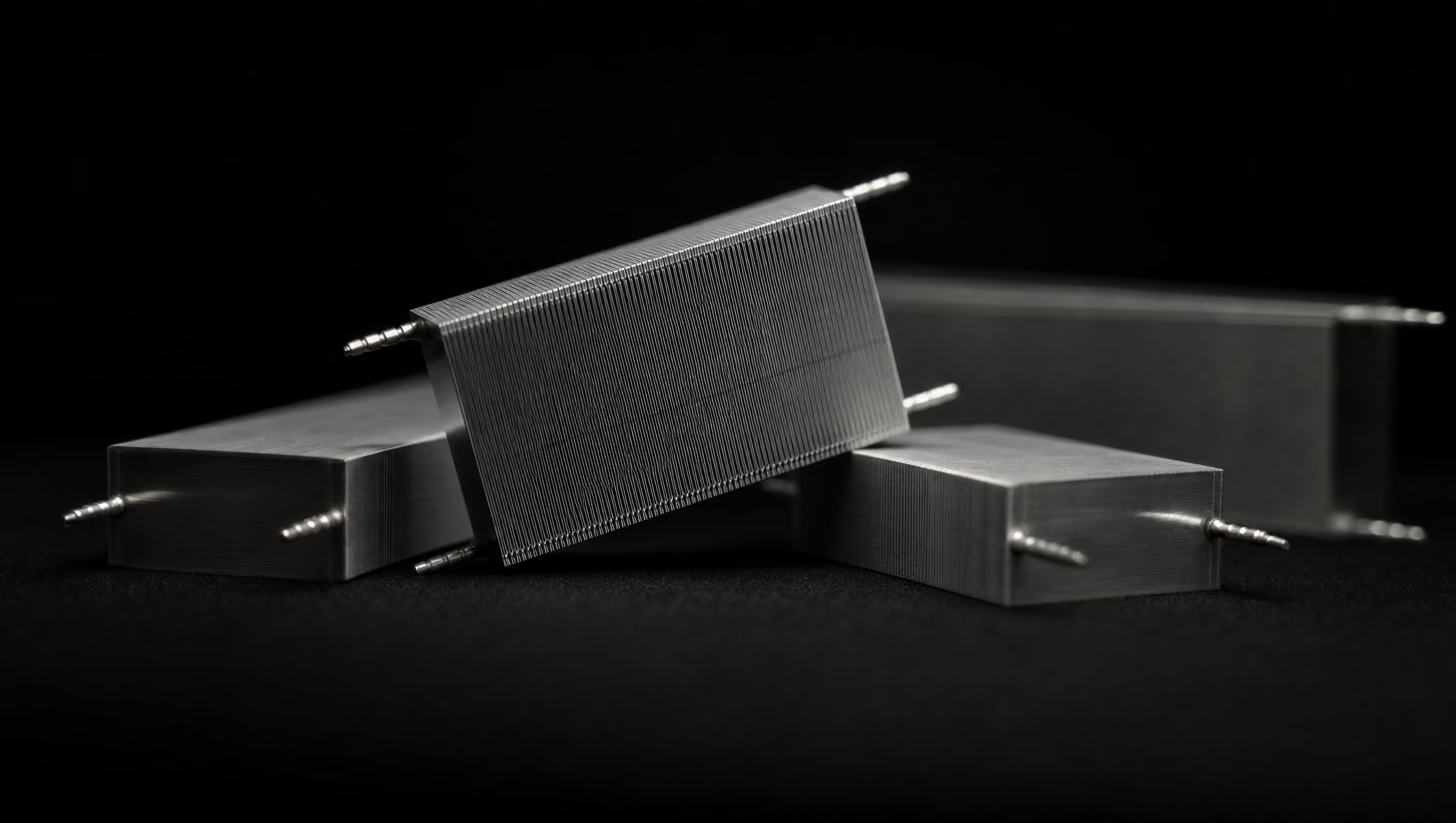
On September 24, 2026, Noctua announced joint research with the U.S. company Forced Physics DCT on applying "JouleForce," an air-cooling technology that uses micro-channels, to desktop PCs and workstations. The developer says the technology targets a range of 500 to over 2,000W, and the effort is an attempt to bring it to quiet PCs. However, this is not a plan tied to a specific product or release date, and current implementations require equipment such as industrial blowers. To gauge how much to expect, it helps to separate the ability to remove heat from the conditions needed to move the air that does it.
Micro-channels that absorb heat, and a mechanism that draws in air
JouleForce passes air through a "micro-channel array," in which many fine channels are lined up, and collects heat from the channel walls. According to Forced Physics' technology description, a fan or blower creates a pressure difference across the device and pulls air into the channels. The warmed air leaves through an exhaust path.
What the developer is trying to change is how the heat-dissipating surface meets the air. The company says the channel geometry enhances heat exchange at the walls, so that the boundary layer that impedes heat transfer in conventional air cooling does not form sufficiently. It is a different approach from simply blowing a large volume of air, but it is too early to treat even the molecular-scale explanation as proven. The evaluation report discussed below also states that additional effects arising at that scale were outside the scope of this preliminary evaluation.
The publicly shown prototype for SP5 combines a vapor chamber, which spreads heat from the source, with fine fins. A suction hose is connected to the space covering the top, and air is drawn up from the base side of the fins. The part that carries heat, the part that transfers heat to the air, and the path the air takes through it work together as one unit.
Understanding this structure also clarifies what the "avoiding the complexity of water cooling" pitch means. What it aims to eliminate is the piping and distribution equipment that circulate coolant externally. The product page describes a sealed two-phase vapor chamber, so it should not be portrayed as a cooler that uses no liquid at all, even internally. A device to move the air is also still required.
From the standpoint of mounting it in a PC, a major difference is whether the heat sink alone can be swapped in. Even if contact between the heat source and the heat sink is good, if air bypasses the channels rather than passing through them, heat cannot be removed under the intended conditions. Bringing JouleForce to PCs is not simply a matter of replacing large conventional fins with fine ones as a standalone component.
Separating "2,000W" from the 700W in the public test
Forced Physics' product page presents 500 to over 2,000W as the platform's target power range. It also states that units are prototyped and evaluated to fit the customer's socket and chassis. The 2,000W figure therefore cannot be read as the rated heat load of a Noctua CPU cooler.
Dividing the published material into target, measurement and research stages, the current position looks like this.
| Published figure or plan | What it indicates | Conditions for application |
|---|---|---|
| 500 to over 2,000W | Target power range advertised by Forced Physics | Description of a platform premised on individual prototyping and evaluation |
| 700W, thermal resistance 0.06°C/W, 65°C, airflow 45 SCFM | Test at Forced Physics on the SP5 prototype, stated in Conclusion 2 of the evaluation report | Not a result from a finished Noctua product or from inside a quiet PC chassis |
| Application to desktop PCs and workstations | Joint research with Noctua announced on September 24, 2026 | No specific product or release date has been set |
The table classifies the product description, page 6 of the evaluation report and Noctua's announcement, all checked as of September 27, 2026. 2,000W+ is the developer's target range, 700W is a test whose conditions are stated in the report, and installation in a quiet PC is research that is only now beginning; these are not figures at the same stage of demonstration.
The report's author is Alfonso Ortega, who studies heat and fluids at Villanova University. However, the opening explicitly states that he wrote it as a technical consultant to Forced Physics. According to the report, thermal resistance and pressure drop were re-measured in the university's lab and agreed with the developer's data to within roughly ±3 to 5%. Reproduction of results in an outside lab has value, but it cannot be recast as a third party unrelated to the developer vouching for the whole product.
The test setup also deserves attention. The report describes a configuration in which the prototype is attached to an electric heater block and drawn through by a centrifugal blower. The 65°C in the 700W entry is a value the report gives as a junction temperature, but this description does not allow us to conclude that a commercial CPU was actually run at 700W. SCFM is a unit for volumetric flow converted to standard conditions; it is not a value for rotational speed or noise.
Thermal resistance is an indicator of how much the heat source's temperature rises above the intake air, divided by the heat input. The lower it is, the smaller the temperature difference needed to remove the same amount of heat, making it a useful clue for comparing cooling performance. But it depends on airflow and mounting conditions. Holding the thermal resistance at one measurement point fixed and extrapolating to 2,000W does not amount to a performance guarantee for a product.
These materials give grounds for continuing research on handling high heat output with air. But what a buyer wants to know is how many watts their own CPU and case can handle at an acceptable noise level. There is still distance to be verified between a prototype's thermal performance and a product's usability.
Lower airflow does not necessarily mean a quieter PC
What Noctua is tackling in the joint research is a pressure drop more than an order of magnitude above the operating range of ordinary axial PC fans. The company explains that JouleForce is currently used by ducting it to industrial blowers, high-speed centrifugal fans, vacuum pumps and similar equipment. It says that simply spinning faster or adding stages would not stay within the quietness desktops demand.
Airflow and pressure play different roles. Airflow is how much air is moved, while pressure relates to the conditions needed to push air through a flow path that resists it. Even if heat can be absorbed efficiently with little air, if a large pressure difference is needed to push that air through narrow channels, a different burden remains on the blower side. "It needs less airflow" alone does not let us conclude that fan power consumption and noise will be small as well.
The evaluation report's pressure-drop comparison with a conventional heat sink must be read with this distinction in mind. Showing good performance against the comparison target used in the test is a different condition from fitting within the operating range of the quiet PC fan you have at hand. That Noctua cites high pressure as a challenge does not make the thermal measurements meaningless, and good measurement results do not mean quietness has been solved.
Noctua also cites the difficulty of reconciling an airtight structure that prevents air leakage with PC case dimensions and ease of swapping parts. In a desktop where users rearrange components, maintaining the prescribed intake and exhaust path is itself a design challenge. Even if the heat sink is small, if the required blower and ducting cannot be installed, the advantage for PCs fades.
What the two companies are exploring is either reducing the required pressure or finding a way to generate that pressure within the constraints of a PC. If they can later measure cooling capacity and noise together in an actual chassis, and also show the power used for airflow, there will be a basis for comparison with existing air and water cooling. Whether they can meet those conditions while maintaining high thermal performance is the test. Only then can it be assessed as an option for cooling high-power PCs without external liquid-circulation equipment.