


Throw a stone into a still pond, and ripples spread evenly outward from the center. But what if those ripples surged toward only one shore, amplifying dramatically as they went, while never reaching the opposite bank at all? That would be a world in which the physical laws we intuitively understand are fundamentally warped. And now, at the frontier of quantum mechanics, essentially this same behavior has been confirmed in electrons.
Breaking Free from the Closed World──A New Map Called "Non-Hermitian"
Quantum mechanics has long been built on the premise of closed systems that do not exchange energy with their external environment. This framework is known as Hermitian physics, in which the conservation of energy holds strictly and the probability of transitioning from one state to another is equal in both directions. The probability of an electron moving from A to B is exactly the same as the probability of it moving from B to A. The Hamiltonian—the matrix representing the total energy of the system, which sits at the core of the calculations—preserves a mathematically elegant symmetry.
Real physical systems, however, are never perfectly isolated. If you cut out and observe a part of a system, there is always some dissipation of energy to the outside, or injection of energy from the outside. The mathematical framework for describing such open systems is non-Hermitian physics. In non-Hermitian systems, the eigenvalue equation takes the form , where the real number directly represents effects such as amplification or dissipation of energy.
In such systems, the balance between the two directions breaks down. The system exhibits extreme directional dependence, giving rise to strange phenomena such as the non-Hermitian skin effect (NHSE), in which waves or electrons pile up exponentially at a particular boundary.
Until now, physicists have demonstrated this phenomenon in the laboratory using macroscopic artificial metamaterials—optical systems with precisely arrayed optical resonators, or electrical circuits with complex wiring of resistors and amplifiers. Drawing out this asymmetric effect naturally inside a single solid-state material, where countless electrons interact in complex ways, has been considered extremely difficult. A research team from Penn State University and Saint Louis University broke through this barrier by exploiting the properties of a special topological material.
Chiral Edge States Set the Stage for the "Hatano-Nelson" Model
The key was a substance known as a quantum anomalous Hall (QAH) insulator. The research team grew a chromium-doped bismuth-antimony-telluride thin film () on a strontium titanate () substrate. Topological insulators possess the unusual property of being insulating on the inside while conducting current without dissipation only on their surface or edges.
Synthesizing this material demands extremely advanced crystal growth techniques. The thin film was stacked atomic layer by atomic layer using molecular beam epitaxy at Penn State University's Two-Dimensional Crystal Consortium (2DCC), supported by the U.S. National Science Foundation (NSF). The vapor pressure ratios of the constituent elements were tightly controlled in order to prevent the formation of tellurium vacancies and to achieve a true charge neutrality point (CNP). By introducing magnetic doping with chromium, special current channels called chiral edge states were created at the edges of this material. Within these channels, electrons continue to flow in only one predetermined direction, without scattering off impurities and reversing course.
The research team fabricated this material into a ring-shaped, multi-terminal device based on a Corbino geometry. Multiple electrodes were arranged around the inner and outer circumferences of the ring, and these were treated as sites (points) in a one-dimensional lattice. In an ordinary material, electron hopping between adjacent electrodes would occur equally in both directions. Because chiral edge states are present here, however, an extreme asymmetry arises in the conductance between adjacent electrodes.
This means that the Hatano-Nelson (HN) model—a representative theoretical model in non-Hermitian dynamics—was, in effect, imprinted directly inside a physical solid-state device. The HN model is a theory describing an asymmetric system in which the probability of hopping to the right differs from the probability of hopping to the left, and the QAH insulator naturally possessed this ultimate asymmetry.
| Feature | Conventional non-Hermitian research platforms | This study's quantum anomalous Hall (QAH) platform |
|---|---|---|
| Physical substrate | Optical resonator arrays, macroscopic LC electrical circuits, acoustic metamaterials | Chromium-doped bismuth-antimony-telluride thin film (a natural electronic system) |
| Operating scale | Millimeters to centimeters (macroscale) | Nanometers to micrometers (quantum scale) |
| Origin of non-reciprocity | Artificial design using external amplifiers and isolators | Chiral edge states arising from the material's intrinsic magnetism and topology |
| Need for external magnetic field | An external field is essential when mimicking this in electronic systems | Self-driven at zero external magnetic field (0 T) thanks to magnetic doping |
Observing the "Skin Effect" as Electron Waves Pile Up in a Corner
When the one-way nature of electrons shapes a non-Hermitian system, what happens across the entire device? The research team connected specific electrodes on the ring with variable resistors and conducted experiments in which the boundary conditions of the circuit were continuously varied. They transitioned the system from a periodic boundary condition (PBC), in which the ring is completely closed, to an open boundary condition (OBC), in which some of the connections are severed.
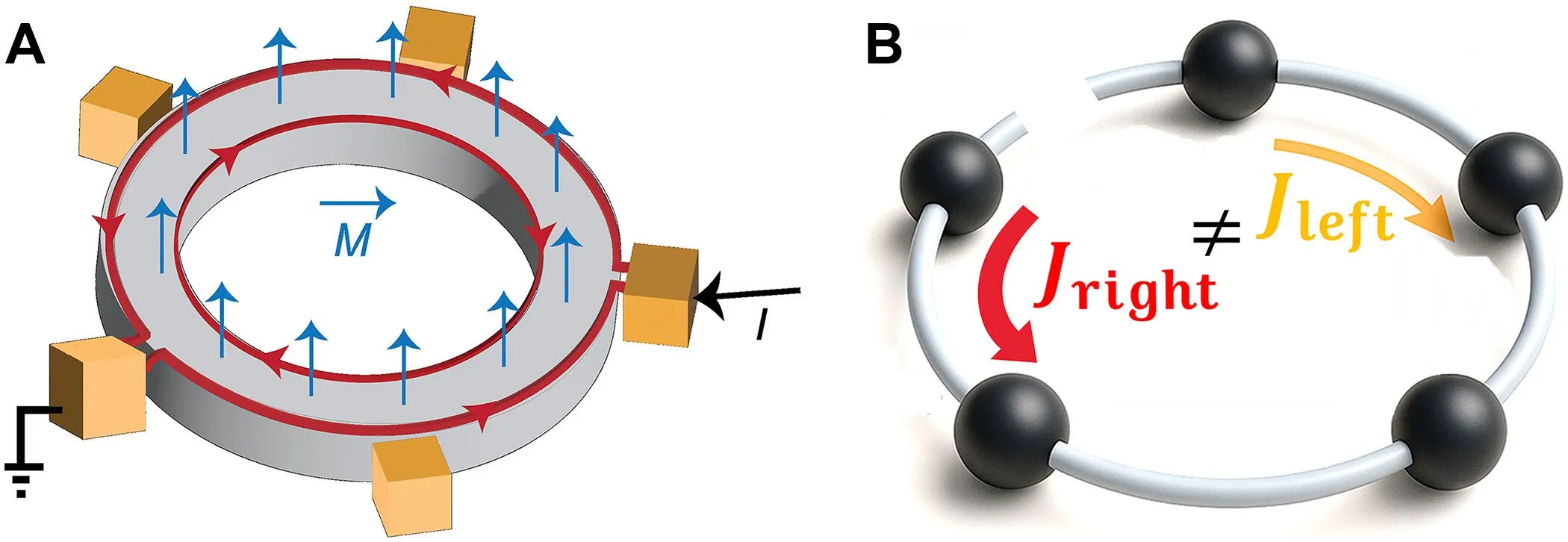
The experiment was carried out inside a dilution refrigerator at an extremely low temperature of 12 mK. Under fully periodic boundary conditions, the probability density of electrons at each electrode was evenly distributed. As the external resistors were adjusted to weaken the coupling at the ends of the system, approaching a pseudo-open boundary condition, a dramatic change occurred in the distribution of eigenstates.
As the element of the conductance matrix representing the coupling between the ends () decreased from to , the system's eigenvalues, which had traced a circle in the complex plane, rapidly collapsed onto a single point on the real axis. Physically, this corresponds to the electron probability density beginning to localize exponentially at a specific end of the system.
This corresponds structurally to a random walk in which, if the probability of stepping right exceeds the probability of stepping left, all walkers eventually end up pressed against the wall on the right. This phenomenon is precisely the non-Hermitian skin effect, captured directly for the first time inside a topological quantum material.
A Path Toward Room-Temperature, Zero-Field Sensors
This achievement extends beyond basic physics and has direct implications for the architecture of next-generation devices. Its greatest advantage is that this extreme asymmetry can be drawn out without any need for a strong external magnetic field.
In conventional systems based on the quantum Hall effect, forcing electrons into asymmetric motion has required massive superconducting electromagnets. The QAH device in this study operates at zero magnetic field (0 T) thanks to the magnetism intrinsic to the material itself. This frees the device from environmental constraints and brings miniaturization and portability within realistic reach.
Non-Hermitian systems—particularly those exhibiting the skin effect—have the characteristic that the eigenstates of the entire system respond extremely sensitively to tiny external perturbations. Because a slight change in the environment is multiplied and amplified across the entire system before being output, this provides the foundational technology for sensors with sensitivity exceeding conventional physical limits.
Looking ahead a few years to market prospects, the use cases for such ultra-high-sensitivity sensors are wide-ranging. In biological interfaces for medical applications, it would become possible to extract extremely weak electrical signals emitted by the brain without their being buried in noise. In inertial navigation systems for deep-sea or outer-space environments where GPS signals cannot reach, such devices are also expected to be deployed as autonomous, high-precision sensors capable of detecting minute changes in geomagnetism or acceleration. There is also anticipated application to new feedback mechanisms that detect environmental noise (decoherence)—currently the biggest obstacle in quantum computer development—with high sensitivity and turn it into a signal for real-time error correction.
The research team also demonstrated a method for artificially turning this asymmetry on and off by manipulating the back-gate voltage to change the chemical potential. When a gate voltage is applied to collapse the chiral edge states, complete one-way transport is lost, and asymmetric bidirectional coupling emerges inside the device. Even in this regime, the asymmetry in the conductance matrix is maintained, and the researchers captured how the behavior of non-Hermitian dynamics changes continuously. The fact that quantum states can be tuned using gate voltage—a standard technique in today's semiconductor industry—is an important step toward future large-scale commercial production.
In the quantum world, the paradigm is shifting from an era of pursuing an ideal, closed system to one of actively harnessing the asymmetry of an open, real-world system. The theory of non-Hermitian physics, which encompasses interactions with the environment and dissipation, has now gained a solid material foundation in magnetic topological insulators. A new design philosophy for electronic circuits is taking shape, aimed at next-generation quantum devices that can convert even environmental noise into amplified signal.