

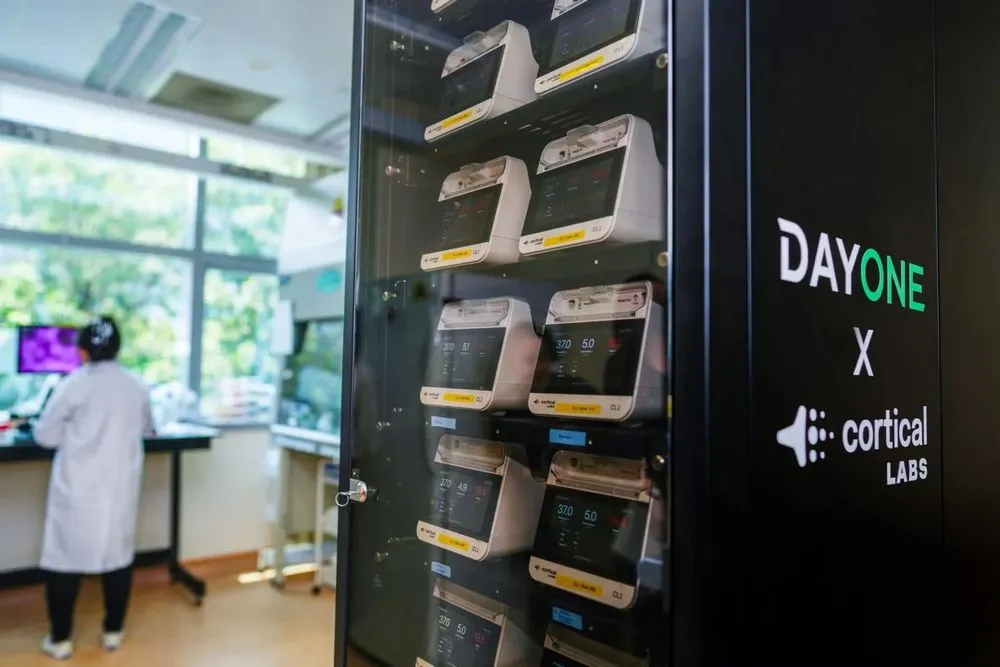
NUS Medicine announced on August 17 that it has installed a rack containing 20 units of Cortical Labs' CL1 at the NUS Life Sciences Institute and is operating it in a research environment. The unveiling on August 6 reportedly drew more than 80 attendees. NUS, DayOne, and Cortical Labs are calling this "the world's first independently operated biology-integrated server rack."
The significance here is not that a performance record for neuron-based computing has been broken. Rather, it marks the point where NUS researchers can culture cells and continue using the system as an experimental platform outside of the equipment and cloud operated by Cortical Labs itself. The value of the rack lies not in the number 20, but in the fact that culture conditions, recordings, and control experiments can now be handled on the university side.
At the same time, it would be premature to picture this "data center" label as a general-purpose AI computing platform. The published materials contain no figures for throughput, accuracy, or availability. Total power consumption for the rack, or operating costs including cooling, water, and consumables, have also not been disclosed. It's necessary to separate what this setup has demonstrated from what it has not yet demonstrated.
A 20-unit research rack, and a conditional plan for 1,000
The rack at the NUS Life Sciences Institute houses 20 CL1 units. DayOne designed and supports the surrounding infrastructure, while NUS researchers culture and grow the cells under the supervision of Professor Rickie Patani. Because an external research institution is now operating the biological layer, it becomes easier to set up repeated experiments under identical conditions and comparisons across different cultures.
However, this is not a deployment into a commercial data center. Under the plan DayOne presented in March, this NUS rack is first and foremost a validation stage—testing integration under real-world loads and comparing performance and efficiency. The plan envisions eventually moving to DayOne's commercial facilities and scaling up in stages to as many as 1,000 units, but this is contingent on technical validation and regulatory approval.
Cortical Labs has already been offering its own self-operated biological cloud platform in Melbourne. What's newly confirmed here, therefore, is not the first appearance of a "biological data center" in general, but specifically a 20-unit research rack operating independently of the supplier. The current setup and the future proposal of 1,000 units cannot be treated as equivalent in scale.
Notably, the announcements from NUS and DayOne do not disclose either the number of cells per CL1 unit or the total neuron count for the entire rack. No specification for a total cell count appears on Cortical Labs' current product pages or in its API preprint either, so the figure of "16 million" cells sometimes cited for a full rack cannot be confirmed from primary sources. Comparing biological scale meaningfully would require, beyond the current cell count, data on survival rates over the culture period and variability across individual units.
A closed loop built from silicon and cultured neurons
In CL1, living neurons are cultured on a silicon chip. The chip delivers electrical stimulation and reads neural spikes via a microelectrode array. Thanks to a nutrient-rich environment and life-support mechanisms built into the device, Cortical Labs states that cultures can be maintained for up to six months.
The computational cycle is hybrid. Software on the digital side encodes the task environment as stimulation, and the cultured neurons respond. The readout is then fed back by the software into the task's output, which in turn informs the next stimulation. The publicly available Python API is designed to handle recording, stimulation, and real-time closed-loop control.
In other words, the neurons are not executing Python instructions themselves. Silicon and electrodes handle input and output, while software and the cultured system exchange responses back and forth. A 2026 preprint related to the API reports sub-millisecond closed-loop interaction and microsecond-level timing control, but this is not a peer-reviewed operational performance benchmark.
The peer-reviewed evidence so far: a limited Pong task
The representative peer-reviewed result for this approach is the DishBrain experiment published in the journal Neuron in 2022. Simulated Pong states were delivered in a closed loop to human- or rodent-derived neural cultures on a high-density microelectrode array. The authors reported apparent learning within five minutes—not observed in control groups—along with goal-directed self-organization under structured feedback.
This was a result obtained in a specific experiment connecting stimulation and readout. It does not provide grounds for claiming that CL1 can run general AI models, replace clusters of GPUs, or handle ordinary data center workloads. If long-term recording and control experiments can continue at the NUS rack, it could serve as a venue for testing under what conditions DishBrain-type results can be reproduced.
From a research standpoint, aligning culture conditions and maintaining control groups will be essential. How consistently individual cultures respond, and how those responses change over time, are measurements that cannot be avoided when evaluating this rack as research infrastructure.
Why testing in Singapore also matters for verifying energy claims
DayOne's March plan included benchmarking performance and efficiency, and establishing frameworks for governance, biosafety, and compliance. Cortical Labs cites potential applications ranging from drug discovery to fraud detection, but these remain unproven deployment targets rather than demonstrated ones.
Singapore's data center energy constraints form part of the backdrop here. According to 2024 IMDA materials, the country has more than 70 cloud, enterprise, and colocation data centers, with total capacity exceeding 1.4GW. The Green Data Centre Roadmap sets a goal of adding at least 300MW in the near future. This is precisely why expectations that such systems can "compute using less power" need to be verified through whole-rack measurements—including life-support equipment—rather than through component-level explanations alone.
Like any ordinary data center, a CL1 rack still requires digital computing hardware, networking, sensors, and power conversion. On top of that, it also needs an environment to sustain the cells. Adding a biological layer does not make this other infrastructure disappear.
What will determine commercial viability: useful work per watt
This announcement confirms that an external research institution has begun operating a 20-unit rack. Transition to a commercial data center, and scaling beyond this, still lie ahead. DayOne itself has placed performance and efficiency measurement, integration testing, governance, and approval as prerequisites that come first.
For proper evaluation, the speed of neural responses alone is not enough. It will be necessary to define which tasks can actually be completed, and to publish—under consistent conditions—figures for power consumption (including life support) and consumables, reproducibility across different cultures, and rack-level uptime. Only once those figures are in hand will it be possible to judge whether the current setup can advance toward a commercial data center.