

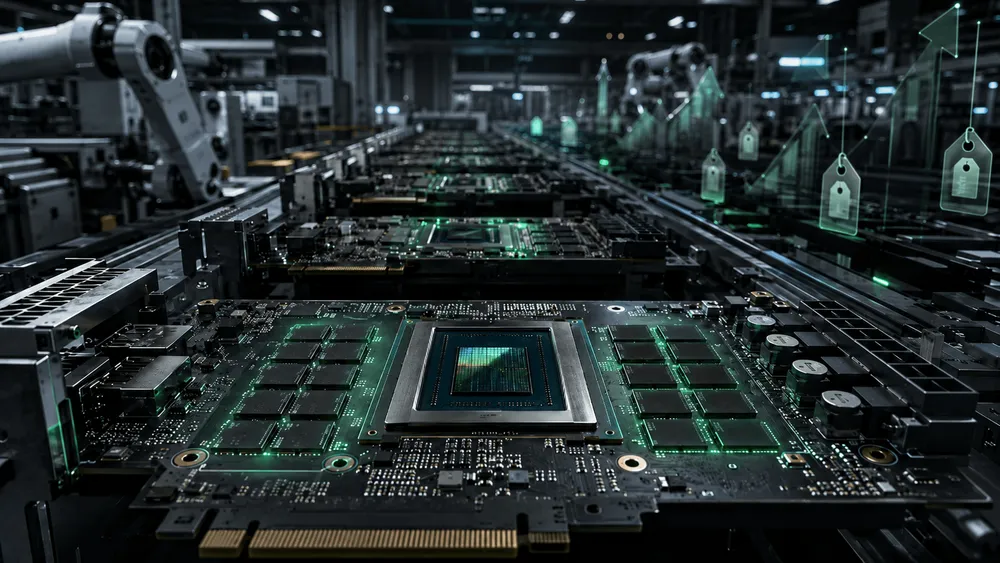
Taiwan's BenchLife reported on July 23, 2026, that NVIDIA had notified add-in card manufacturers (AICs) of a price increase for GeForce GPU KITs. A GPU KIT is a supply unit combining a GPU and video memory (VRAM), and this time the scope reportedly expanded to include GDDR6-equipped products in addition to GDDR7-equipped ones. The revision reported in May had been limited to the RTX 5090 and the China-market RTX 5090 D V2, so if accurate, this latest move would bring even mainstream, budget-priced products that use GDDR6 into the range of potential cost increases. However, NVIDIA has not made any public announcement about the notice, and the size of the increase, the effective date, and the affected model numbers remain unclear.
Expansion from May's RTX 5090-only hike to GDDR6
The first revision reported by BenchLife on May 14 centered on the GDDR7 used in the GPU KITs for the RTX 5090 and RTX 5090 D V2. That article noted that, at the time, no price increase notice had reached other GDDR7-equipped RTX 50-series products, and NVIDIA's manufacturer's suggested retail price (MSRP) had not changed either. It was an adjustment limited to just those two flagship products, not a price revision across the entire GeForce lineup.
The July 23 article states that NVIDIA notified AICs that it was expanding the revision to "other GeForce products in the lineup," raising prices for GDDR6 alongside the GDDR7 used in the Blackwell generation. BenchLife explains that memory prices are the primary driver behind the GPU KIT price increases. While costs for cooling modules, printed circuit boards, packaging materials, and other components are also rising, the report states that these increases are smaller than those for GDDR7 and GDDR6.
Much remains unconfirmed in this latest notice. BenchLife does not indicate the rate of the price increase, the amount of the increase per kit, or the effective start date. The affected regions and model numbers have also not been disclosed. No NVIDIA documents or comments have been made public either. Therefore, it cannot be confirmed that all models will see a price increase.
GPU KIT price increases and retail prices are not the same thing
Under the GPU KIT supply arrangement, AICs procure a GPU and VRAM together as a set, then add power circuitry, a PCB, and cooling mechanisms to complete a graphics card. Accordingly, a revision to kit pricing flows into the cost of the main components that card manufacturers purchase. How much of that cost increase reaches retail prices from there depends on how much AICs and distributors along the supply chain absorb.
However, the rate of increase in material costs and the rate of increase in retail prices do not necessarily match. The timing and amount that eventually surface depend on factors such as how much kit inventory an AIC purchased at the old price, how much of a margin cut it is willing to accept, and at what point each stage on the way to retailers revises its pricing. If existing inventory remains, the impact on retail prices will be delayed; for models with thin inventory, the impact is likely to appear sooner.
This also needs to be considered separately from MSRP revisions. For the RTX 5090 series in May, even though GPU KIT costs rose, the MSRP was left unchanged, according to BenchLife. The July report likewise does not mention any new MSRP. Card manufacturers could respond by raising street prices, tightening supply, or reducing the production ratio of lower-priced models, but which approach they will take cannot be determined from the notice alone.
GDDR6 also remains in the RTX 5050 and some RTX 40 products
Cross-referencing NVIDIA's official specification sheets shows that GDDR6 is not memory exclusive to the previous generation. Among desktop RTX 50-series products, the RTX 5090 through the RTX 5060 use GDDR7, while the RTX 5050, the entry-level model of the Blackwell generation, uses GDDR6. NVIDIA launched the RTX 5050 in 2025 starting at $249, with a launch configuration of 8GB of GDDR6 on a 128-bit bus.
| Product group per official specifications | Memory type |
|---|---|
| RTX 5090, 5080, 5070 Ti, 5070, 5060 Ti, 5060 | GDDR7 |
| RTX 5050 | GDDR6 |
| RTX 4070 | GDDR6 or GDDR6X |
| RTX 4060 Ti, RTX 4060 | GDDR6 |
What this comparison table shows is that a notice covering GDDR6 could potentially also relate to the current RTX 5050. In the RTX 40 series as well, the RTX 4060 Ti and RTX 4060 use GDDR6, and the RTX 4070 has both GDDR6 and GDDR6X versions. However, the official specifications only reveal the memory type; they do not indicate which products are subject to this price increase.
What the report explicitly states is GDDR7 and GDDR6, with no mention of GDDR6X. Therefore, there is no basis for assuming the scope will expand to products using GDDR6X. Until notification details by model number are released, it is reasonable to treat the RTX 5050 and GDDR6-equipped RTX 40 products as "specification-based candidates" rather than confirmed targets.
A market where DRAM prices rose more than 60% in a single quarter
In financial materials released on June 24 for its fiscal 2026 third quarter, major memory manufacturer Micron disclosed that company-wide DRAM prices rose in the low-60% range compared to the previous quarter. Bit shipment growth remained in the low single digits, and the company cited tight supply-demand conditions and improved product mix as reasons for the price increase. Revenue from the mobile and client business also grew 49% quarter over quarter, with price increases driving the revenue growth even as bit shipments declined.
Micron expects tight supply-demand conditions for DRAM and NAND to persist beyond the end of 2027. The company explains that new fabs take time from construction to ramp-up, and that growth in HBM is putting pressure on the supply of non-HBM DRAM. Since GPU memory also draws on DRAM manufacturing capacity, the reported rise in GeForce procurement prices is consistent with this broader market environment.
However, Micron's low-60% figure represents an average price change across DRAM overall, not the contract prices for GDDR6 or GDDR7 specifically. Pricing and trading terms specific to NVIDIA have also not been disclosed. While the broader market tightness can explain the background, it is not a figure that directly proves the size or cause of the price increase in this particular notice.
GDDR7 supply also varies in stage depending on capacity and speed. According to Micron's product catalog, among its 24Gb parts (equivalent to 3GB per chip), the 28GT/s version is in mass production while the 32GT/s version is being sampled. But the catalog does not list transaction prices. The fact that a high-density part has reached the mass-production stage is a separate matter from whether sufficient quantities can be procured at a desired price.
The price increase amount and effective date will determine retail impact
The first figure buyers should check is not the rate of the GPU KIT price increase, but the gap between wholesale and street prices for each affected model. With a notice like this one, where neither the size of the increase nor the effective date has been disclosed, it is not possible to calculate retail price impacts in advance. Price tracking needs to distinguish between standard and premium models from the same AIC, and to separate out any temporary shortages that occur immediately after launch.
On the AIC side, the timing for exhausting old-price kit inventory differs by product. For budget-tier products like the RTX 5050, even a small absolute cost increase can significantly affect profit margins, but neither NVIDIA nor the AICs have disclosed per-model profitability for this situation. It would be premature to conclude, based solely on the price-hike report, that entry-level models will disappear immediately or that all products will rise by the same percentage.
The full picture will become clear once the affected model numbers and effective date are known, and once wholesale price revisions by AICs show up consistently in retail prices across multiple regions. Until then, it is necessary to track the change—from an adjustment limited to the two flagship products in May to one that expanded to include GDDR6 in July—while keeping the GPU KIT price increase and the price consumers actually pay at retail as separate matters to follow.