

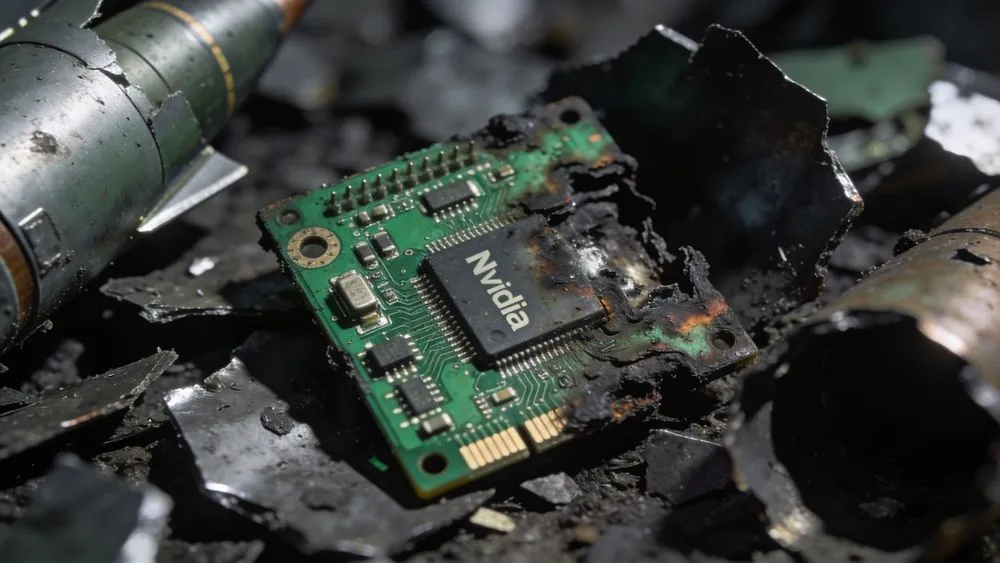
In August 2026, a charred circuit board was found among missile wreckage recovered from the Ukrainian battlefield. Etched on its surface was the marking "TE980M-A1"—the part number for the Jetson Orin NX 16GB, an edge AI module launched by NVIDIA in early 2023. This component, designed with consumer applications like robot vacuums and drone delivery in mind, had been built into the brain of the Russian S-71M "Monokrom" cruise missile, which flies at speeds of 500–600 km/h.
Ukraine's Defence Intelligence (GUR) publicized this discovery on August 12 via the country's War&Sanctions portal. In its statement, GUR said, "The use of this component indicates the possible application of artificial intelligence technology in the missile." This is not mere speculation—the very design philosophy of the S-71M presupposes autonomous attack capability.
What makes this discovery significant is the chip's price. The Jetson Orin NX 16GB has a mass-production price of $999 (for orders of 1,000 units or more). While military-grade components are subject to procurement tracking, consumer products in this price range blend seamlessly into global electronic component distribution networks, and mechanisms to trace end users are effectively nonexistent.
The Design Philosophy of Export Controls as a "Wall," and Its Underlying Assumptions
Within weeks of Russia's full-scale invasion of Ukraine in February 2022, the U.S. Department of Commerce restricted the export of advanced semiconductors to Russia. NVIDIA also completely ceased its offices and sales operations in Russia that same year. The Jetson Orin NX 16GB launched in early 2023—meaning this chip entered the market after NVIDIA had already withdrawn from Russia, and no official channel exists through which it could reach Russia.
The design philosophy behind these export controls rested on a simple premise: if you cut off the supply of advanced chips, Russia would be unable to mass-produce precision-guided weapons and autonomous systems. In the first half of 2022, this premise appeared to be working. According to KSE Institute's analysis of tariff data, Russia's monthly imports of "battlefield goods" fell from $1.04 billion before sanctions to $565 million six months after sanctions took effect—a 45% decline.
However, the recovery was swift. From January to October 2023, monthly imports of the same goods reached $932 million—only a 10% decline from pre-sanctions levels. A report published by the U.S. Senate Committee on Homeland Security and Governmental Affairs in September 2024 identified transshipment through third countries as the primary driver of this recovery, naming Armenia, Kazakhstan, Turkey, Hong Kong, and China as key transit hubs. According to the report, exports to Russia routed through these countries have surged since 2022, with some intermediaries using layers of multiple shell companies to conceal transactions with sanctioned entities.
What Is the S-71M "Monokrom"?
The S-71M is a small cruise missile designed to be carried in the internal weapons bay of the Su-57 stealth fighter. It is a derivative of the S-71K "Kovyor," featuring an airframe with enhanced low-observability characteristics. Its radar cross-section (RCS) is 0.007 square meters—a value comparable to a small bird, making detection by conventional air defense radar extremely difficult.
| Item | S-71M "Monokrom" | Conventional Kh-101 Cruise Missile |
|---|---|---|
| Warhead weight | 250 kg | 400–480 kg |
| Range | 200–400 km (estimates vary) | Approx. 2,500–5,500 km |
| Cruising speed | 500–600 km/h | Approx. 900 km/h |
| RCS | 0.007 m² | Approx. 0.01–0.1 m² (estimated) |
| Guidance method | Autonomous target search via neural network + terminal guidance | Inertial navigation + TERCOM + GLONASS |
| Human involvement | Not required (in autonomous mode) | Target set before launch; autonomous during flight |
| Carrier aircraft | Su-57 (future: Su-30/34/35 as well) | Tu-95MS, Tu-160 |
What's notable is the design philosophy behind the guidance system. Russian patent documents state that the S-71M's guidance and control system "performs autonomous search based on threat priority and independent decision-making for target destruction." According to GUR's explanation, the recovered Jetson Orin module was connected to an onboard camera, and during terminal guidance—the final phase when the missile approaches its target—the optical sensor's captured imagery is processed by machine learning algorithms, allowing the missile to autonomously home in on its target. Human operators are not involved at this stage.
Whereas the Kh-101 relies on inertial navigation and terrain contour matching (TERCOM), following a pre-launch-configured flight path, the S-71M can select its own target during flight and determine attack sequence based on priority. This difference has direct implications for survivability in electronic warfare environments. On the Ukrainian battlefield, where GPS jamming and communications disruption have become routine, autonomous guidance that doesn't rely on external signals significantly affects a weapon's operational effectiveness.
What It Means That the Jetson Orin NX Is Not "Weapons-Grade"
NVIDIA told The Register that the Orin module is consumer-grade and not intended for military use by design. "Used Jetsons are available through many resale channels. We can't track products after they're sold, but if we identify customers violating U.S. export controls, we take appropriate action," the company stated.
This response is technically accurate. The Jetson Orin NX 16GB has a mass-production price of $999—two orders of magnitude apart in both price and performance from NVIDIA's data center GPUs like the H100 and B200. Its AI compute performance is 100 TOPS (INT8 sparse), roughly 1/40th of the H100's approximately 3,958 TOPS.
| Item | Jetson Orin NX 16GB | NVIDIA H100 SXM |
|---|---|---|
| AI compute performance (INT8 sparse) | 100 TOPS | Approx. 3,958 TOPS |
| Power consumption | 10–25 W | Up to 700 W |
| Mass-production price | $999 | For data centers (price undisclosed) |
| Intended use | Robotics, autonomous systems, edge inference | Data centers, large-scale training/inference |
| Export control status | None (consumer product) | Yes (subject to advanced AI chip regulations) |
However, the computation required for a missile's terminal guidance is fundamentally different from training a large language model. The task of identifying a target just a few meters away via image recognition and correcting trajectory requires processing power well within the reach of 100 TOPS—more than sufficient. The 10–25 watt power consumption characteristic is also an advantage inside a missile body with limited power capacity. A data center GPU's 700-watt power draw simply isn't feasible to fit inside a missile in the first place.
In fact, GUR has confirmed the same Jetson Orin module in the V2U attack drone, which has been deployed in combat since February 2025, and in the Iranian-designed Shahed-236. In the case of the V2U, the Jetson Orin was mounted atop a Chinese-made Leetop A203 mini-computer, used for terrain-matching navigation and target recognition. The fact that the same module has been diverted for use across different platforms—a cruise missile and an attack drone—suggests that Russia is systematically procuring and repurposing specific consumer AI components.
In other words, what's slipping through the gaps in export controls isn't "advanced AI chips." It's untrackable edge AI modules that circulate widely for consumer use.
The Structural Problem Illustrated by 5,816 Components
This discovery is not an isolated incident. GUR's War&Sanctions portal, which was transferred from NACP (National Agency on Corruption Prevention) to GUR in June 2024, has continuously published teardown investigations of Russian weapons recovered from the battlefield. As of August 2026, 5,816 foreign-made components have been identified across 202 types of Russian weapons systems. U.S.-made parts are the most numerous, with components from Switzerland, Japan, Belarus, and China also included.
What these numbers reveal is a structure in which Russian weapons production has been unable to escape its dependence on foreign-made components. Individual components are consumer products, and none of them individually were designed with military conversion in mind. Microcontrollers, FPGAs, power management ICs, and now the Jetson Orin—only when these are combined together does a weapons system come into being. As long as export controls focus on individual "advanced products," they cannot fully address this problem of combination.
A report published by the U.S. Government Accountability Office (GAO) in 2025 concluded that export controls have "hindered but not fully prevented" Russia's acquisition of technology. The report further criticized the Commerce and Treasury Departments for failing to set measurable goals regarding the effectiveness of sanctions and export controls, recommending improvements. Without the ability to measure effectiveness, it becomes impossible to identify which parts of the system are working and which parts are broken.
In its announcement, GUR stated, "The discovery of NVIDIA Jetson in a new Russian missile once again demonstrates the need to strengthen sanctions pressure and coordinate the efforts of the civilized world." At the same time, GUR touched on another implication: the fact that Russia cannot produce its own domestic substitute. If Russia possessed a domestically-made edge AI chip capable of autonomous guidance, there would be no need to depend on a $999 American-made module.
Questions That Remain
GUR has not disclosed exactly which neural network model the Jetson Orin mounted in the S-71M is running, what its training data consists of, or what hit rate the autonomous mode achieves. The S-71M itself has only seen limited combat deployment since early 2026, and the full picture of its mass-production status and operational doctrine remains unclear.
For those who design export control systems, this case poses a clear question. Tightening regulations on data center-bound chips does nothing to stop weapons conversion happening with a $999 edge module. Restricting the distribution of consumer products would hamper the development of robotics and autonomous driving. Within this irreconcilable tension, what kind of verifiable framework can be built? The 5,816 component part numbers are waiting for that answer.