


NVIDIA has released the weights and inference code for Nemotron-Labs-Image-30B-A3B, a text-to-image AI model, on Hugging Face. On a benchmark of rendering long English text inside images, the released image generation model on its own scores 94.30, below OpenAI's GPT Image 2 at 96.00. But when the same model is paired with another NVIDIA AI model, the score rises to 97.00, reversing the ranking. A technical report dated November 23, 2026 compares performance for the standalone image generator and for two configurations in which an external AI assists with production.
Applying the language model Nemotron 3 Nano to image generation
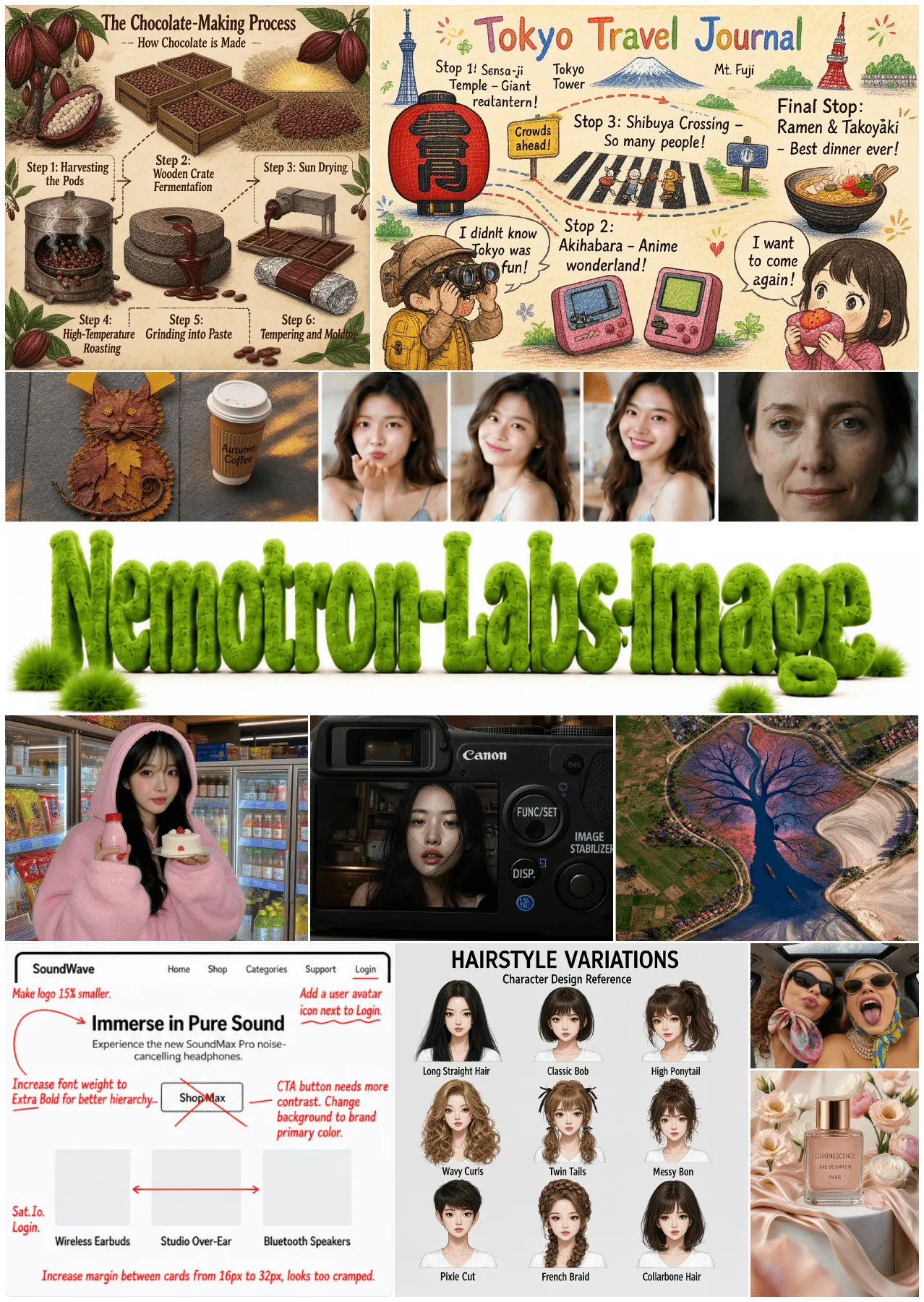
The image generation model is built on NVIDIA's language model Nemotron 3 Nano. It applies the mechanism of predicting the next token in a text sequence to predicting tokens that represent an image. In the model name, "30B" refers to 30 billion total parameters, and "A3B" refers to the roughly 3 billion parameters used when processing each token. According to NVIDIA's model card, the image generation weights are distributed as 32 split files, and a decoder that converts token sequences into images is included.
The basic unit of an image is a 16×16-pixel patch. At 1024×1024 pixels, one of the recommended resolutions, image tokens are placed at a 64×64 grid, or 4,096 positions in total. Based on the text instruction and the tokens generated so far, the model predicts the token for each next position in sequence. Finally, the decoder converts the token sequence into a single image.
Although each token is processed with about 3 billion parameters, generating an image requires sequentially predicting 4,096 tokens. The inference code example published by NVIDIA uses four 80GB H100 GPUs. However, that is the configuration used for official verification, and the minimum GPU setup required to run the model is not stated.
Even with the same generator, AI-assisted production changes performance significantly
NVIDIA calls the overall production system that includes the image generation model "Nemotron-Labs-VisualCreation." When generating images directly, the system creates multiple candidate images, and a vision-language AI model selects the one that best fits the instruction.
The technical report separately evaluates the standalone image generator, a configuration in which a Nemotron-family AI handles production planning and candidate selection, and one in which GPT-6 takes on that role. In the table below, GPT-6 is the AI model that assists production, while GPT Image 2 is an image generation model used as a point of comparison.
| Model / configuration | GenEval2 (composition and instruction following) | LongTextBench (English text in images) | WISE Verified (knowledge accuracy) |
|---|---|---|---|
| Nemotron-Labs-Image-30B-A3B alone | 31.71 | 94.30 | 46.30 |
| Same model + Nemotron-family AI | 52.56 | 97.00 | 88.60 |
| Same model + GPT-6 | 65.43 | 97.98 | 91.50 |
| GPT Image 2 | 81.00 | 96.00 | — |
| Nano Banana Pro | 59.00 | 97.60 | 87.60 |
| SenseNova-U1.5 | 55.00 | 98.80 | — |
| Qwen-Image | 33.80 | 94.30 | 51.00 |
Source: Tables 6, 7 and 9 of the technical report. Higher values are better in all cases; "—" indicates no score was reported. GenEval2 is scored using the Soft-TIFA GM metric. LongTextBench is evaluated in English, so these results cannot be used to judge text rendering accuracy for Japanese signs or diagrams.
The difference between configurations is most pronounced on WISE Verified, which evaluates whether image content is consistent with real-world knowledge. Adding the Nemotron-family AI raises the score from 46.30 to 88.60, an improvement of 42.30 points, surpassing Nano Banana Pro's 87.60. With GPT-6, the score rises further to 91.50.
On GenEval2, which measures the ability to place elements in an image according to multiple instructions, the configuration with GPT-6 assistance still falls 15.57 points short of GPT Image 2. These scores reflect an entire pipeline that includes production planning, external context information and candidate selection, and the contribution of each individual step to the improvement has not been isolated.
Combining image and code generation to produce editable deliverables
A distinguishing feature of VisualCreation is that it handles not only image generation but also the production of deliverables that can be edited afterward. For example, when a poster is created with a typical image generation AI, both the headline and the background are saved as pixels in a single image. Revising only the text or layout after completion is not easy.
With VisualCreation, it is also possible to leave the background to the image generation model while specifying headline text and layout in HTML or SVG. The generated code is rendered in a browser, and if there are problems with text or layout, the relevant code is corrected. Through this design, which NVIDIA calls "Pixel as Code," photo-like imagery and editable text and shapes can be handled in a single production process.
On BizGenEval, which evaluates the finish quality of slides, posters and similar materials, the configuration with the Nemotron-family AI scored 64.7 and the one with GPT-6 scored 86.0. GPT Image 2 scored 83.2, so the ranking is again reversed depending on the system configuration. However, BizGenEval evaluates the appearance of deliverables; whether text and shapes can be edited individually is assessed in a separate test. A BizGenEval score for the standalone image generation model has not been published.
Only the image generation model is public for now
As of November 26, 2026, what has been released is the image generation model's weights, the accompanying tokenizer, the model definition and the inference code. The software that orchestrates the entire production process and "VisionCode," which generates editable code, are scheduled for release after NVIDIA's internal legal review. The released model weights are also covered by a license that limits use to non-commercial research and evaluation.
According to NVIDIA's release plan and terms of use, what can be verified with the current distribution is the performance of the standalone image generation model in response to text instructions. Reproducing the performance of VisualCreation as a whole, including candidate selection, text placement correction and the creation of editable materials, will require waiting for the remaining components to be released.