

On August 20, Newcomer reported—based on a letter to investors—that NVIDIA has agreed to pay $6 billion for a non-exclusive license to AI startup Poolside's "Model Factory." According to the letter, NVIDIA will also invest an additional $1 billion in Poolside and extend job offers to 109 people who worked on Laguna and Model Factory. This is neither a full acquisition of Poolside nor an acquisition of a single model's weights. To properly interpret the reported value of this deal, it's necessary to separate what the $6 billion is actually paying for from what Poolside retains.
As of August 22, neither NVIDIA nor Poolside has officially announced this deal. The signing, deal completion, license duration, and scope of intellectual property remain undisclosed, so the exact contours of what the $6 billion buys are still unclear.
The $6 Billion Is Not an Acquisition Price
Summarizing Newcomer's report simply as "NVIDIA acquires Poolside for $6 billion" obscures the full picture of the deal. The letter describes three separate tracks: a non-exclusive license to Model Factory, job offers to personnel, and a new equity investment in Poolside. The $6 billion figure was reported as the price of the license—not the value of an equity stake in Poolside, nor the total compensation for the 109 people.
| Item | What Newcomer Reported | What Remains Unconfirmed |
|---|---|---|
| Model Factory | Agreement to pay $6 billion for a non-exclusive license | Contract duration, scope of IP covered, treatment of source code |
| Personnel | Job offers extended to 109 people who worked on Laguna and Model Factory | Number who accept, start dates, employment terms |
| Investment | NVIDIA to invest $1 billion in Poolside | Investment terms, use of funds |
| Distribution to investors | $6 billion to be distributed by the end of 2027 | Payment terms, execution timeline |
Poolside's pre-money valuation was reported at $12 billion. But this figure cannot be used to back out the overall deal price or NVIDIA's ownership stake. The $1 billion is a separate investment, distinct in nature from the $6 billion licensing fee. Based on what's been reported, the structure appears designed to separate funds distributed to existing investors from funds flowing into Poolside, where the founders remain.
The letter reportedly describes this deal as neither an acquisition nor an acquihire, stating that Poolside's founders will remain with the company. That said, the 109 people are not employees who have already been hired—they are simply the pool of people to whom NVIDIA extended offers. It has not been disclosed whether all of them will move to NVIDIA, or how many will remain at Poolside. It's premature to conclude, based on this personnel movement, that Poolside's R&D will halt or that the company will be absorbed into NVIDIA.
What Model Factory Actually Is
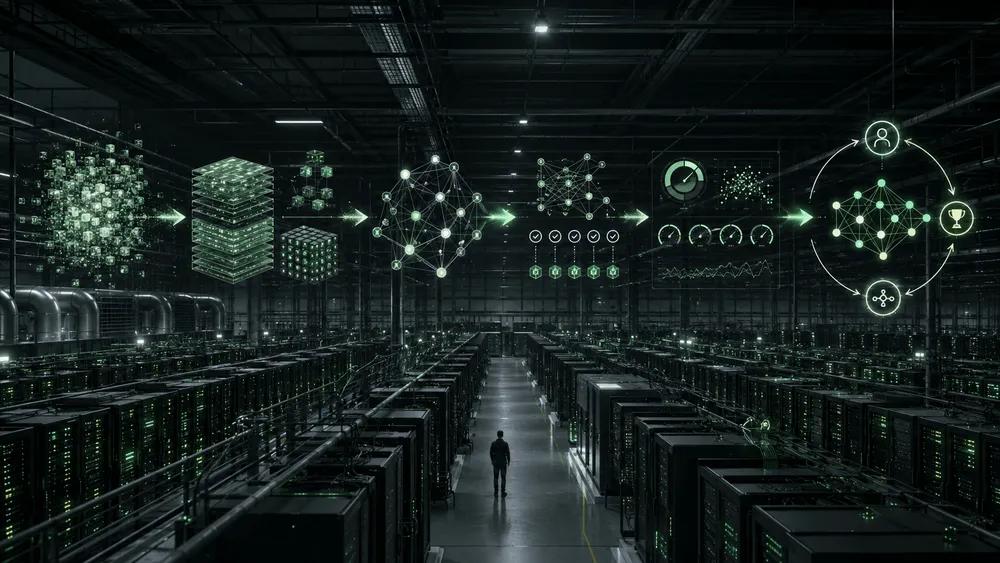
According to Poolside's own public description of Model Factory, the subject of the license is not a single model or a set of trained weights. It is an internal platform that connects everything from data ingestion, refinement, deduplication, and mixing, through automated evaluation during training, to reinforcement learning that uses code execution. It also covers architecture comparison, observability, and weight transfer to inference environments. The system uses Kubernetes as an orchestrator to schedule jobs and control priority across large-scale GPU clusters.
For this type of infrastructure, both the scale of GPU resources and the speed of iterating through experiments constitute value. How quickly one can update training data, launch multiple experiments, and loop back to the next experiment based on interim evaluations determines how many rounds of model improvement are possible. Poolside states that deduplication work that once took more than a week can now be executed with a single operation, and that experiment deployment that used to take weeks has been reduced to under an hour—sometimes as little as roughly 10 minutes. These are not third-party-verified performance figures but Poolside's own claims. Even so, they help clarify that what's being licensed is less a single finished model and more an operational system built to accelerate iteration.
Poolside states that Model Factory handles jobs on a cluster made up of 10,000 NVIDIA H200 GPUs. The aim is to bring data handling, training, evaluation, and reinforcement learning together into a single operational environment, rather than connecting them through separate tools. For NVIDIA, beyond simply supplying GPUs, the implementation knowledge of how users sequence experiments and where they cut down on wait times may also be part of what makes the license valuable.
NVIDIA Hardware Experience Built Up Through Laguna
Poolside's Laguna M.1 serves as a public example of Model Factory's scale. The company has described Laguna M.1 as a Mixture of Experts (MoE) model with 225 billion total parameters, of which 23 billion are activated during inference. Poolside states that training it from scratch in-house required 30 trillion tokens and 6,144 interconnected NVIDIA Hopper GPUs.
This figure does not mean that Laguna M.1 used the full capacity of the 10,000-GPU H200 cluster. The model's training conditions and the cluster scale that Poolside describes as managed by Model Factory were disclosed as separate pieces of information. That said, this is consistent with Poolside's explanation that data curation, pre-training, and post-training were all performed on NVIDIA hardware. Poolside also states that Laguna XS.2 supported TensorRT-LLM from its first day of release.
The same caution applies to the personnel figures. As of April 2026, Poolside described its Laguna Applied Research organization as consisting of roughly 60 people. The 109 people mentioned in this deal, however, are the pool of individuals who received job offers related to Laguna and Model Factory work. Since neither the timing nor the departmental definitions match up, these figures cannot be used as a direct comparison to gauge headcount changes or whether the entire research organization is moving.
In October 2024, Poolside announced it had raised $500 million and expanded its training cluster to 10,000 GPUs. This latest report also shows that NVIDIA, as a GPU supplier, and Poolside's training and inference environment already had a long-standing technical relationship. What's newly reported is a move to gain access—through licensing and hiring—to the systems and personnel that accumulated within that environment.
Overlap With NeMo, and an Undisclosed Integration Plan
NVIDIA itself offers "NeMo," an end-to-end platform for building, customizing, and deploying generative AI models. According to official documentation, NeMo includes large-scale training and data curation capabilities. It also handles evaluation and reinforcement learning. Comparing the two based on publicly available categories alone, there is considerable overlap in functionality between Poolside's Model Factory and NeMo.
However, overlap does not necessarily mean replacement or integration. Neither Newcomer's report nor either company's public materials confirm whether Model Factory's code will be incorporated into NeMo, used for NVIDIA's internal model development, or offered to external customers. Since this is a non-exclusive license, if the reporting is accurate, Poolside should be able to continue using Model Factory as well. It cannot be characterized as a deal in which NVIDIA alone monopolizes the technology.
Still, the fact that job offers were extended alongside the licensing deal is significant. While Model Factory's public description outlines the structure of each stage of the pipeline, the specifics of how data is partitioned, how evaluation criteria are chosen, and how cluster job priorities have been tuned are not things that can be transferred through documentation alone. This gives grounds to think that what NVIDIA is aiming to acquire includes not just rights to the Model Factory software, but also the opportunity to hire the people who have operated it within a large-scale GPU environment. That said, it remains unknown exactly who will actually move.
Technical Scope and Continued Development Await Disclosure
At this point, the broad outlines of the deal are visible, but the practical core details remain undisclosed. It's unclear how much of the $6 billion license covers—model weights, training code, data processing, or operational tools. Nor is it clear when and under what conditions the payment will be distributed to investors. Whether antitrust review or other regulatory scrutiny will be required also cannot be confirmed from publicly available information.
How many of the 109 people accept their offers will also serve as a measure of Poolside's remaining development capacity. Whether the founders stay is a separate question from who will continue developing Laguna and Model Factory, and under what structure. The composition of the leadership team remaining at Poolside, the company's product continuity plans, and the roles of the staff who stay have not been disclosed.
The first thing to watch is whether NVIDIA and Poolside formally announce the terms of the deal. Next, it will be important to track how many of the job offers actually convert into hires, and whether Poolside continues development using the non-exclusive Model Factory license. Only once the actual personnel movement and Poolside's continued development become clear will it be possible to judge how the $6 billion will reshape NVIDIA's development infrastructure.