


Many people have had the experience of trying to photograph a park at dusk with a smartphone, only to notice that an insect's wings appear blurred out within the frame. When wings flap dozens of times per second, not just cameras but even the human eye can perceive that "something" is there, yet fail to grasp its outline. A drone called "Phantom Twist," designed by an engineering team at Northwestern University, deliberately exploits this phenomenon to render the entire aircraft nearly invisible.
What Decades of Drone-Hiding Research Got Wrong
The history of research aimed at making drones less noticeable has converged on a single point: "changing how it looks." Camouflage paint, display panels that project the surrounding scenery in real time, metamaterials that control light diffraction—all of these approaches try to blend the drone into the visual field by manipulating the "color" or "surface" of the airframe.
However, all of these share a common underlying assumption: that the airframe is stationary, or that even if it moves, its shape stays constant. But if an airframe rotates faster than a camera's shutter speed can capture, it might make more sense to weaponize that rotation rather than fuss over its appearance. This inverted line of thinking was implemented by a team led by Associate Professor Michael Rubenstein (Computer Science and Mechanical Engineering) at Northwestern University.
The background to this insight lies in trends in computer vision research. As deep-learning-based object detection has rapidly improved in accuracy, researchers have begun systematically analyzing the conditions under which drones are difficult to detect. What emerged from this was a structural asymmetry: a stationary airframe body paired with rapidly spinning propellers. The propellers do blur, but the airframe body remains sharply visible to the camera. Amid mounting evidence that appearance-altering approaches are "promising on paper but impractical in the field," Rubenstein's team redirected the question. Could the airframe itself be built into the perceptual system's "blurring mechanism"?
"Most approaches have focused on making the drone look like its surroundings. What we asked instead was whether we could design the drone itself around how humans perceive motion," says Rubenstein.
The structural difference between a typical quadcopter and Phantom Twist is simple. A quadcopter distributes lift and attitude control across four motors and their respective propellers, while the airframe body itself remains constantly stationary. The propellers spin, but the body stays still—creating a fixed, easily visible target. Phantom Twist rejects this fundamental design premise entirely.
Not Deceiving the Eye, But Following Its Mechanism
The human visual system integrates the light information it receives over a short time window before forming an image. This is structurally similar to a camera shutter, and fast-moving objects get blurred and averaged out within the integrated image. When an electric fan's blades spin, they appear to vanish for the same reason: the image of the blades gets "smeared" across the time dimension.
What Phantom Twist did was exploit this characteristic to its extreme limit. With a single motor and single propeller, while the propeller spins in one direction, the airframe body itself rotates in the opposite direction. In a typical four-rotor design (quadcopter), only the propellers rotate while the airframe body remains stationary and visible. In Phantom Twist, there is no part that stays still—not a single one.
The entire airframe reaches up to 25 rotations per second. Assistant Professor Emma Alexander, a computer vision expert, explains it this way: "The human eye takes a certain amount of time to accumulate a signal—a concept similar to a camera's exposure time. When an object rotates quickly, its outline blurs and its features are lost. Since this drone is made almost entirely of near-transparent material, the opaque components get visually averaged with the background, appearing as little more than a faint haze."
This constraint of "signal accumulation" is a universal characteristic of human vision. While conventional invisibility research started from the question of "how to make a drone look like its surroundings," Phantom Twist's design philosophy started from a different question: "Can we physically create conditions under which the human visual system cannot process shape?" Rather than camouflage, it exploits the very mechanism of perception itself.
How AI Selected an "Invisible Shape" from 20,000 Design Candidates
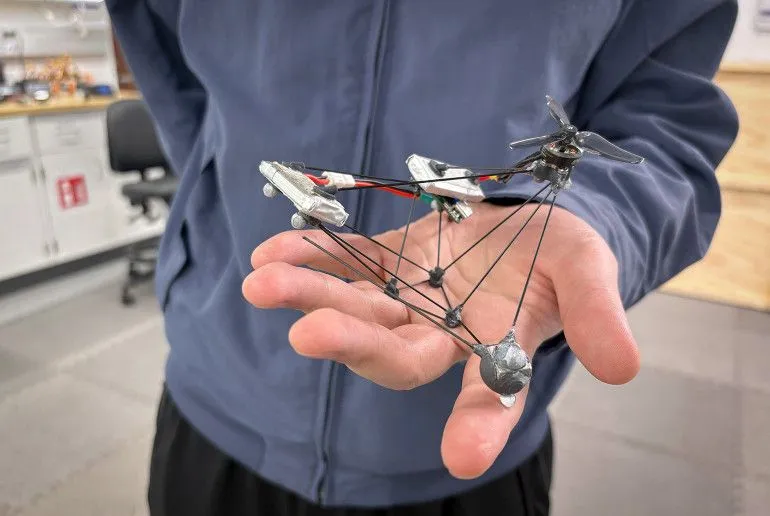
Simply spinning the airframe isn't enough to sufficiently reduce visibility. Depending on how the components are arranged, they can overlap during rotation and appear as an opaque mass. So the team prepared a two-stage automated design pipeline.
In the first phase, they generated roughly 20,000 stable-flight-capable configurations by varying the placement of key components—motor, propeller, circuit board, counterweight, and battery. In the second phase, they simulated the drone's flight for each configuration and overlaid it onto 100 real-world background images. The "visibility" of each simulated image was evaluated using a metric called LPIPS (Learned Perceptual Image Patch Similarity), narrowing the field down to 500 designs with low scores (i.e., harder to distinguish from the background). After that, an optimization algorithm repeatedly adjusted component positions to push the scores even lower.
LPIPS was originally used to evaluate the quality of generated images, measuring the difference between two images using feature representations from a neural network that closely approximates human perception. Rather than simple pixel-level differences, it can quantify differences in terms of "whether a human would notice something is off"—and this played a pivotal role in the research. In other words, the objective function of the design itself directly defines "what it means to be hard for a human to see," incorporating an evaluation axis into the design process that differs fundamentally from the lift, stability, and payload specs traditionally used in drone design.
The design process was fully automated. According to Rubenstein, actual fabrication only began once a drone meeting all criteria had been identified.
In the final selected design, components are distributed both in height and angular position so that they do not visually overlap with one another during rotation. As a result, when everything blurs together during spin, it doesn't appear as a crisp shape but rather as a pale, translucent cloud.
What the Figure "Roughly 10 Times Less Visible" Really Means
As a final evaluation result, the team reports that, measured by the same LPIPS metric, visual perceptibility is roughly 10 times lower compared to a conventional quadcopter. "10 times less visible" is a substantial quantitative difference, but it doesn't mean "completely invisible."
The drone remains visible as a faint, hazy shape. It becomes harder to distinguish from the background, but the visibility is not zero. The research team itself acknowledges current limitations. The whirring sound of the propeller remains, and some wires and support rods on the airframe are still partially visible. Rubenstein states that as a next step, they are considering using more transparent materials and adopting quieter propulsion systems.
LPIPS also has limitations as a metric. While it approximates the human visual system, it is not an exhaustive evaluation covering every lighting condition, distance, or moving object. Nor does the visual system of wildlife necessarily have the same sensitivity as that of humans. When considering applications in environmental monitoring or wildlife observation, the standard for "low visibility" changes depending on whether the observed subject is human or animal.
Another important factor is the correlation between airframe design and flight angle. While the current design is optimized to minimize visibility from nearly all viewing angles, real-world conditions—flight altitude, downwash strength, background color temperature, and illumination—vary enormously. The 100 background types used in the simulation are merely samples, and the team itself recognizes that broader validation will be needed for real-world deployment. Since LPIPS is based on a static model of human perception, gaps remain—such as those related to saccadic eye movements tracking a moving object or peripheral vision characteristics—that future evaluation frameworks will need to address.
Comparison with Conventional Representative Drones
| Comparison Item | Conventional Quadcopter | Phantom Twist |
|---|---|---|
| Rotating parts | Propellers only | Entire airframe (25 rotations/sec) |
| Parts that appear stationary | Airframe body | None |
| Design approach | Visual camouflage | Perceptual metric as design objective |
| LPIPS visual perceptibility | Baseline (1) | Approx. 1/10 |
| Number of motors | 4 | 1 |
| Current challenges | Easily detected visually | Noise, some wires visible |
From Coexisting with Nature to Reconnaissance, the Design Questions Continue
Phantom Twist is aimed at civilian applications. Observing birds during breeding season, surveying wetland environments, inspecting bridges. If a drone is harder to see, there's greater scope for gathering data without disturbing the behavior of what's being observed. Drone technology has historically been poured into a "specs race"—improving camera resolution, extending flight time. In areas where that competition has reached a certain maturity, the center of gravity of the question is shifting from "what can it capture" to "how does it exist." That said, minimizing presence isn't something vision alone can accomplish. This design has not solved the propeller noise problem. Many bird species rely more on hearing than sight to trigger alert behaviors, so whether low-perceptibility drones truly transform ecological surveys can only be judged once both visual and auditory evaluations are in place.
At the same time, what this research demonstrates is the reproducibility of an approach: "design based on the mechanism of perception, rather than altering appearance." This time, LPIPS was adopted as the design metric with the goal of minimizing visual perception, but the same pipeline could potentially be extended to minimize acoustic perception or thermal infrared signature. Simultaneously closing off all three perceptual routes—vision, hearing, and heat—hasn't been achieved with current technology, but this points toward a direction that could work as a design framework.
Published as a peer-reviewed conference paper (accepted at RSS 2026, arXiv:2605.11296), this research has crossed a milestone in that independent real-world flight tests confirmed stability. However, evaluation under more diverse conditions, verification of effects on animal visual systems, and practical evaluation of flight time, payload, and noise all remain unimplemented.
What Phantom Twist has also opened up is a different question. Noise is a perceptual channel with attributes on par with vision, but this research has focused specifically on minimizing visual perception. Only once multimodal perceptual minimization—incorporating noise perception as an objective function as well—is achieved will we truly approach a "drone that goes unnoticed." Whether an "invisible drone" can truly become practical will be answered by the next prototype, and by the independent replication experiments that follow.