


A new paper recasts a photon interference phenomenon observed in 2018 as an example of a "time qubit." On October 20, 2026, Tai Hyun Yoon of Korea University and the Institute for Basic Science (IBS) posted a single-author preprint that reinterprets an existing photon experiment as a mechanism for controlling changes in a quantum state in the reverse direction. The paper has not yet been peer reviewed, and it does not report that a photon traveled into the past.
A qubit is the basic unit of quantum information, representing data through two basis states and their superpositions. In this proposal, the two paths light can take serve as the basis states, and in each path the direction of the state change driven by a specific interaction is reversed. This differs from the conventional "time-bin qubit," which relies on differences in photon arrival time. The key is a phase operation on the light; it does not rewind time for the entire apparatus. Understanding this distinction is essential for separating what has been confirmed in existing experiments from the control capability the new theory predicts.
What does a half-cycle phase operation actually reverse?
The starting point of this work is the theory paper "The time qubit", which Yakov Bloch posted on November 10, 2025. Bloch proposed a thought experiment in which magnetic fields of equal magnitude and opposite direction are placed on two paths. If a spin rotating in a magnetic field is likened to the hand of a clock, the hand turns in opposite directions on the two paths. By superposing and interfering such states in a quantum manner, the idea is to control the direction of state change.
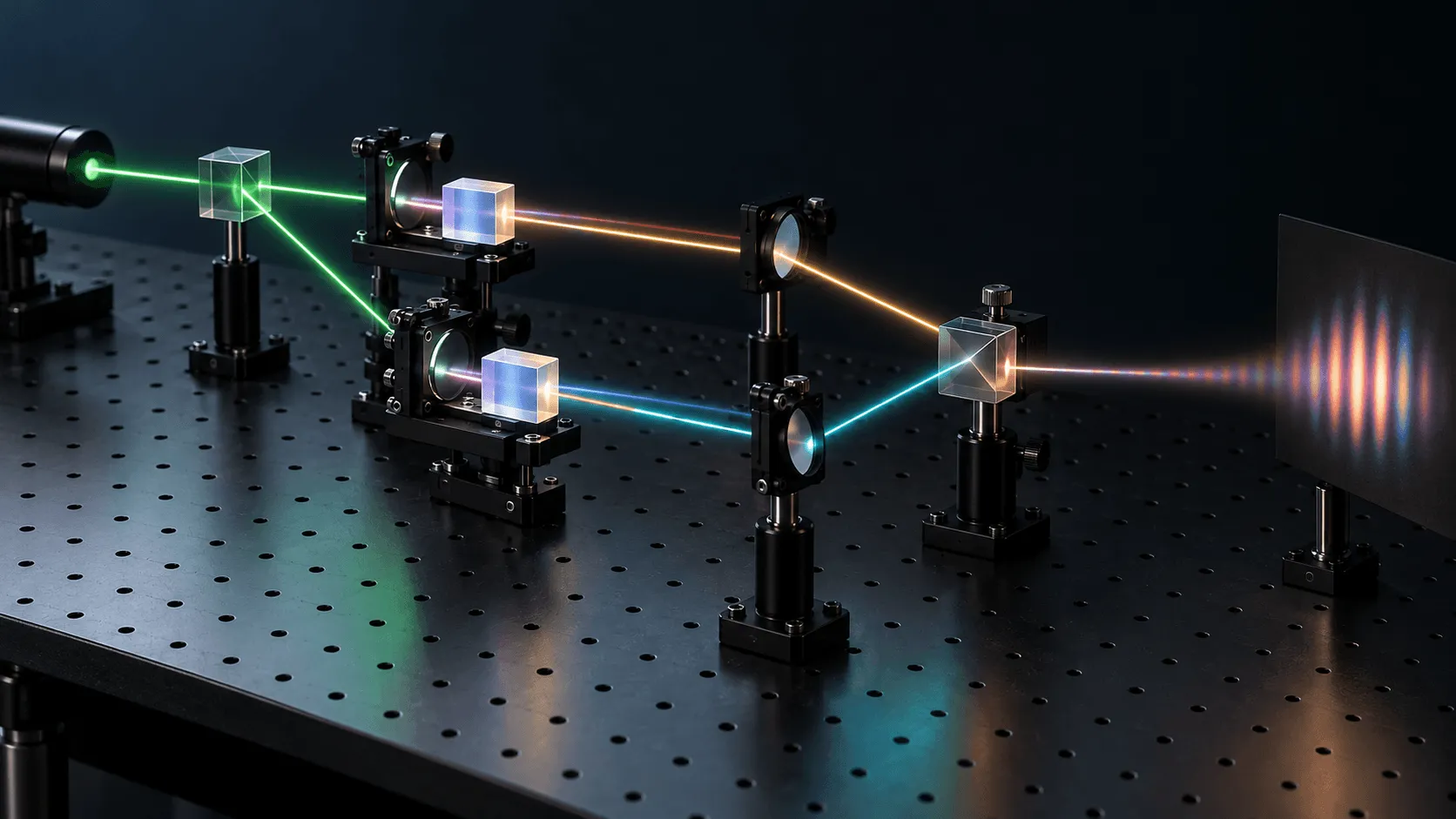
Yoon applied this idea to the generation of photon pairs. Photon-pair sources made of a nonlinear optical material called PPLN are placed on the two paths and driven by a common pump beam at a wavelength of 530 nm. The pump beam supplies the energy needed to generate photon pairs, and its repetition rate is set at 250 MHz. In addition, an external "seed" beam at 1542 nm, which stimulates photon-pair generation, is injected, and a signal beam at 807 nm is extracted.
Here, shifting the relative phase between the pump and seed beams by π (180 degrees), or half a cycle, flips the sign of the control term V that represents the stimulated process. The paper writes the Hamiltonians corresponding to the two paths as "H± = H0 ± V." A Hamiltonian is the operator that governs the time evolution of a quantum state; in this expression, H0 represents the background of spontaneous photon-pair generation, and V is the interaction controlled from outside.
The important point is that the phase operation flips the sign of V, not of the entire Hamiltonian including H0. Fully reversing the time evolution of a quantum state would require flipping the sign of the whole Hamiltonian, H0 included. The relationship that holds in this proposal, in which a change advanced for a certain time in one path is advanced in the opposite direction in the other, is limited to the stimulated term V. In other words, "time reversal" here means reversing the change in quantum state produced by a controlled interaction, not rewinding physical time itself.
How the which-path information in the partner photon is erased
Preparing two optical paths alone does not guarantee that interference of the signal beam will be observed. If the "idler" beam, the other half of each photon pair, retains information that identifies which photon-pair source produced it, interference between the signal beam's paths is suppressed. Even if only the signal beam is observed, its quantum correlation with the idler beam affects whether interference can occur.
The externally injected seed beam plays the role of solving this problem. Using a common, strong seed beam makes it hard to distinguish a state in which one photon was added in one path from a state in which it was added in the other. If the generation path of a photon pair can no longer be identified from the idler beam, interference arises between the signal beam's two paths. The paper explains that, through this mechanism, interference is established without physically overlapping the two idler beams.
Yoon quantified this relationship using the visibility of the interference fringes. Visibility is the difference between the maximum and minimum detection rates divided by their sum; the closer it is to 1, the clearer the fringes. Assuming ideally overlapping optical modes, a low photon-pair generation rate, and symmetric paths, visibility is given by n/(1+n), where n is the effective mean photon number of the seed beam.
Under this formula, visibility is 0 at n = 0, 0.5 at n = 1, and 100/101, or about 0.990, at n = 100. These, however, are theoretical values under idealized conditions. In a real optical system, factors such as how well the optical modes overlap also affect fringe visibility, so the seed photon number alone does not determine the measured result. Moreover, the study deals with the relationship between information that could identify the photon-pair generation path and quantum correlation; it does not demonstrate a causal relationship in which photons act on past events.
Figure 4 (measured data) and Figure 5 (theory) must be kept apart
The most important point in evaluating the paper is the difference between Figures 4 and 5. Figure 4 shows interference data measured in earlier research, whereas Figure 5 is based on a theoretical calculation that assumes phase-stabilized conditions. The two differ in the nature of the evidence they provide, and it cannot be interpreted that the control operations depicted in Figure 5 have been confirmed experimentally.
This difference can be verified from the figure captions, data availability statement, and Supplementary S6.4 of the 2026 paper. In the data availability statement, Yoon explains that the experimental data in Figure 4 were adapted from reference [2], which refers to the original 2018 paper. However, the main text also cites another reference for part of Figure 4, so it is not accurate to assume that all of the data in Figure 4 come from a single 2018 experiment.
| Item compared | Type of evidence | Measurement conditions / assumptions | What can be concluded |
|---|---|---|---|
| Figure 4 of the 2026 paper | Measured interference data from existing work | Phase scanned without active closed-loop path stabilization | Supports that the interference phenomenon was observed. It does not demonstrate the full sequence of state-control operations newly proposed |
| Figure 5 of the 2026 paper | Theoretical calculation | Assumes closed-loop phase stabilization | Shows the possibility of state control and state recovery under the assumed conditions. It is neither an independent experiment nor a replication |
Figure 5 depicts trajectories representing state preparation, readout, and the process of returning a state to its original form, but these presuppose closed-loop control that continuously detects and corrects phase drift. The phase scan in Figure 4, by contrast, was measured without such active path stabilization. Therefore, the fact that interference was confirmed in Figure 4 does not mean the sequence of state operations assumed in Figure 5 has been achieved experimentally.
The main basis for the existing experiment is the peer-reviewed paper "Frequency comb single-photon interferometry", published by Sun Kyung Lee and colleagues in the journal Communications Physics on September 4, 2018. Its DOI is 10.1038/s42005-018-0051-2. That study reported a high interference visibility of 0.99, but this value was obtained after subtracting the detector's steady background signal from the raw data. Although the number is close to the roughly 0.990 obtained from the theoretical formula above, the two were derived on different bases, and it cannot be concluded that performance improved by comparing them.
The 2018 experiment used an optical system with a low photon-pair generation rate. A pulse repetition rate of 250 MHz corresponds to an interval of 4 ns, and the camera integrated signals from 2.5 million pulses over a 10 ms exposure. The mean number of signal photons was about 0.02 per pulse, so not every pulse contained one photon. The measurement was made under low-generation-rate conditions in which single-photon events dominate, and the 2.5 million integrated pulses cannot be equated with the number of independent trials or the number of qubits.
The error bars attached to the experimental results represent the standard deviation of values obtained from multiple measurements. However, the number of measurement repetitions is not stated in the main text or figure captions of the original paper. The number of integrated pulses and the number of times the measurement itself was repeated must be treated separately.
Applications to quantum computing need further demonstration
Yoon also proposes a method for reconstructing the components of a quantum state from the difference and sum of the photon count rates detected at the two outputs. He further shows that the "Loschmidt echo," which expresses how much states that have undergone reversed time evolution overlap, might be evaluated from photon counts. This is an attempt to move the concept of interaction reversal beyond a theoretical metaphor and connect it to the actual control and measurement of quantum states.
The paper also lists "no need for post-selection" as an advantage, but its meaning needs care. Post-selection refers to extracting and analyzing only events that satisfy certain conditions after measurement. The claim here is that the operation of selecting particular detection events through coincidence counting becomes unnecessary; it does not mean that photon loss or the vacuum component, in which no photon is present, can be eliminated.
Even if the concept of controlling a single qubit holds, that alone does not make general-purpose quantum computing with many qubits possible. General-purpose quantum computation requires additional mechanisms, such as gate operations that entangle multiple qubits. The paper also mentions applications such as quantum error correction, integration of optical systems, and simulation of relativistic phenomena, but all of these remain at the proposal stage. No measurement results demonstrating faster computation or practical quantum error correction are presented.
The 2018 interference experiment is a peer-reviewed result, but that fact does not mean the new 2026 interpretation has been academically verified. In a search by paper identifier and title through October 25, 2026, no independent replication supporting this interpretation was found. The focus going forward is whether the full sequence of operations, from quantum state preparation through control to readout, can be reproduced in an actual phase-stabilized apparatus. If that verification advances, it will become clear how far existing photon interference phenomena can be used as a technology for controlling changes in quantum states in the reverse direction.