

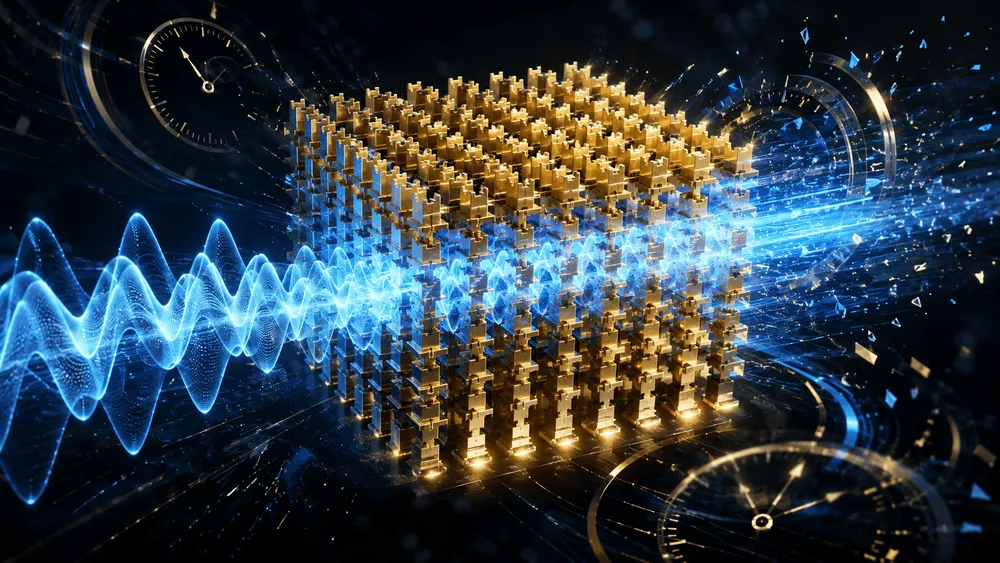
Our lives today are underpinned by the precise control of light. From the massive intercontinental submarine fiber-optic networks to the barcode readers at supermarket checkouts, technologies that manipulate the wavelength and direction of light form the foundation of modern society. For a long time, humanity has controlled light by changing the curvature of lenses, the angle of mirrors, or the composition of materials. But now, a concept that once sounded like science fiction—controlling light not through spatial patterns but through the periodicity of "time"—has for the first time been demonstrated in an actual device.
In July 2026, an international research team consisting of École Polytechnique and Collège de France in France, along with the Helmholtz-Zentrum Dresden-Rossendorf (HZDR) in Germany, announced in the journal Nature that they had successfully created an all-optical photonic time crystal (PTC). This achievement adds an entirely new dimension to how light interacts with matter.
The Limits of Spatial Lattices and the Terahertz Wall
Until now, humanity has primarily controlled light by engineering the "spatial structure" of materials. The pinnacle of this approach is the photonic crystal, which emerged in the 1980s. By arranging materials with different refractive indices into a lattice with precision on the scale of a few nanometers to a few micrometers, photonic crystals allow only specific wavelengths of light to pass through or be reflected. Just as semiconductors control the flow of electrons, photonic crystals direct the traffic of light particles—photons. This technology has contributed enormously to the development of today's high-performance lasers, photodetectors, and advanced optical communication infrastructure.
However, control via spatial lattices has a fundamental limitation: once the structure is fabricated, its properties remain static. While it was possible to slightly alter the refractive index by applying an external magnetic field or changing the temperature, it was extremely difficult to dynamically control the material's properties at speeds matching the oscillation of the light wave itself.
Furthermore, the "terahertz wave" region that the research team targeted occupies a peculiar position within the electromagnetic spectrum. Terahertz waves oscillate roughly 1,000 times faster than the frequency limits of today's best-performing electronic components, yet they are slower than the infrared light used in fiber-optic communications. This band, lying right between electronics and photonics, forms the backbone of next-generation ultra-high-speed communication standards (6G and beyond), enabling the instantaneous transmission of massive amounts of data. In medical imaging, because terahertz waves lack the ionizing effects of X-rays that can damage cells, they are also expected to be put to practical use as a safe, non-destructive method for internal imaging and inspection of the human body. Despite this potential, convenient means of freely controlling, generating, and detecting terahertz waves have long been lacking—a technological void known as the "terahertz gap." Existing electronic circuits cannot keep up with these frequencies, while conventional optical components are too large relative to the wavelength of terahertz waves—a dilemma that has persisted for years.
Rewriting a Material's Optical Properties in Picoseconds
To fill this technological void, the research team brought the relatively new physics concept of the "time crystal" into the realm of light control. A time crystal refers not to a spatial arrangement, but to a state in which temporal change repeats regularly and periodically. It is a phase of matter in which the system itself continues to change in a specific pattern over time, even without a continuous external supply of energy. Over roughly the past decade, physicists have been advancing experimental verification of this bizarre state of matter.
To fuse the properties of this time crystal with those of a photonic crystal, the École Polytechnique team constructed a special structure known as a "plasmonic metamaterial." The device's structure is minute yet complex. On top of a base layer of indium antimonide (a compound of indium and antimony—a semiconductor with excellent optical properties in the infrared and terahertz range), an insulating layer is deposited, and on top of that, a "crenellated" gold structure on the micrometer scale is arranged. This gold structure, shaped like the battlements of a castle wall, functions as a type of cavity, trapping photons—the particles of light—between itself and the semiconductor layer.
When light strikes this structure, the free electrons on the semiconductor surface are excited into behaving collectively like a wave, a phenomenon known as a "surface plasmon." These electrons couple with the light wave and play a role in sustaining its oscillation. By firing a terahertz-band laser pulse into this system, the team was able to instantaneously alter the electrons' state of motion.
Overcoming the Limits with the Power of a Massive Accelerator
Rewriting a material's optical properties in sync with the oscillation of light itself posed a significant technical hurdle. It was not enough to simply change the properties—the refractive index had to be altered dramatically, "as if the material were suddenly emitting an entirely different color," and this change had to be completed within an extremely short window of time: picoseconds (one trillionth of a second). A typical tabletop laser setup was incapable of generating terahertz pulses with both sufficiently high power and phase stability to achieve this. This was because, in the terahertz range, there had been no efficient light source capable of concentrating high-energy photons into short pulses.
What broke through this barrier was TELBE, a superradiant terahertz light source attached to ELBE, the particle accelerator facility at Germany's HZDR. Only with the help of a powerful electron beam was the research team able to fire terahertz pulses with extremely high electric fields and coherent phase into the plasmonic metamaterial. This infrastructure—which accelerates a bunch of electrons to nearly the speed of light and causes the collective to emit strong electromagnetic waves—offers pulse intensities and a degree of control that tabletop lasers simply cannot match.
Under the influence of the terahertz wave's strong electromagnetic field, the electrons at the semiconductor surface rapidly change their effective mass. As the electrons become heavier and their movement slows, the device's overall optical properties—such as reflectivity and resonant frequency—are rewritten within a picosecond timescale. To use an analogy, it is as if the color of a window pane or the reflectivity of a mirror transformed into an entirely different property in an instant faster than light itself could pass through. As Jan-Christoph Deinert of HZDR points out, without this specialized accelerator facility, the coherent, ultrafast modulation required for a photonic time crystal could not have been achieved.
A "Wall of Time" That Prevents Photon Dissipation
This extremely rapid temporal modulation produced a result that runs counter to our everyday intuition about the behavior of light. In ordinary metamaterials, some of the photons trapped within the cavity inevitably escape—either by passing through the material or being lost as heat within the metallic structure (dissipation). No matter how thick a spatial wall (a highly reflective mirror or a precisely engineered photonic crystal) is designed to be, absorption by the material itself or minute structural defects have always prevented complete suppression of photon dissipation in the terahertz band.
However, when the optical properties of this plasmonic metamaterial were modulated temporally on a picosecond scale, photon dissipation was confirmed to drop to half of its normal level. This demonstrates that by manipulating not a spatial wall but a "wall of time," it is possible to block the photon's escape route and prevent loss. Because the material's properties switched so rapidly, the very process by which photons would transmit through the material and escape was temporally cut off.
The theoretical model constructed by the research team at Collège de France also supports this phenomenon. The behavior of light observed in the experiment matched precisely with the values predicted by the theoretical equations. This is not a matter of chance or measurement error—it means that what is happening inside a photonic time crystal can now be clearly described and controlled according to physical law. With both theory and experiment now aligned, the foundation for future device design has been laid.
Light Amplification Awaiting Observation, and Future Prospects
This achievement marks a milestone that extends the paradigm of light control in the terahertz range from space into time. It represents a new tool for manipulating light in a frequency band that electronic components cannot reach and that conventional optical components could never fully control. Yet, unresolved scientific questions still remain.
The research team suspects that photons trapped within the crystal may not only avoid dissipation but also be "amplified" inside the device through effects unique to time crystals. Although the indirect data showing that photon dissipation was halved contain hints suggesting an increase in the total number of photons, the team has not yet been able to directly observe this amplification phenomenon itself. The team is currently continuing experiments aimed at directly capturing how light caught in this "photon trap" multiplies over time.
If this amplification is clearly confirmed, and if its efficiency can be artificially enhanced, it would lead directly to the development of terahertz lasers—optical systems capable of instantaneously switching the color and intensity of light at speeds matching the oscillation of light itself. Should this be realized, it would bring closer to reality medical devices capable of non-invasive, molecular-level diagnosis of living tissue, environmental sensors that can instantly identify airborne pollutants, and ultra-high-speed wireless communication networks that could surpass today's fiber-optic communications. In order to further push the limits of information and communication technology, and to obtain a new set of eyes capable of peering deep into the heart of matter, the field now awaits direct proof of "photon amplification" from the next round of experiments.