

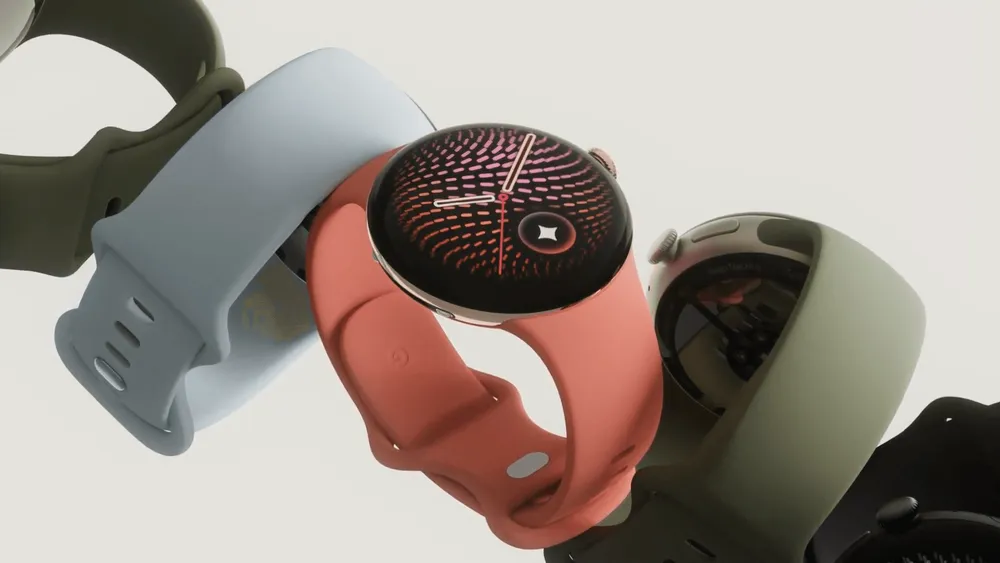
The newly announced "Pixel Watch 5" from Google is available for preorder on the Japanese Google Store starting at 62,800 yen. It comes in two sizes, 41mm and 45mm, and features a Snapdragon W5 Gen 2 Accelerated chip with a Cortex-M55 co-processor, 64GB of eMMC storage, and Wear OS 7.
The product page states that it's 20% faster than Pixel Watch 4. However, judging the generational gap based solely on buzzwords like AI, dual-frequency GPS, and long battery life can easily lead to a mistaken picture. Pixel Watch 4 already had on-device Smart Replies, dual-frequency GPS, and comparable stated battery life and charging speeds. The value of Watch 5 doesn't lie in introducing these features for the first time, but rather in how it improved processing performance, updated storage capacity and the OS, and layered in plans for new health features.
20% Faster and 64GB: What's Built on Top of Watch 4
In terms of hardware, the most obvious change in Pixel Watch 5 is the increase in storage to 64GB. Pixel Watch 4 had 32GB, so Watch 5 doubles the capacity. Wear OS also advances from Watch 4's Wear OS 6 to Wear OS 7. While Google cites the same Snapdragon W5 Gen 2 family and Cortex-M55 combination, it describes Watch 5 as 20% faster than Watch 4.
The minimum smartphone requirements for pairing have also changed. Pixel Watch 5 supports most devices running Android 12 or later, and requires a Google account and the Pixel Watch app. Pixel Watch 4 required Android 11 or later. For users still holding onto older Android devices, it's necessary to check not just the watch's storage and display, but also the requirements for the smartphone it will pair with.
| Item | Pixel Watch 5 | Pixel Watch 4 | How to Read the Comparison |
|---|---|---|---|
| Processing Performance | Google states 20% faster than Watch 4 | Snapdragon W5 Gen 2 / Cortex-M55 | Chip name alone doesn't fully explain the generational gap |
| Storage | 64GB eMMC | 32GB | Storage capacity doubled |
| OS | Wear OS 7 | Wear OS 6 | Software generation advanced |
| Controls | Touchless one-handed gestures | — | New control element added on Watch 5's side |
| Heart Rate Tracking | Same as Watch 4 | — | Not all health sensors have been overhauled |
Looking at the spec sheet side by side, it's natural to see Watch 5 not as a comprehensive redesign, but as an update focused on refining the data volume the watch handles on its own and everyday operations. The move to 64GB expands the room available for software and data stored on the watch itself. Whether Google's cited 20% figure translates into a noticeable difference—whether in touch operations while looking at the screen, or in the feel of switching between multiple features on Wear OS 7—remains to be evaluated.
Meanwhile, Google explicitly states that heart rate tracking is the same as on Pixel Watch 4. Just because health-related topics have increased doesn't mean the underlying measurement system has been uniformly updated.
Dual-Frequency GPS Carries Over from Watch 4
Google promotes Pixel Watch 5's high-precision GPS that uses machine learning. For regions including Japan, the specs include dual-frequency GPS supporting five satellite positioning systems including GPS.
However, dual-frequency GPS is also listed in Pixel Watch 4's spec sheet. Watch 5 isn't the first to switch to this positioning method. The stated battery life for always-on display mode—up to 30 hours for the 41mm and up to 40 hours for the 45mm—is also the same as Watch 4, and the condition of charging to 50% in about 15 minutes for both sizes carries over as well. The display's peak brightness of 3,000 nits is likewise unchanged.
What needs to be distinguished here is the difference between how existing positioning features are handled via software and machine learning, versus whether the GPS hardware method itself is new. The former is included in Google's explanation. As for the latter, comparing the spec sheets from Watch 4 to Watch 5 shows continuity.
To measure actual differences during activities like running or cycling, real-world testing would be needed—including in areas where satellites are hard to lock onto, at various movement speeds, and accounting for battery consumption. At the very least, based on the product specs alone, dual-frequency capability itself cannot be called a novelty of Watch 5.
The Health Features Coming in September Deal in "Trends"
What deserves the most careful reading with Watch 5 is the health features scheduled for release in September 2026. Google mentions blood pressure trends and insulin resistance trends. Both are general wellness-oriented features and are not intended for medical diagnosis or treatment.
Blood pressure trends do not mean real-time blood pressure measurement. Insulin resistance trends similarly are not a real-time glucose measurement feature. Google explicitly states these cannot be used to diagnose hypertension or diabetes, or to adjust medication or insulin dosages. While the product name and description of health features might suggest something closer to a medical device, what's actually being offered here is information intended to help users reconsider their lifestyle habits.
The value of new health-related features isn't determined solely by an increase in sensors on the watch. What matters is what exactly is being measured, what numbers are returned, and where the line is drawn for deferring to medical judgment. As for the September timeline, the available product page doesn't specify the target regions in Japan, supported models, or rollout order. There's no basis to assume that preorder customers in Japan will be able to use these features immediately upon release.
Safety features like loss of pulse detection also come with conditions. Google states that it does not detect every instance of pulse loss, and is not intended for people with pre-existing heart conditions or those who require continuous cardiac monitoring. Whether emergency calling is possible also depends on the watch's calling capabilities. In the health domain, it's better to check the scope of applicability first, rather than being swayed by the impression a feature's name gives.
Separating On-Device Smart Replies from Premium Health Coaching
Pixel Watch 5 introduces Gemini as a support feature for things like Raise to Talk and personalized assistance. Each Gemini feature comes with its own conditions—such as supported countries and languages, and a minimum age of 18—and more advanced use may require a subscription.
The term "on-device AI" also means different things depending on which processing it refers to. In January 2026, Google updated Smart Replies on Pixel Watch 3 and Pixel Watch 4 to an on-device model derived from Gemma. This allows replies to be sent even without a smartphone connection, and is said to be three times more memory-efficient and twice as fast as before. In other words, AI processing on the watch didn't suddenly begin with Watch 5.
In contrast, Google Health Premium's adaptive coaching requires a separately purchased subscription, the Google Health app, and an internet connection. Google's explanation doesn't support the claim that health coaching is entirely processed within the watch itself. Lumping together the reply feature that's fully self-contained on the watch with health support that assumes a service connection—both under the umbrella of "AI"—risks misunderstanding the actual usage conditions after purchase.
According to Google's update guarantee page, Pixel Watch 5's release month, based on the US Google Store, is October 2026, with the guarantee update deadline set for at least October 2029. At the point of preordering, comparing the regional rollout of the September-planned health features against the actual difference the 64GB storage increase and 20% speed boost make in daily use will be the key factor in deciding whether to upgrade from Watch 4.