


An international research team including MIT reported on November 19, 2026 that a primordial black hole captured by a star could grow inside it and ultimately cause the star to explode. According to the theoretical study, while the black hole swallows surrounding gas almost directly, it can keep growing without producing any major change in the star. But once the gas forms a rotating "accretion disk," the energy released could destroy the entire star. The peer-reviewed paper by Ore Gottlieb and colleagues, "The Life and Death of Stars That Capture Primordial Black Holes", was published the same day in The Astrophysical Journal, and MIT also announced the results.
Primordial black holes are hypothetical black holes thought to have formed shortly after the birth of the universe, and they are one candidate for dark matter. This study mainly targeted masses of to g, roughly the range from an asteroid to something lighter than the Moon. Using theoretical calculations and numerical simulations, the team examined the whole sequence: how a primordial black hole is captured by a star, how it grows in the core, the two possible outcomes (explosion or quiet disappearance), and the remnant black hole and observable light signatures. This is not a study that actually discovered a primordial black hole or a star explosion triggered by one; it examines concrete observational approaches for confirming their existence.
Captured by the gravity of a planet or companion star, then growing in the stellar core
When a small black hole drifting through space passes through a star once, it normally just continues on through. It experiences drag from the star's gas but does not lose enough kinetic energy. The team therefore considered capture pathways that make use of the gravity of a planet orbiting the star, or of the other star in a binary system. Through gravitational interactions among the three bodies, a black hole that was originally not bound to the star can be shifted onto an orbit that passes repeatedly through the star's interior.
Once captured, the black hole is slowed by gravitational interaction with the surrounding gas as it passes through the star again and again. This is due to "dynamical friction," in which gas pulled in by the black hole's gravity impedes its motion. The orbit gradually loses energy, and the black hole sinks toward the star's center. However, being captured by the star's gravity in the first place and reaching the center within the star's lifetime are governed by different conditions.
For example, in a system consisting of a Sun-like star and a Jupiter-like planet, the calculations showed that a black hole would need a mass of about g or more to reach the center within the lifetime of the star's main-sequence phase, during which it fuses hydrogen in its core. Lighter black holes would require a companion star on a closer orbit or more favorable capture conditions. When the mass falls to about times that of the Sun (one ten-quadrillionth), the hosts in which the black hole can reach the center in time are limited to systems such as low-mass M-type stars with a companion orbiting on an extremely short period.
Even after reaching the center, the black hole does not immediately trigger an explosion. In the early stage, the surrounding gas has little angular momentum and falls onto the black hole in a nearly spherically symmetric manner. This kind of inflow is called "Bondi accretion." Because most of the energy generated by the infall is carried into the black hole along with the gas, the force pushing back on surrounding material is weak, and the black hole can grow without causing noticeable changes to the star.
In a related preprint that examined this early growth in detail, Matteo Cantiello and colleagues numerically calculated spherically symmetric gas flow assuming conditions in the Sun's core. They found that accounting for radiative cooling of the gas increases the inflow rate by roughly 2 to 7 times compared with conventional Bondi accretion without cooling. They also showed that radiative efficiency varies with the black hole's mass, and that the effect of light being carried into the black hole along with the inflowing gas is important.
For the growth of black holes inside stars, earlier research published in 2024 had also examined a model in which radiative efficiency drops because light is trapped in the gas. What distinguishes the present study is that it connects this accretion physics to capture by planets or companion stars, to stellar rotation, and to the conditions leading to an explosion.
Whether an accretion disk forms determines the star's fate
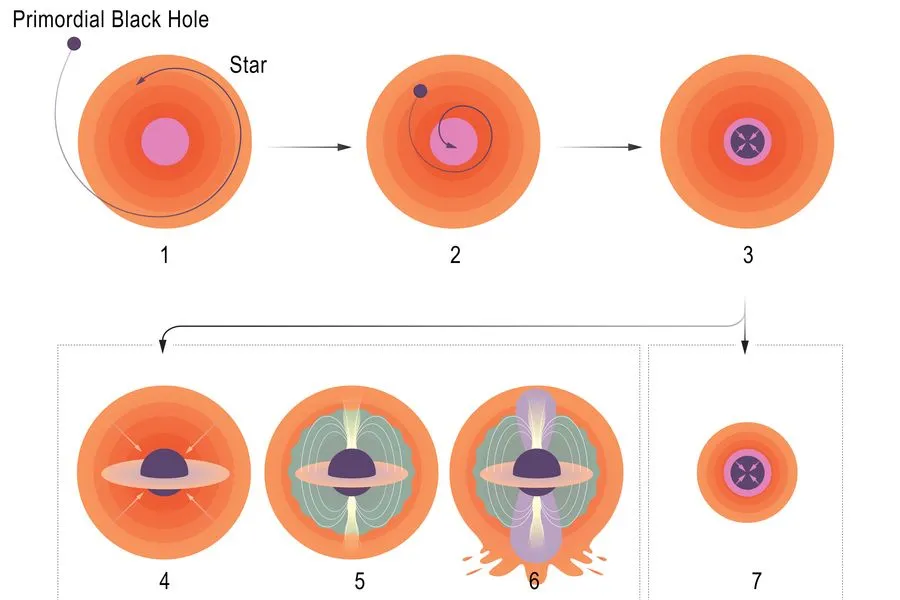
As the black hole grows, the region over which its gravity affects the surrounding gas also expands. The gas drawn in then carries more angular momentum and is less likely to fall straight into the black hole. If there is enough angular momentum, the gas forms an "accretion disk," spiraling in around the black hole. Disk formation requires that the gas can move in circular orbits outside the black hole's innermost stable circular orbit.
Once an accretion disk forms, part of the energy released by the infalling gas begins to be transferred to the surrounding stellar material. This happens because "disk winds," streams of gas blowing off the disk, and "jets," narrowly collimated high-speed streams of matter, push aside the surrounding gas and generate shock waves. If the energy released exceeds the binding energy holding the star together gravitationally, the star is destroyed.
On the other hand, stars can spin more slowly as they age. If the star loses its angular momentum before the black hole has grown enough, the black hole mass required to form an accretion disk can exceed the mass of the entire star. In this case, the black hole quietly swallows the star without producing powerful disk winds or jets.
Using a stellar population model, the research team calculated the fractions of the two outcomes while accounting for the black hole's initial mass, the timing of capture, and changes in the star's rotation speed. According to Table 3 of the paper, for an initial mass of times the Sun's (one hundred-billionth), 23.2% ended in explosion and 76.0% in quiet consumption. For an initial mass of times the Sun's (one ten-quadrillionth), the explosion fraction rose to 52.2%.
| Initial primordial black hole mass | Explosion | Quiet consumption | No outcome during main sequence |
|---|---|---|---|
| solar masses (one hundred-billionth) | 23.2% | 76.0% | 0.8% |
| solar masses (one ten-quadrillionth) | 52.2% | 44.8% | 3.0% |
These fractions are model results for cases in which primordial black holes of each initial mass were able to reach the center of a star, and each row sums to 100%.
The explosion fraction is higher for lower-mass black holes because the stellar systems that can carry a lighter black hole to the center are limited. Such hosts include many relatively fast-rotating low-mass stars, which favor accretion disk formation. In other words, the figures do not compare black holes of different masses placed in the same star; they also reflect differences in the types of stars that can capture them. "No outcome during main sequence" means that neither an explosion nor complete consumption occurs while the star is fusing hydrogen, and it does not determine the star's later fate.
The 3D simulation tracked only 0.78 seconds after disk formation
The team calculated the process by which a black hole grows inside a star and forms an accretion disk using the stellar evolution code MESA. Assuming a rotating star with the same mass and metallicity as the Sun, a black hole with an initial mass of solar masses reached the conditions for accretion disk formation in about 70 million years, and one with solar masses did so in about 9 billion years.
These calculations used four models that varied the initial black hole mass and the star's rotation rate. However, the black hole was placed at the star's center from the start, so the calculation does not reproduce the process of capture from space. The radiative and dynamical effects the black hole has on its surroundings before disk formation are also omitted. While the stellar population model accounts for rotation slowing over time, in the MESA calculations the surface rotation rate stayed nearly constant. The values of roughly 70 million years and 9 billion years represent growth times obtained under these conditions.
The team then carried the stellar interior structure at the moment of disk formation into a three-dimensional simulation, calculating the motion of gas and magnetic fields near the black hole using general relativistic magnetohydrodynamics (GRMHD). At this stage, the black hole's mass was set to about 0.04 solar masses. The simulation was run until 0.78 seconds after disk formation, and by the final time the shock wave driven by the jet had reached about 2,400 km from the center.
In this early stage, the hydrodynamic disk wind blowing off the accretion disk was the main source of energy. A jet moving at nearly the speed of light was also produced, but its advance was impeded by the pressure of gas falling in from the surroundings, and it was seen to change direction and erupt intermittently.
The team predicts that as magnetic flux later accumulates around the black hole, the system will shift into a "magnetically arrested disk (MAD)" state, in which a strong magnetic field impedes the inflow of gas, and a sustained, powerful jet will form. The jet and disk wind would ultimately destroy the entire star. However, what the 3D simulation actually tracked was only the 0.78 seconds immediately after disk formation; it did not calculate the formation of a steady, strong jet or the explosion of the whole star.
The main stages and results covered in the study are as follows.
| Calculation target | Method and main results |
|---|---|
| Long-term growth up to disk formation | MESA stellar evolution calculations. Growth times of about 70 million and about 9 billion years for the models set up |
| Just after disk formation | Tracked to 0.78 seconds in a 3D simulation. Disk wind carried the energy, and the shock reached about 2,400 km |
| Destruction of the whole star | Analytical prediction of seconds to minutes. If a sustained jet does not form, minutes to about 1 hour |
These are based on Sections 9 and 11 of the paper. The time to destruction of the entire star is an analytical estimate, not a result reproduced through to the end by the 3D simulation.
Among the computational limitations, the magnetic turbulence arising inside the accretion disk could not be tracked at sufficient spatial resolution. The final behavior of the jet also has not reached the stage of confirming that results stay unchanged as resolution is increased. To predict the explosion's brightness and duration more accurately, it will be necessary to calculate the post-disk-formation evolution over longer times and at higher resolution, and to examine how light propagates outward through the ejected material.
What to observe to find explosions caused by primordial black holes
The team predicted that if a star explodes, light at different wavelengths would be observed over time. In Table 5 of the paper, the radiation at each stage is roughly estimated using a representative case of a Sun-like star and a black hole with about 0.08 solar masses at the time of disk formation. Right after the explosion, a short, high-energy flash occurs when the shock wave reaches the star's surface; then the ejected gas expands and cools, emitting ultraviolet and blue visible light. As more time passes, a radio afterglow, produced when the ejecta interact with surrounding gas, becomes the observational target.
The expected signals include hard X-rays and soft gamma rays from the jet, a shock-breakout flash lasting under a second, ultraviolet and blue light lasting about a day, and a radio afterglow from several days onward. However, high-energy emission from the jet would be seen only if the jet escapes the star and points toward the observer.
| Observational signal | Typical timescale | Wavelength and characteristics |
|---|---|---|
| Prompt emission from the jet | Within minutes | Hard X-rays and soft gamma rays. Requires jet escape and a favorable viewing direction |
| Flash as the shock reaches the surface | Under 1 second | Hard X-rays and soft gamma rays. Less dependent on viewing direction than the jet |
| Glow from cooling ejecta | About 1 day | Ultraviolet and blue visible light. Emitted in nearly all directions |
| Radio afterglow | Several days onward | Produced by interaction between the ejecta and surrounding gas |
The times are typical durations of each signal or rough guides to when it is observed; they do not represent durations all starting from the same moment.
The luminosity of the blue light produced by cooling was estimated at about erg/s. Although dimmer than the short high-energy flash, it lasts about a day and can be observed from nearly all directions, which is an advantage for searches. On the other hand, if the jet escapes the star at a high rate, searching with bright high-energy emission could be advantageous for reaching farther distances.
Which wavelength to prioritize depends on the rate of explosions and the jet escape fraction. If jet escape is rare but explosions themselves are relatively frequent, searches using ultraviolet and blue visible light lasting about a day would be promising. Conversely, if the explosion rate is low, high-energy emission, which can be observed from farther away, might be more advantageous for finding the first candidates.
However, this emission is not unique to primordial black holes. Ordinary supernovae and low-luminosity gamma-ray bursts can also show similar wavelengths and time evolution. The team therefore stresses that it is important to combine the light from the explosion itself with the environment in which it occurred and with observational records from before and after the explosion.
For example, an explosion occurring in an old stellar population, which is hard to explain with the end of an ordinary massive star's life, and showing strong radio or high-energy emission relative to visible light, would be grounds for considering a primordial black hole explosion. On the other hand, if sustained or repeated X-ray activity was observed before the explosion, one must also consider the possibility of an X-ray binary, in which a compact object such as a black hole draws in gas from a companion star. In post-explosion observations, whether the star that originally supplied the gas remains is also a clue.
In ordinary supernovae, the decay of the radioactive isotope nickel-56 can keep the light going for a relatively long time after the explosion. Because the present model does not assume a long-lived component from radioactive nickel, the absence of a characteristic "tail" in the late light curve is also a clue. However, other transients share similar features, so it is necessary to examine differences from ordinary core-collapse supernovae and low-luminosity gamma-ray bursts by combining the time evolution of the emission with the environment and past activity.
Explosion rates, and the low-mass black holes left behind
How many explosions would actually be found is not determined by the brightness of individual explosions alone. It depends on many conditions: how often stars capture primordial black holes, the fraction that go on to explode after capture, the sky area and cadence of telescope surveys, and the jet escape fraction and direction.
Assuming that all dark matter consists of primordial black holes, the team roughly estimated capture frequencies. Converting the mass-dependent estimates in Table 1 of the paper to the same units, the capture rate spans a very wide range, from about to 100 events per year per cubic gigaparsec (Gpc³) of the universe. This value is only the frequency at which stars capture primordial black holes, not the actual number of explosions. Moreover, because the capture rate is proportional to the fraction of dark matter made up of primordial black holes, a smaller abundance would lower the rate.
The black holes left after the explosion also offer clues for finding primordial black holes. In the team's model, a rapidly spinning black hole with a mass of roughly 0.01 to 1 solar masses is left behind. If a black hole below one solar mass, which is difficult to form through ordinary stellar evolution, were found in the future through gravitational-wave observations of a merging binary, it could be strong evidence of a different formation pathway.
However, to observe such gravitational waves, the remnant black hole would need to form a binary and merge within the age of the universe. In the search approach the team outlines, combining multiwavelength emission from the explosion, the characteristics of the stellar population in which it occurred, and the mass and spin of the remnant could allow the primordial black hole hypothesis to be tested through observation.