


On August 25, 2026, Qualcomm announced that its next-generation Oryon CPU for premium smartphones will reach 5GHz. According to the company, this marks the first time a mobile CPU has hit the 5GHz mark. Along with the higher peak clock speed, the preview introduced "Oryon FlexCache," which allows Prime and Performance cores to draw from a single shared cache pool. The goal is to reduce the time compute units spend waiting for data.
The announcement is a technical preview ahead of Snapdragon Summit 2026, and Qualcomm has not even disclosed the official name of the SoC that will use this design. No benchmarks have been shared either. To connect the 5GHz figure to real-world smartphone speed, two separate questions need to be considered: how much latency FlexCache can actually eliminate, and how long the peak clock speed can be sustained under power and thermal constraints.
5GHz Is About 5.5% Above the Current Official Maximum
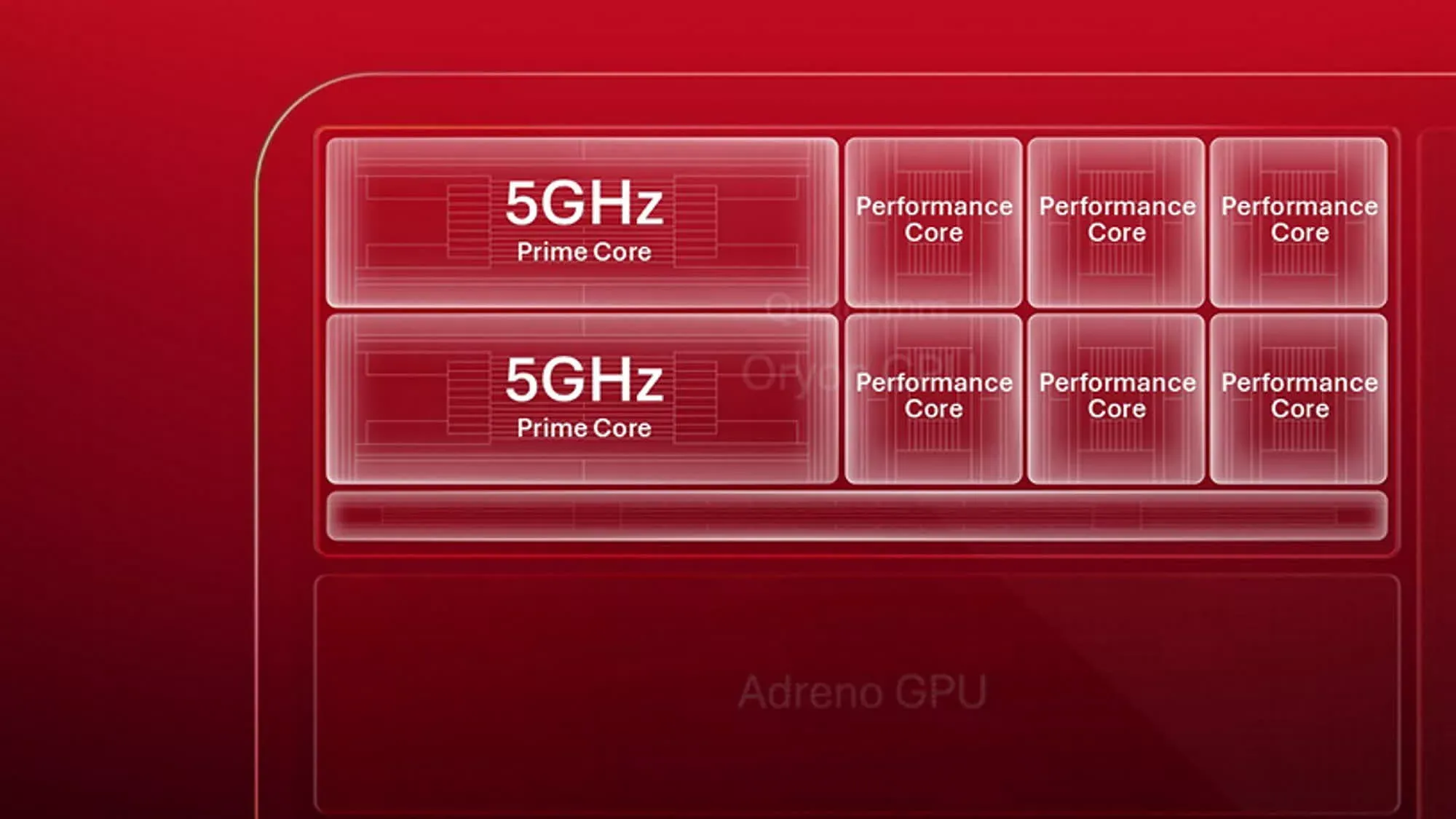
The diagram Qualcomm released shows two Prime cores running at 5GHz alongside six Performance cores. The overall configuration of eight cores in total matches the current Snapdragon 8 Elite Gen 5. Since the frequency of the Performance cores was not disclosed, the only confirmed numerical change so far is the ceiling for the Prime cores.
Qualcomm's official page lists the Snapdragon 8 Elite Gen 5's peak clock speed as 4.74GHz. The gap to 5GHz is 0.26GHz, or roughly a 5.5% increase. There is also a 4.6GHz variant, from which the increase would be about 8.7%. However, this is simply a ratio derived from peak frequency alone — it does not mean CPU performance scales by the same percentage.
| Confirmed in official information | Snapdragon 8 Elite Gen 5 | Next-gen platform preview |
|---|---|---|
| Prime cores | 2, up to 4.74GHz | 2, 5GHz |
| Performance cores | 6, up to 3.62GHz | 6, frequency not disclosed |
| Product status | Product name and specs already announced | Neither official name nor model number disclosed |
| New cache technology | No mention of FlexCache | FlexCache introduced |
Frequency refers to the number of operating cycles a CPU can execute per second. The actual amount of work completed also depends on instructions per cycle (IPC) and how often execution stalls while waiting for data. Qualcomm states that the new Oryon delivers higher IPC, but has not specified by how much. At this stage, 5GHz represents a stated ceiling, not a measured result of real-world performance.
Combining Prime and Performance cores is not itself new. According to Qualcomm's own explanation of Oryon, power-efficient Performance cores were introduced in the second generation. In the current third generation, CPU technology is shared across PC and mobile platforms, with Prime and Performance cores combined depending on the use case. What's new this time isn't the use of mixed core types — it's that the different core groups can now draw from the same dynamic cache pool. Notably, Qualcomm has also not disclosed which generation number the new Oryon belongs to.
FlexCache Reduces Idle Fixed Allocation and Core-Migration Wait Times
CPUs place data needed for computation into cache, which is smaller and faster than system memory. According to Qualcomm's explanation, each Oryon core has its own L1 instruction cache, while a larger L2 cache sits close to the CPU complex. Previous generations of Oryon also featured large L2 caches assigned per cluster.
FlexCache extends this design across different core types. Prime and Performance cores access the same cache pool, with capacity dynamically allocated based on load. During heavy workloads, Prime cores can draw on the entire pool, making it easier to keep large working sets in cache. Here, a "working set" refers to the cluster of instructions and data that a given task repeatedly accesses over a short period.
Dynamic allocation also has the advantage of reducing unused capacity. When cache is fixed per core group, spare capacity on one side can go unused even if the other side needs more room for a large task. A shared pool allows spare capacity to be lent out based on where the workload is concentrated. On the other hand, if both Prime and Performance cores demand large amounts of capacity at the same time, contention can occur. Since Qualcomm has not disclosed the allocation algorithm or the minimum capacity guaranteed to each core, FlexCache's advantages cannot be judged from total capacity alone.
Core migration is one scenario where this matters. When the OS shifts a task to a different core, if the necessary data remains in the shared pool, the destination core may be able to retrieve the same content without traversing additional cache layers or the interconnect as often. In cases where a working set would otherwise be evicted to a more distant layer, DRAM access can also be reduced. This can shorten latency and potentially lower the power used for data transfers. Even compute units capable of running at 5GHz gain nothing if they stall on every cache miss — FlexCache is designed to reduce that kind of idle time.
That said, Qualcomm has not explained whether FlexCache is the L2 cache itself or a separate layer. Total capacity, latency, and bandwidth remain undisclosed, as does the minimum capacity guaranteed to each core. The hierarchy cannot be determined from the official diagram alone.
The Impact on AI and Gaming Depends on the Working Set
Qualcomm cites agentic AI and gaming as target use cases, and also mentions multitasking and video editing. In an AI agent scenario, for example, a sequence of tasks unfolds as the system plans, calls tools, and receives results. If the core handling the task changes partway through but the same data stays nearby, the wait time each time a step is handed off can be reduced.
The aim is similar for gaming. As long as game state data and the information needed for the next frame fit within cache, it becomes easier to keep frame time variance low. In video editing, frames are passed between decoding, effects processing, and export, which involves handoffs between cores. All of these are use cases Qualcomm has presented, but no measured improvements in frame rate or processing time have been published yet.
FlexCache is also not a substitute for installed memory. Cache is far smaller than DRAM and serves only to temporarily hold data close to the processor while it's in use. If a working set exceeds the pool's capacity, DRAM access will still occur, and sufficient RAM is still required for data that multiple apps hold onto over long periods. Qualcomm's claim that performance is easier to maintain even under memory constraints applies only within the range where DRAM access frequency can be reduced.
Sustained Clock Speed and Power Consumption Will Determine the Real Verdict
Qualcomm emphasizes that reaching 5GHz was not achieved through process node shrinkage alone. The company says it jointly tuned custom microarchitecture, implementation choices, and the CPU subsystem as a whole. At the same time, Qualcomm has not disclosed the manufacturing process used for the new SoC, nor how many seconds one or two Prime cores can sustain 5GHz, nor how much power that requires.
In smartphones, brief peak performance and performance sustained after heat builds up don't always align. Instantaneous tasks like launching an app can benefit from a high boost clock, but workloads like gaming or video export depend more on the clock speed maintained after temperatures rise. Results also vary depending on a device maker's cooling design and power configuration.
If Snapdragon Summit reveals cache capacity, the conditions under which IPC comparisons were made, and power consumption under single- and multi-core loads, it will become possible to judge whether 5GHz and FlexCache function together as a coherent design. Once sustained performance figures under matching device conditions are also available, this preview will move from being a record-setting milestone to a demonstration of real-world progress.