

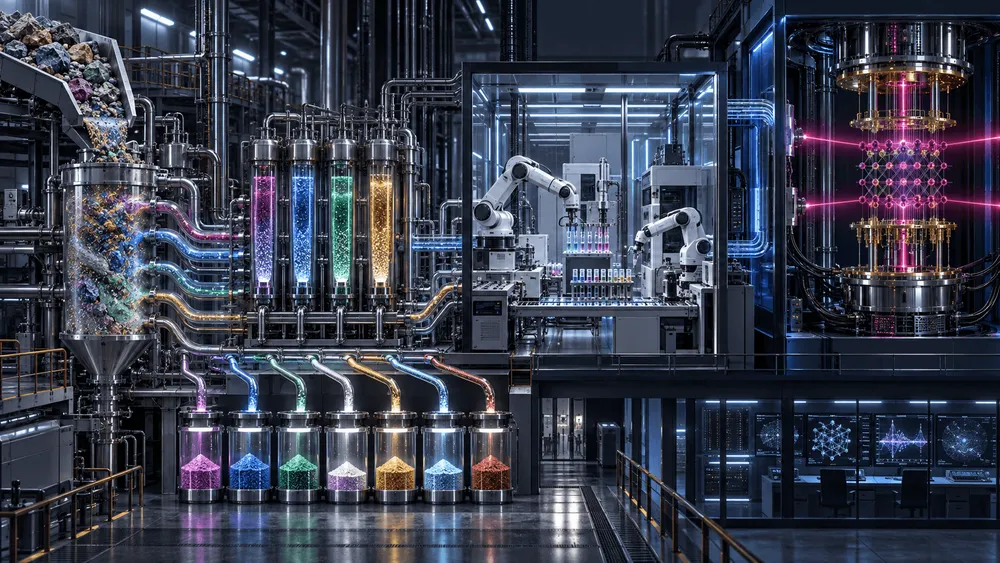
USA Rare Earth, French quantum computing company Pasqal and industrial chemistry AI firm Riven Systems have announced a plan to search for new rare earth extractants using quantum machine learning. Riven will generate training data from thousands of automated experiments, and Pasqal's neutral-atom quantum processing unit (QPU) will compare quantum and classical models. But a quantum computer has not separated any rare earths. What begins here is an attempt to find the chemistry that splits highly similar elements through a closed loop of experiments and computation. Its value will depend not on qubit counts but on whether candidate molecules can actually shorten processes that can run to hundreds of stages.
The role of quantum computing outside the separation equipment
The division of labor the three companies presented on September 17, 2026 is clear. Riven Systems will run thousands of experiments in its autonomous mineral-separation lab, generating data for learning extractant selectivity. Pasqal will compare a quantum machine learning model running on a neutral-atom QPU against classical models trained on the same data. USA Rare Earth will contribute its separation-process expertise and a place to test candidates on real feedstock.
The target materials are also chosen with practical use in mind: material expected to come from the Round Top deposit in Texas, mixed rare earth carbonate (MREC) supplied by third parties, and cutting scrap from neodymium magnet processing. In the plan, quantum machine learning selects promising extractants, Riven's autonomous lab tests them, and top candidates are validated at USA Rare Earth's R&D facility in Wheat Ridge, Colorado. Only then would a candidate be incorporated into the company's processing flowsheets.
The QPU, then, is not a device that shines lasers on ore to sort elements. It is part of a computational model that uses classical data from autonomous experiments to decide which molecule to try next. Nor, within what has been announced, is it "quantum chemistry simulation," in which a quantum computer directly calculates electronic states with high precision. The quantum feature map, circuit design, training method and number of qubits have not been disclosed.
The announcement says that if more strongly binding molecules are found, processing facilities could be made smaller and capital costs, operating costs and energy consumption could fall. All of these are future possibilities. In its disclaimers, the company also states that industrial applications combining quantum computing, AI and autonomous labs are new and relatively unproven, and that the effort may not yield practical molecular candidates.
Small chemical differences that create hundreds of stages of equipment
The difficulty of rare earths lies not only in getting them out of the ground. Elements such as neodymium, praseodymium, dysprosium and terbium behave similarly in chemical terms, making it hard to separate them from a mixture to high purity in one step. Solvent extraction, widely used for this, mixes an aqueous phase with an organic phase and exploits small differences in how readily a target element moves into one or the other. The process repeats mixing and settling many times to build up that difference.
According to a U.S. Department of Energy (DOE) report on the neodymium magnet supply chain, a solvent-extraction train can use up to several hundred mixer-settlers. Each unit consists of a tank that mixes solvent with feed solution and a tank that separates the light and heavy phases by gravity. DOE cites an example in which separating neodymium and praseodymium alone could require 30 units, and explains that the process consumes large volumes of acid, alkali and water. Reagent purchases and wastewater treatment translate directly into operating costs.
The extractant matters at the very start of this chain. If selectivity for a particular element improves even slightly, the number of stages needed to reach the same purity and recovery might fall. Fewer units could reduce not only plant footprint and capital cost but also residence time, solvents, wash solutions and wastewater. Conversely, an extractant that binds strongly in the lab is unusable in commercial processes if phase separation is slow, the molecule is fragile, it cannot be reused, or it is toxic or expensive.
DOE's "several hundred stages" and "30 units" illustrate industry structure; they are not USA Rare Earth's current equipment counts. Still, the reason the three companies tie molecular discovery to supply-chain competitiveness is clear. What they are aiming at is not just computational speed, but the very structure that has amplified small chemical differences across large plants.
Classical AI as the benchmark
Machine-learning searches for extractants did not wait for quantum computers. A peer-reviewed paper published in JACS Au in 2022 by researchers including those at Oak Ridge National Laboratory used a classical fully connected neural network to predict distribution ratios, which indicate how much a lanthanide moves into the organic phase.
The team collected 1,202 distribution ratios from the literature for 14 trivalent lanthanides and 109 ligands. Combining physicochemical descriptors of the molecules with atomic bonding information, the best model achieved a coefficient of determination (R²) of 0.85, a root-mean-square error (RMSE) of 0.53 and a mean absolute error (MAE) of 0.34 on the validation set. Because the model predicts the logarithm of the distribution ratio, these errors are not small. Even so, it serves as a starting point for screening large numbers of candidates.
The paper did not stop at prediction. The researchers synthesized four new diglycolamide-type ligands that were excluded from the training and validation data and compared them with measured values. For each ligand, R² between predicted and experimental values was 0.78 to 0.92, and MAE was 0.21 to 0.41. However, only four new ligands were tested, and the authors report large errors for molecules with functional groups that were scarce in the training data.
This earlier work gives concrete shape to the benchmark Pasqal's quantum model must clear. It has to use the same experimental data, match the training and validation splits, and be compared against strong classical models. Beyond predictive accuracy, comparison should cover whether it can extrapolate to unseen molecular scaffolds, how many hours training and inference take, and what the total cost is, including QPU usage fees. Beating a weak classical model would not demonstrate practical value for quantum computing.
Three hurdles quantum AI must clear
Before quantum machine learning reaches the supply chain, it faces at least three hurdles. The first is a computational comparison. The quantum and classical models are given the same training data and compared, including cross-validation, unseen molecular scaffolds, computation time, power consumption and cost. If accuracy is equal, the quantum model needs to show a different advantage, such as learning from less data or narrowing the candidate space faster.
The second is chemical experimentation. Molecules the model scores highly are synthesized, and distribution and separation factors are measured in mixed solutions containing dysprosium, terbium, yttrium and others. Beyond selectivity, the speed of phase separation, extractant stability and reusability, and tolerance to impurities must be confirmed. The autonomous lab's loop works only when hits and misses in prediction are fed back into the next round of learning.
The third is the process itself. Real feedstock is processed continuously, and the question is how many mixer-settler stages can be cut while maintaining purity and recovery. Reagents, water, wastewater, energy, throughput, and capital and operating costs will not necessarily all improve together. If an extractant improves one metric but is more expensive, competitiveness does not rise.
The announcements from the three companies confirmed as of September 20, 2026 lay out the division of roles and the design of comparison tests, but do not disclose extractant candidates, the predictive accuracy of the quantum model, its gap with classical models, or the reduction in equipment stages or energy.
That does not mean the project has failed simply because results are unpublished; it is at a stage before results. That is exactly why, when "quantum AI improves efficiency" is announced in future, it should be read in separate parts: which classical model it was compared against, whether candidates were synthesized, and whether process metrics improved on real feedstock. Folding all three into a single headline makes it impossible to tell research progress from marketing.
From Wheat Ridge to the supply chain
USA Rare Earth announced in June 2026 that it had begun operating a hydrometallurgical demonstration facility in Wheat Ridge. The facility has multistage solvent-extraction circuits, SCADA for real-time monitoring, and an on-site analytical lab. It handles three feed streams—Round Top ore, third-party MREC and magnet cutting scrap—which overlap with the materials named in the new partnership.
The facility is also where the company is de-risking three flowsheets in parallel: one for Round Top, one for tolling of external feedstock, and one for magnet recycling. USA Rare Earth says it will use process data as foundational data for a digital twin being developed with the National Energy Technology Laboratory, which is under DOE. The autonomous lab learns molecular selectivity, quantum and classical models narrow candidates, and Wheat Ridge validates them on real feedstock. If these three data systems can be connected, there is a path for turning computational improvements into plant design values.
Concentration in the supply chain is the backdrop to the urgency of that validation. According to the U.S. Geological Survey (USGS), China accounted for 68% of global rare earth mine production in 2023. Over 2020–2023, on average, 67% of U.S. apparent consumption of rare earth compounds and metals depended on supply from China. The former is a share of mine production and the latter is the share of import sources in U.S. consumption; neither is China's share of global separation and refining capacity. The figures measure different things, but they share a point: securing ore alone does not resolve midstream dependence.
A quantum model that only slightly outperforms classical models will not shift this concentration. The conditions are that candidate molecules reproduce on real feedstock, reduce equipment stages, reagents, water, wastewater or energy by a measurable margin while maintaining purity and recovery, and remain economical at commercial scale. If it gets that far, the three companies' closed loop could be assessed not as a quantum computing demo but as a manufacturing technology that expands Western separation capacity.