


A fusion reactor generating 1 gigawatt of power consumes about 1 pound (roughly 450 grams) of tritium per day. Meanwhile, the current global annual production of tritium is a mere few pounds. A next-generation reactor, freshly brought online, would exhaust the entire terrestrial supply in just a few weeks. For humanity to keep burning the fire of the sun here on Earth, we cannot simply resupply fuel from outside—we must build a "self-breeding" mechanism that continuously generates fuel within the scorching reactor core itself.
A Self-Breeding System to Keep the Sun's Fire Burning
In magnetically confined tokamak reactors, hydrogen isotopes are made to collide violently within ultra-high-temperature plasma.
This equation means that when deuterium (D) and tritium (T) fuse into helium, they release a high-speed neutron and enormous energy into the surrounding environment. Deuterium, one of the two reactants, can be easily extracted from the virtually inexhaustible ocean. But tritium, the other reactant, is lost through radioactive decay with a half-life of about 12 years, meaning it is practically nonexistent in nature.
To preempt this fundamental resource depletion, designers have envisioned a roughly 1-meter-thick "blanket" surrounding the plasma. Inside this blanket circulates a molten salt liquid called "FLiBe"—a mixture of fluorine, lithium, and beryllium. When high-energy neutrons ejected from the plasma slam into atoms within the salt, the nuclei split apart, generating fresh tritium. Furthermore, the beryllium in the mixture multiplies the neutrons, sustaining the chain reaction needed to keep the fuel supply uninterrupted.
This molten salt serves as a massive shield protecting the superconducting magnets from the intense neutron shower, while also acting as a coolant that carries the plasma's heat to the turbines. Above all, it must function as a giant factory that continuously produces new fuel as fast as it is consumed.
The problem lies in the microscopic chemical reactions governing how freshly generated tritium behaves within the salt. If tritium behaves as a standalone gas, it rises as bubbles through the salt and can be easily recovered and reinjected into the reactor core. Conversely, if it bonds with surrounding fluorine atoms to form tritium fluoride (TF), it transforms into a highly corrosive compound that eats away at the metal of pipes and pumps from the inside.
From a materials engineering perspective, finding a molten salt composition that allows precise control over tritium's bonding process represents the single greatest vulnerability for achieving continuous operation of a fusion reactor.
The 10% Wall Facing Classical Supercomputers
To predict the outcome of this delicate bonding behavior, computational chemists have long relied on a method called Density Functional Theory (DFT). DFT treats the countless electrons within a molecule as an approximate density distributed in space, enabling rapid calculation of material properties.
However, inside molten salt exposed to intense neutron radiation, powerful magnetic fields, and swirling heat of several thousand degrees, molecular structures dynamically distort and electron behavior becomes extremely complex. A team at Oak Ridge National Laboratory (ORNL), working on this challenge as part of the U.S. Department of Energy's (DOE) Genesis Mission, previously found in earlier research that classical DFT approaches can produce errors of up to about 10% when calculating the free energy of molten salts.
Free energy is the fundamental metric that determines whether molecules bond or repel each other. A 10% margin of error is fatal in the world of precise molecular design. With this level of coarse accuracy, it is impossible to determine whether the tritium produced will turn into a poison that dissolves pipes or can be safely recovered as a gas.
The rules governing the behavior of matter are, at their core, quantum mechanical. As the size of the molecule being calculated grows and "electron correlation"—the mutual influence between electrons—intensifies, the number of possible electron configuration patterns balloons exponentially. No matter how much supercomputers increase their computational speed or expand the scale of their parallel processing, classical algorithms that rely on approximation cannot, by extension, exhaustively and accurately explore this vast space of possibilities.
Hybrid Computing That Entrusts the Complex Entanglement of Electrons to Quantum Circuits
To break through this dilemma between precision and scalability, a joint team from ORNL, Cleveland Clinic, and IBM adopted a paradigm called "Quantum-Centric Supercomputing (QCSC)," which directly integrates quantum computers into classical supercomputer workflows.
At the core of the computational framework they implemented lies a spatial partitioning method called "Embedded Wave Function (EWF)." Rather than directly calculating the energy of the entire molten salt system—where countless ions dance chaotically—they carve out a localized "cluster" consisting of 21 ions from within the system.
Regions where electron entanglement is relatively weak, and where existing algorithms can achieve sufficient accuracy, are handled as usual by classical supercomputers built from CPUs and GPUs. Meanwhile, only the most complex portions—where numerous electrons are strongly quantum-entangled and where classical computation causes errors to balloon—are sent to IBM's quantum processing unit (QPU).
This division of labor resembles the process of recording a performance by a massive orchestra. The harmony woven by most of the instruments is accurately captured by a high-performance digital recorder (classical computation), while only the unpredictable, extremely delicate solo passages are entrusted to a skilled performer on the spot (quantum computation). This approach maintains continuity across the entire system while pushing the quality of the most difficult local sections to the extreme limit.
On the QPU, an algorithm called "Sample-based Quantum Diagonalization (SQD)" is executed to derive the ground-state energy of the many-body system. The Cleveland Clinic research team had previously applied this method to electronic structure simulations of a massive protein (12,635 atoms), proving its effectiveness. This time, they transplanted that bio-computing technology into the entirely different field of physics: fusion energy.
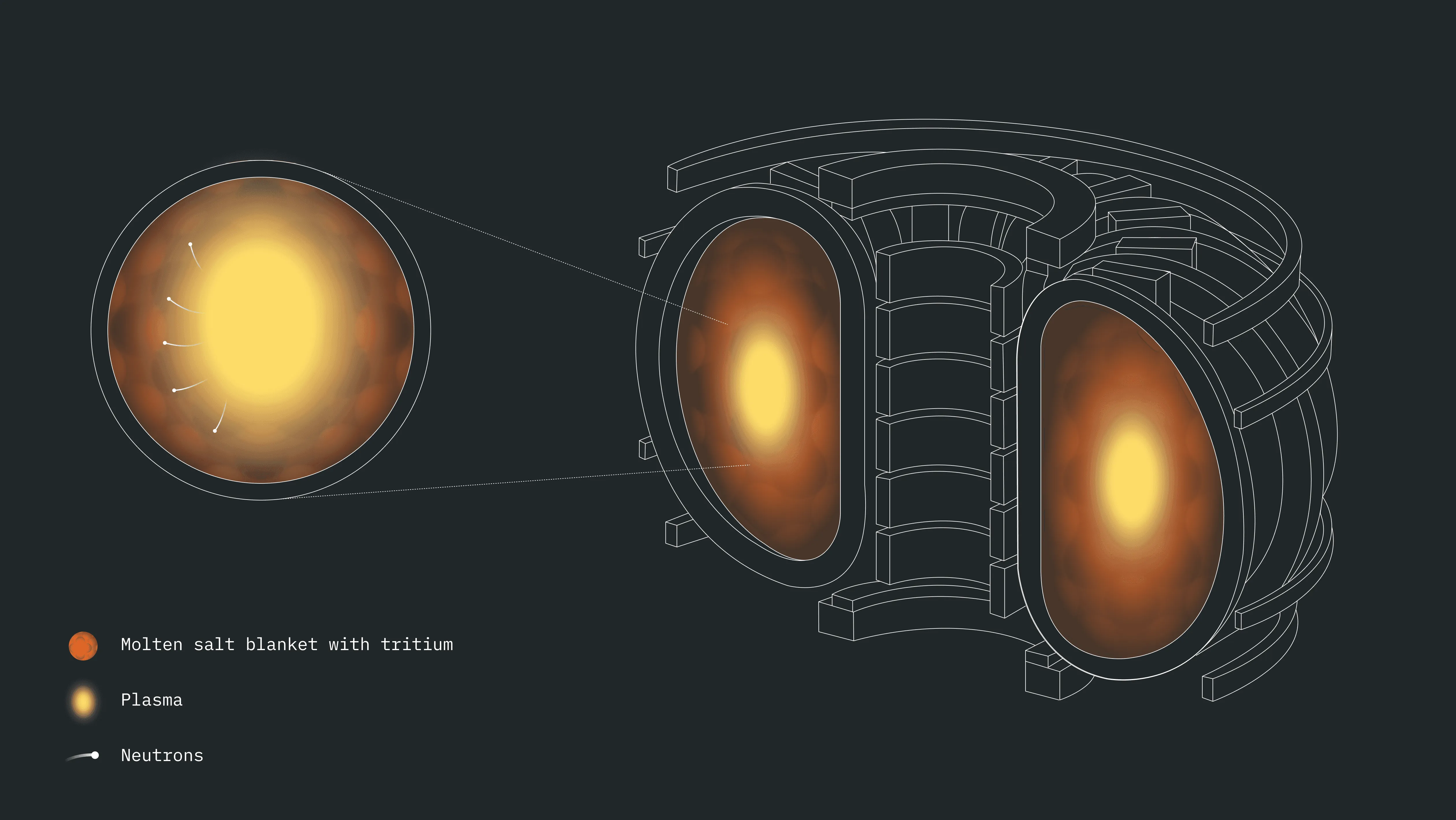
Using this hybrid quantum-classical method, the research team tested nine different molecular configurations in FLiBe molten salt, calculating the energies with and without the presence of tritium with high precision.
| Evaluation Axis | Conventional Classical Simulation (DFT, etc.) | Quantum-Centric Supercomputing (This Study) |
|---|---|---|
| Computational Approach | Approximate calculation of the entire space using CPU/GPU | Hybrid division of labor between classical and quantum via clustering |
| Free Energy Error | Up to approximately 10% | 0.3–0.7 kcal/mol (extremely high precision) |
| Prediction of Tritium Behavior | Significant uncertainty in determining bonded vs. free state | Rigorous resolution of electronic states, enabling accurate separation of bonding energy |
| Applicable Scale | Statistical approximation of bulk liquid | Demonstrated with a 21-ion cluster (future expansion to tens of thousands of atoms) |
The simulation results obtained kept errors to an extremely small range of just 0.3–0.7 kcal/mol when compared against the theoretical exact solution based on a full configuration interaction model. The 10% uncertainty that plagued classical calculations was eliminated, and for the first time, a clear numerical indicator of how strongly tritium bonds in specific molecular configurations was extracted.
A Massive Loop and National Strategy for Synthesizing Next-Generation Materials in Virtual Space
This simulation using a 21-ion cluster does not fully capture the complexity of the entire 1-meter-thick molten salt blanket. To approach the true properties of the bulk liquid, it will be necessary to further increase the number of atoms in the simulation and extend the system's behavior both temporally and spatially.
However, the blueprint for the future presented by this research is clear. The ultimate goal the team envisions is building a mechanism that runs an autonomous material discovery cycle by combining artificial intelligence, existing supercomputers, and quantum processors.
As a first step, an AI agent scans ORNL's accumulated 70 years of molten salt databases, screening promising candidates from among countless chemical compositions. In the second stage, classical supercomputers rapidly simulate thermal fluid dynamics and neutron irradiation resistance for the selected candidates, evaluating tritium breeding ratios and cooling performance as a fluid.
Then, in the final stage, a quantum computer rigorously calculates the fine chemical bonding behavior that classical computation cannot fully resolve, and calculates the risk of tritium transforming into a corrosive substance. These precise calculation results are immediately fed back to the AI, sharpening the precision of the next round of candidate material proposals.
This integration of heterogeneous computing resources also forms the core strategy of the DOE's "Genesis Mission." In this mission—which links the massive experimental data held by national laboratories with the world's most advanced computing clusters to solve critical challenges at a national scale—establishing fusion fuel supply chains is positioned as a top priority target.
Looking at the broader industrial context, the paradigm of quantum computing is at a turning point. Just as Microsoft announced in 2024 a hybrid strategy integrating other companies' quantum hardware with its own cloud infrastructure through Azure Quantum, companies are shifting away from showcasing "quantum supremacy" through a single piece of hardware, and toward generating practical value in collaboration with existing systems. IBM embedding its own superconducting quantum chips (such as the 156-qubit Heron) as a "subroutine" within ORNL's massive computing infrastructure, and continuing to produce concrete results ranging from proteins to fusion materials, is precisely a testament to this pragmatic approach.
Currently, numerous experimental fusion reactors are under construction worldwide, competing over plasma sustainment duration. What determines the practical viability of fusion as a sustainable energy source is not plasma control physics alone. The era of repeated trial and error—actually mixing molten salt at thousands of degrees in a harsh laboratory swarming with radiation—is drawing to a close. Researchers are on the verge of gaining the power to design the perfect molten salt within a computer's virtual space and verify its behavior at the level of individual atoms.