

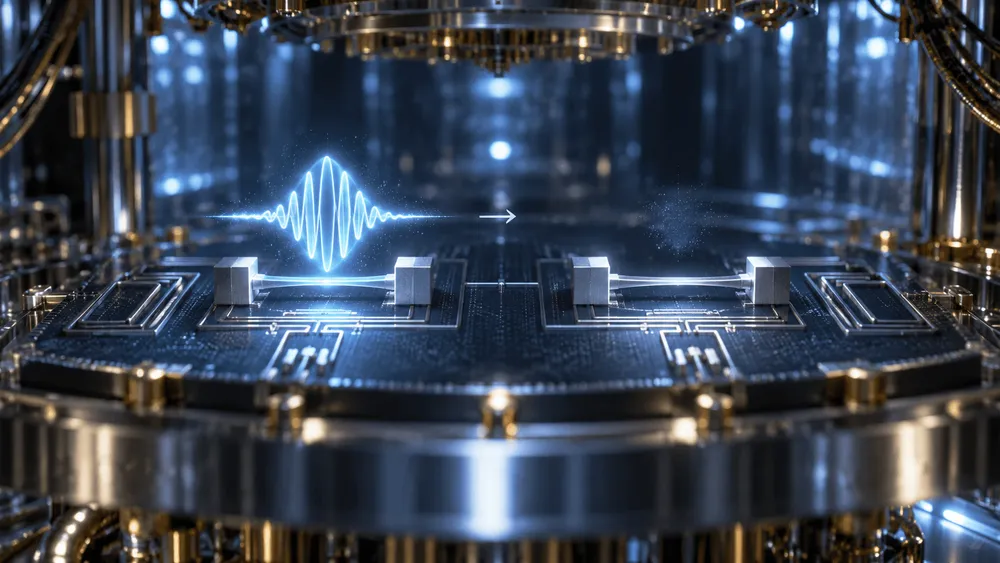
What happens when sound is captured at the smallest possible scale?
Sound waves traveling through air or matter are observed as continuous waves at everyday scales. But when matter is cooled to extremely low temperatures and thermal noise is suppressed to the utmost limit, the energy of mechanical vibration no longer varies continuously—it takes on discrete values instead. In physics, this smallest unit of vibrational energy is called a "phonon," a concept analogous to the photon in light.
The phenomenon known as a "quantum jump"—in which a quantum system moves discontinuously, rather than continuously, from one energy state to another—has been discussed since the early 20th century, when Niels Bohr proposed his model of the atom. In 1986, researchers succeeded in tracking quantum jumps in real time using a single trapped ion, and in 2007, the same feat was achieved with a single photon inside a superconducting cavity.
However, continuously tracking the quantum jump in which a single phonon is lost from a mechanical system—one in which a vast number of atoms vibrate collectively—had long remained out of reach.
In September 2026, a research team led by Associate Professor Amir Safavi-Naeini at Stanford University reported in the journal Science (DOI: 10.1126/science.aeh7535) that they had succeeded in continuously tracking, in real time, the exact moment a single phonon disappears, using a nanomechanical resonator fabricated with semiconductor microfabrication techniques.
While the quantum nature of mechanical vibration has previously been confirmed statistically or indirectly, this experiment tracked it as a series of individual state transitions. This article walks through the measurement system built in an extreme cryogenic environment, the statistics obtained from 294 consecutive measurements, and the challenges that remain for future applications in quantum memory and ultra-sensitive sensors.
How was the experimental system built to capture quanta of sound?
This experiment was not a simulation or a computational model—it was a physical experiment conducted in an extremely cold environment using a dilution refrigerator.
In quantum optomechanics and quantum acoustics research, which treats mechanical vibration quantum-mechanically, the target oscillator must be isolated from thermal noise as much as possible. At room temperature, thermal energy continuously excites large numbers of phonons, making it difficult to distinguish and observe just a single phonon.
The research team coupled a tiny mechanical resonator formed on a chip to a transmon-type superconducting qubit on the same circuit. This qubit functions as a highly sensitive detector that reads out the number of phonons present in the resonator.
Between the resonator and the qubit exists an interaction known as "dispersive coupling," in which the qubit's resonant frequency shifts slightly depending on the number of phonons in the resonator.
Rather than simply reading out this frequency shift directly, the research team built a measurement technique that applies microwave pulses to the qubit to probe the parity—that is, the evenness or oddness—of the phonon number in the resonator.
Starting the resonator from its ground state, near zero phonons, the team excited a single phonon and then repeated parity measurements at intervals of about 12 microseconds. This allowed them to continuously track the resonator from the state in which the phonon was present until the moment it was lost.
One of the technical challenges was maintaining the resonator's vibration for a sufficiently long time.
Weakening the coupling to the external environment preserves vibrational energy longer, but reading out the signal requires coupling to a detector. If the coupling to the detector is made too strong, energy tends to leak away through that same channel.
For the resonator used in this study, the decay time of vibrational energy when left unmeasured reached approximately 2.1 milliseconds—an extremely long lifetime for a nanoscale mechanical system. This margin of time made it possible to perform quantum non-demolition measurements repeatedly before the phonon was lost.
| Platform | First real-time observation of quantum jumps | Detector / readout method | Measurement environment / conditions | Main physical and technical constraints |
|---|---|---|---|---|
| Trapped ion | 1986 (Bergquist et al.) | Fluorescence detection (electron shelving method) | Vacuum, laser cooling | Targets a single or small number of isolated atoms |
| Superconducting microwave cavity (photon) | 2007 (Guerlin et al.) | Readout via Rydberg atoms | Cryogenic microwave cavity | Requires indirect readout using flying atoms |
| Nanomechanical resonator (phonon) | 2026 (Safavi-Naeini et al.) | On-chip superconducting qubit | Dilution refrigerator, on-chip circuit | Loss due to measurement backaction; independent replication not yet reported |
Quantum jumps in ions and electromagnetic fields have been observed for decades, but the target of this study was the mechanical vibration of a solid-state structure composed of billions of atoms.
What characterizes this experiment is that, within such a massive collective motion, the team tracked in real time a transition in which energy equivalent to just one phonon was lost.
What 8,447 measurement trajectories revealed: a "discontinuous decay"
Along with the paper, the research team has made their experimental data publicly available in the Zenodo data repository (record number: 20944616). It includes a total of 8,447 measurement trajectories that passed post-selection.
In each experimental run, the team performed 294 consecutive parity measurements at intervals of roughly 12 microseconds.
However, not every individual measurement returns a correct result. Because dephasing and other effects cause the superconducting qubit to lose phase information during measurement, the accuracy of a single measurement is only about 67%.
To address this, the research team selected for analysis only those trials in which the first six consecutive measurements all indicated "a phonon is present." By restricting the analysis to trials meeting this condition, they raised their confidence that a single phonon was present in the resonator at the starting point to approximately 85%.
Analyzing the 8,447 measurement trajectories selected in this way revealed that the energy of the mechanical vibration did not decrease smoothly—instead, it was lost discontinuously at a certain moment.
In a classical oscillator, the amplitude decreases exponentially and continuously over time. In quantum mechanics, however, because the energy levels themselves are discretized, the transition from the state with one phonon to the state with zero phonons occurs discontinuously.
In the actual measurements, the "one-phonon" state persisted up to a certain point in time, after which it switched, at a random moment, to the "zero-phonon" state. Once the system transitioned to zero phonons, it remained in the ground state thereafter.
This discontinuous change of state was observed as the quantum jump of a single phonon.
Furthermore, when the team tallied the times at which jumps occurred across the measurement trajectories, the resulting distribution followed an exponential decay with an average time of about 645 microseconds. This is consistent with the probabilistic decay process predicted by quantum mechanics, in which the probability of decay does not depend on how much time has already elapsed.
At the same time, the effect that the measurement itself has on the resonator—so-called measurement backaction—cannot be ignored.
According to Associate Professor Safavi-Naeini, the probability that a single parity measurement leaves the phonon number undisturbed was about 99%.
That figure is high for a single measurement, but when 294 measurements are performed consecutively, small disturbances accumulate. Whereas the phonon lifetime was about 2.1 milliseconds when left unmeasured, it shortened to about 649 microseconds during continuous measurement.
Based on this analysis, the team estimates that each measurement caused an additional energy loss with a probability of about 1.3%.
The research team combined Bayesian inference with a forward-backward algorithm to estimate the actual underlying phonon-state dynamics, accounting for both measurement error and measurement backaction.
What sets this apart from previous experiments?
The quantum nature of mechanical systems itself was not confirmed for the first time in this study.
In 2010, a research group led by Andrew Cleland and John Martinis at the University of California, Santa Barbara, cooled a tiny piezoelectric mechanical resonator to extremely low temperatures using a dilution refrigerator and succeeded in bringing its mechanical mode into the quantum ground state (Nature 464, 697–703, 2010).
They further excited a single phonon in the resonator and experimentally demonstrated that its energy levels were quantized.
However, many prior experiments, including the 2010 study, centered on a "prepare a state, then measure after a fixed delay" approach. By repeating the same experiment under identical conditions many times and gathering statistics, researchers confirmed the existence and lifetime of quantum states.
This method cannot track, within a single trial, exactly when a phonon was lost.
What this new experiment adds is precisely this information along the time axis.
Rather than simply observing the average decrease in energy, the team tracked, within a single experimental trial, the moment when the state repeatedly confirmed to contain one phonon switched to a state with zero phonons.
However, this does not mean the researchers literally "watched sound waves themselves suddenly vanish" with their eyes.
The actual raw data obtained is a series of signals from the readout circuit of the superconducting qubit. Because the fidelity of a single measurement is only about 67%, each individual measurement result includes some misjudgments.
The research team statistically analyzed the sequence of consecutive measurement results to estimate the underlying phonon-number state changes.
Nor did the researchers control the timing at which phonons were lost. Quantum jumps occur randomly, and this experiment verified whether the statistics of their occurrence times match the predictions of quantum mechanics.
What challenges remain between proof of concept and practical use?
A technology capable of repeatedly measuring a mechanical quantum state without significantly disturbing it could have applications in quantum information processing and ultra-sensitive measurement.
Compared with microwave photons or superconducting circuits, mechanical resonators have shorter wavelengths, raising the possibility of packing many vibrational modes into a small region. Because they are also physically massive structures, they are sensitive to external physical influences such as force, acceleration, and mass change.
Associate Professor Safavi-Naeini and colleagues point to two main directions for future application.
One is application to quantum memory and quantum error correction.
Because superconducting qubits have limited coherence times for holding quantum information, research is underway to store quantum states in longer-lived mechanical resonators instead.
If this measurement approach can be extended so that a single qubit is coupled to multiple mechanical resonators, it could lead to a scheme in which errors are detected via parity measurement without directly destroying the quantum information stored in the resonators.
The other direction is application to sensors capable of detecting extremely small changes in mass.
Safavi-Naeini and colleagues, together with Professor Michael Roukes of the California Institute of Technology, are pursuing research into technology that detects the tiny frequency shift caused by a single protein molecule attaching to a resonator's surface, with sensitivity approaching the quantum limit.
However, these applications are not imminent.
First, this experiment did not itself demonstrate quantum error correction. What was observed was a relatively simple energy relaxation process in which a single phonon is lost. A quantum memory capable of holding an arbitrary quantum superposition state for a long time while detecting and correcting errors has not yet been realized.
Furthermore, energy loss due to measurement backaction remains a significant challenge.
In the current apparatus, a phonon is lost with a probability of about 1.3% for each measurement. When measurements are performed continuously over hundreds of cycles, the act of observation itself substantially shortens the phonon's lifetime.
For application to quantum error correction, it will be necessary to reduce qubit dephasing to improve measurement precision, while further suppressing the unwanted measurement backaction imparted to the resonator.
In addition, this experiment was conducted in an extremely cold environment—the millikelvin regime inside a dilution refrigerator. At this point, no independent replication by outside research groups has been reported.
For this reason, it would be premature to view this result as something that will soon lead to practical devices usable at room temperature or in simple cooling environments.
In this experiment, the researchers succeeded in continuously tracking, within a solid-state structure made of billions of atoms, the moment at which mechanical vibrational energy equivalent to a single phonon was lost.
This represents an important advance in observing quantum phenomena in mechanical systems as individual instances of time evolution.
At the same time, applying this work to quantum computer memory or practical biosensors will require further reducing the disturbance caused by measurement and establishing technology to stably integrate and control multiple resonators.