


On November 11, 2026, QuantumScape announced Osprey, a solid-state battery development platform that combines a cathode using a sulfide-based solid electrolyte with the company's proprietary ceramic separator. The existing QSE platform used a liquid electrolyte inside the cathode; Osprey replaces it with a solid electrolyte. The design lets customers incorporate their own cathodes, and the company aims to expand collaboration with battery makers and automakers. However, cell manufacturing is currently at the lab-scale demonstration stage, and challenges remain before mass production.
QuantumScape reports that a cell retained about 80% of its initial capacity after 1,000 charge-discharge cycles at 30°C under an externally applied pressure of 1 atmosphere. The company also published results for roughly 5-minute fast charging and for thick, high-capacity cathodes, but these were obtained under different conditions. Comparing the conditions and results of each test shows both Osprey's technical potential and the points that still need to be verified before commercialization.
Sulfide-based electrolyte in the cathode, ceramic at the lithium metal interface
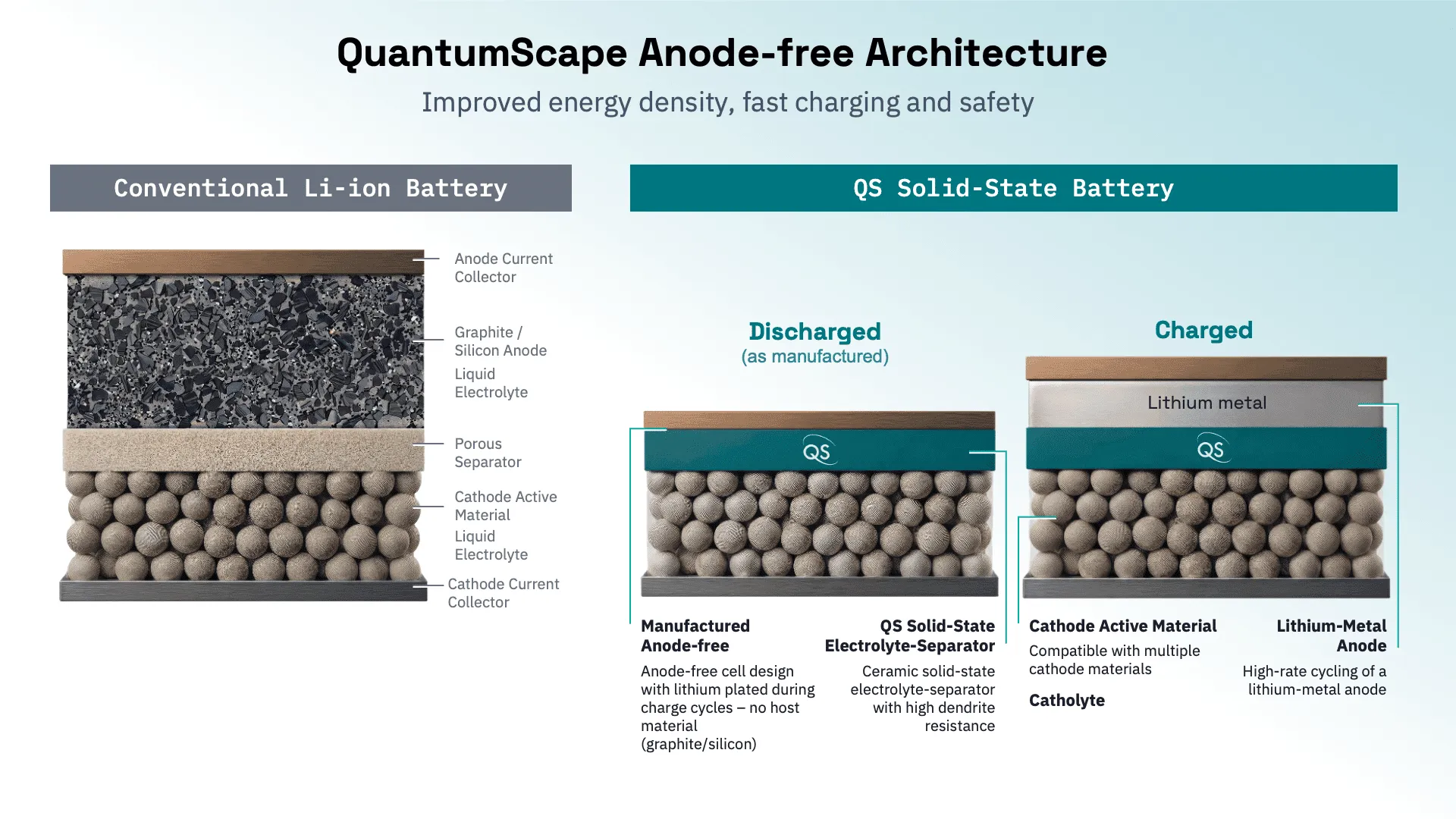
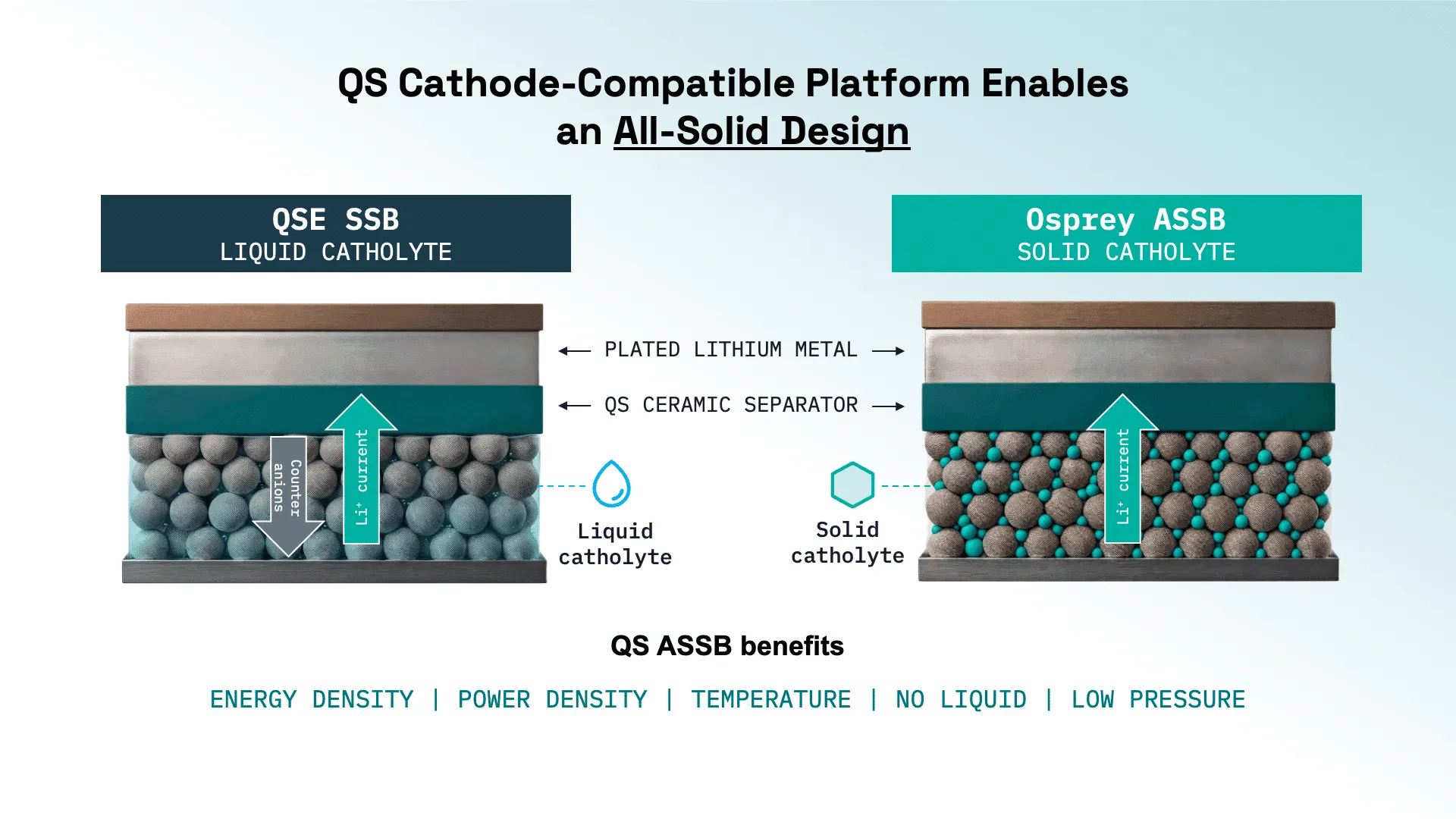
Osprey rests on three pillars: the ceramic separator, a cathode using a sulfide-based solid electrolyte, and the manufacturing process that combines the two. QSE-5, which uses the earlier QSE platform, employed a liquid electrolyte inside a high-nickel NMC cathode. In Osprey, the electrolyte that conducts lithium ions inside the cathode is changed to a sulfide-based solid material, creating an all-solid-state structure with no liquid electrolyte.
The proprietary ceramic separator and the "anode-free" design carry over from the earlier approach. Anode-free means that no anode active material is built in during manufacturing; instead, lithium metal is deposited during the first charge to form the anode. This does not mean the battery operates without an anode, but that lithium metal or other anode active material is not pre-installed during manufacturing.
According to QuantumScape, sulfide-based solid electrolytes offer high lithium-ion conductivity and are easy to process. However, they react readily when in direct contact with lithium metal, require pressure to maintain a stable interface, and must also address dendrites, the branching lithium deposits. In Osprey, the sulfide electrolyte is used inside the cathode, while the ceramic separator sits where the cell contacts lithium metal, so that each material plays to its strengths. That said, not every challenge specific to solid-state batteries has been resolved, including the resistance that arises at the interface between the solid electrolyte and the cathode material.
1,000-cycle life and 5-minute charging demonstrated, but under different test conditions
The Osprey performance data QuantumScape released covers 1,000-cycle life, roughly 5-minute fast charging, low-temperature performance, and thick-cathode operation. However, these were measured under different conditions, including temperature, cell configuration, cathode areal capacity, and applied pressure. In particular, the life test and the fast-charging test share the same cathode dimensions, layer count, and applied pressure, but differ in temperature and cathode areal capacity. The energy density of up to about 1,100 Wh/L is a design projection for large cells, not a measured value.
The table below organizes the white paper and test data QuantumScape published on November 11. Results from different tests cannot be combined to conclude that a single cell meets all of these performance targets at once.
| 確認項目 | 成果・予測値 | 試験温度 | セル構成・正極の面積当たり容量 | 印加圧力 | 出典 |
|---|---|---|---|---|---|
| 寿命特性 | 1,000サイクル後に約80%の容量を維持。充電1C CC-CV、放電1C CC、充電状態0〜100% | 30℃ | 正極50×65mm、2層、5.5mAh/cm² | 1気圧 | 寿命試験図 |
| 急速充電 | 充電状態10%から80%まで約5分、10C | 80℃ | 正極50×65mm、2層、5.9mAh/cm² | 1気圧 | 急速充電試験図 |
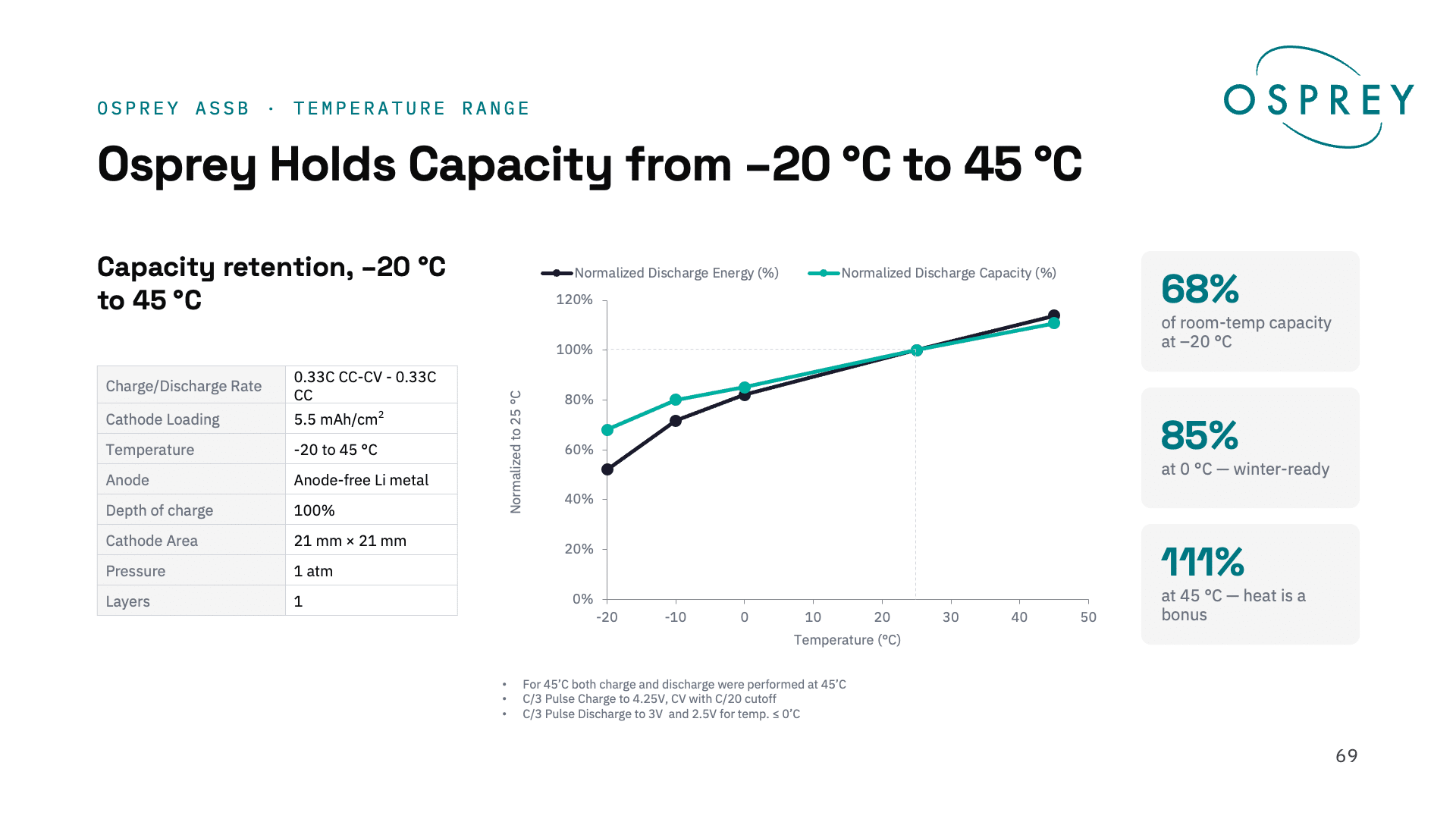
| 低温特性 | 25℃での容量を基準に、−20℃で68%、0℃で85% | −20℃、0℃、比較対象25℃ | 正極21×21mm、1層、5.5mAh/cm²、C/3程度のパルス充放電 | 1気圧 | 低温試験図 |
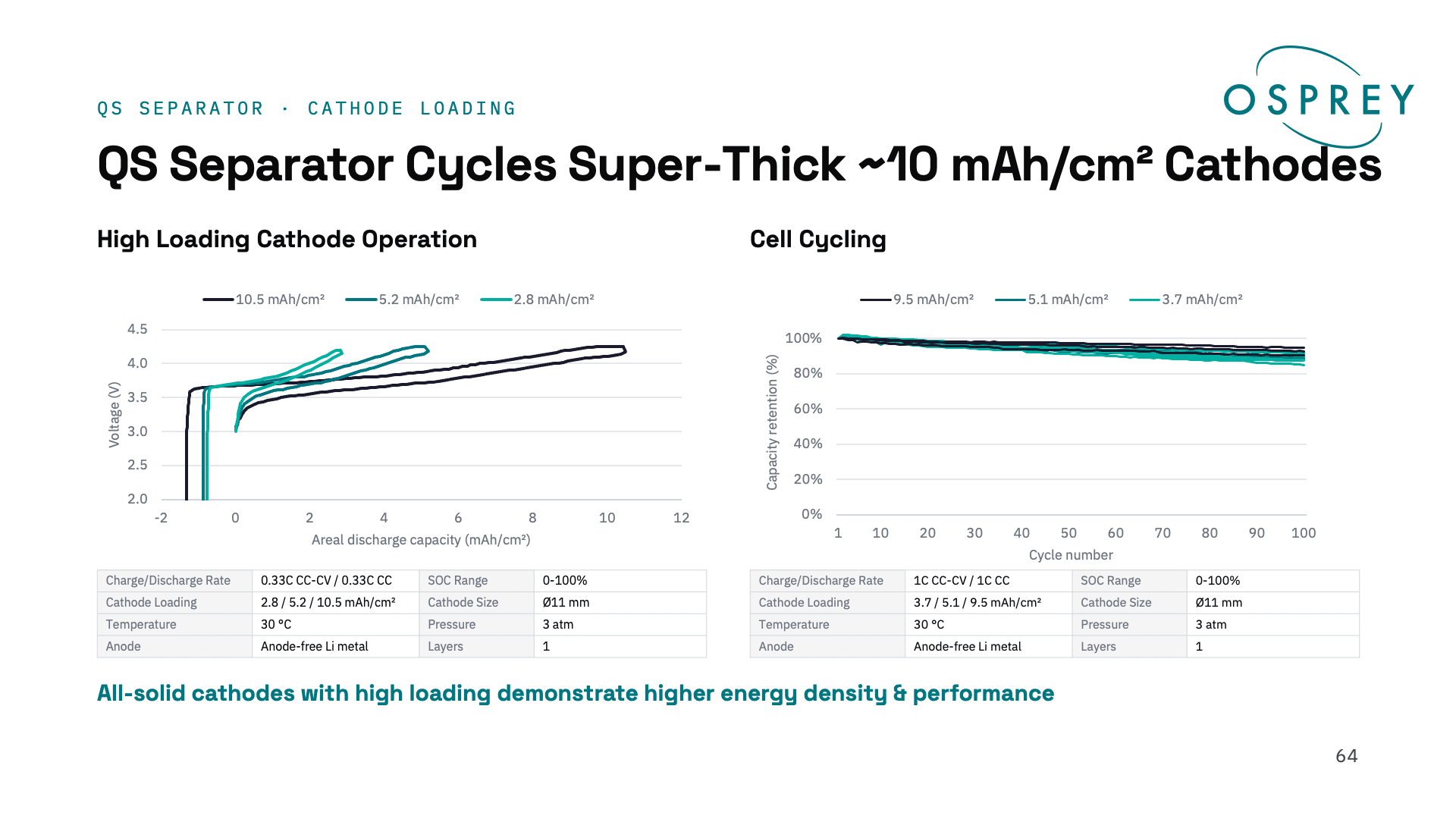
| 厚い正極 | 放電試験で最大10.5mAh/cm²、100サイクル試験で最大9.5mAh/cm² | 30℃ | 直径11mm、1層 | 3気圧 | 厚い正極の試験図 |
| 高エネルギー密度設計 | 最大約1,100Wh/L | 実測条件の提示なし | 大型セル向けの設計予測 | 実測条件の提示なし | 同社ホワイトペーパー |
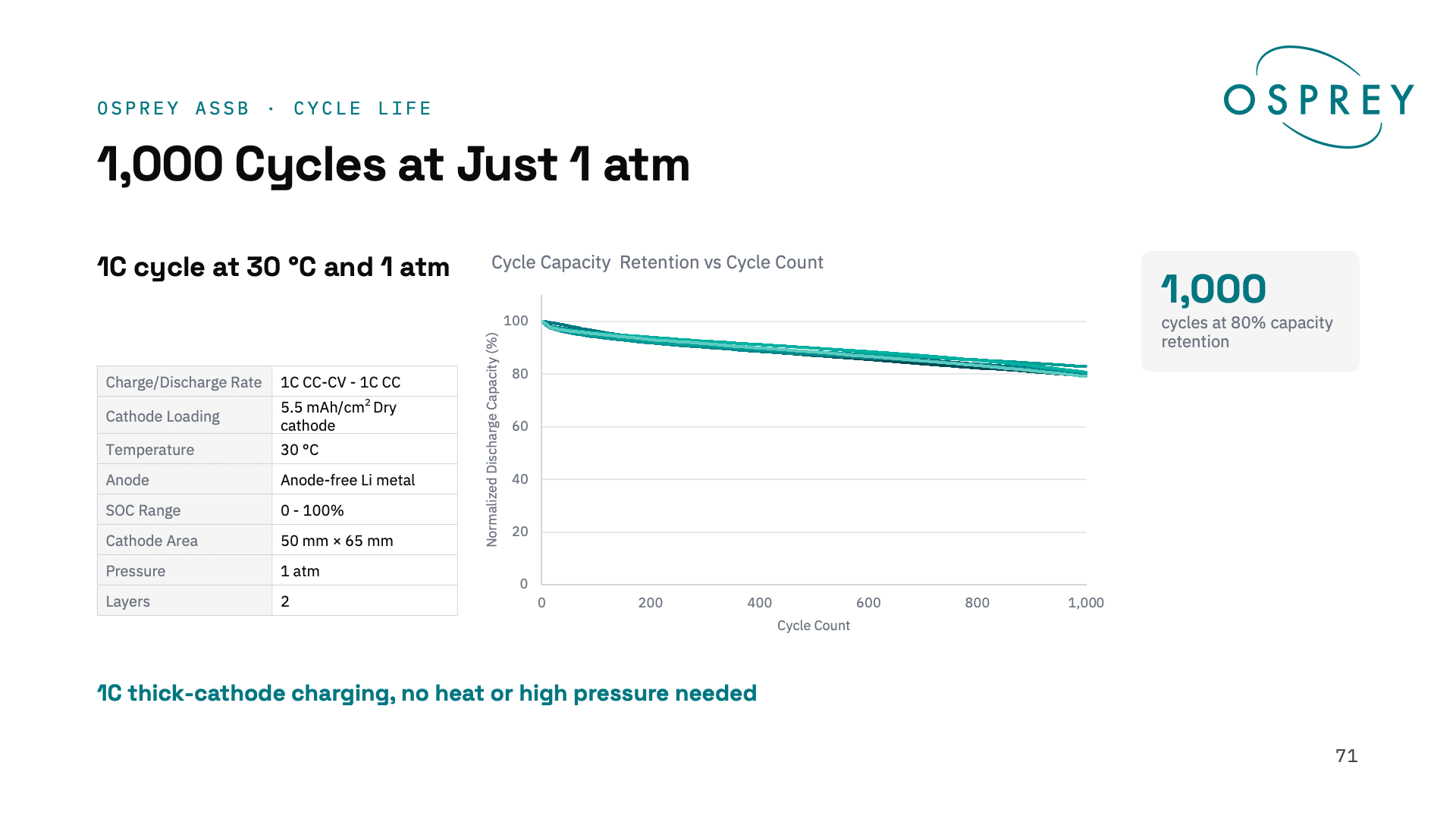
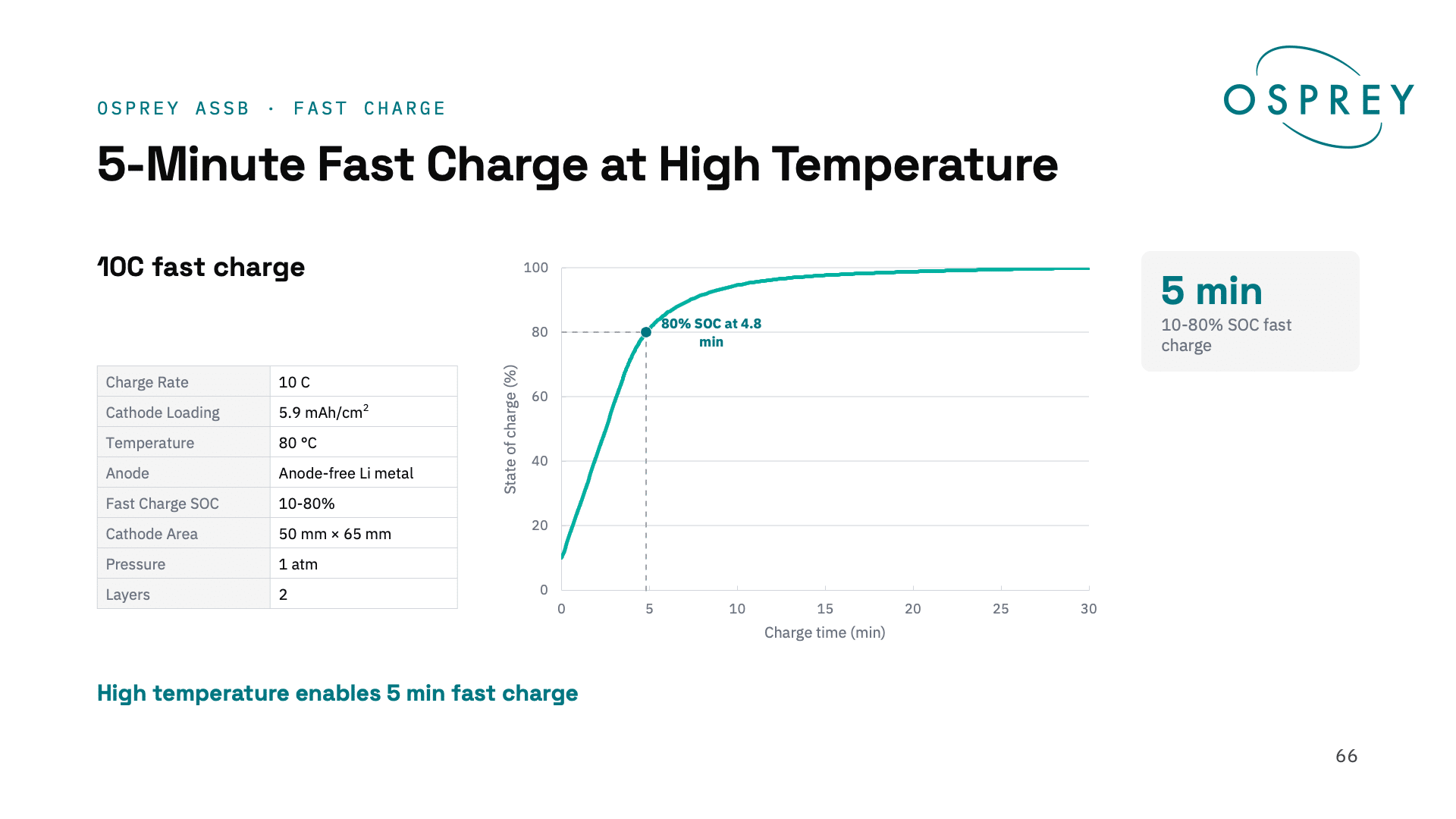
"1C" denotes the rate at which a cell is fully charged or discharged in about one hour at constant current. The 1 atmosphere in the table refers to pressure applied externally to the cell, which is not the same as an unpressurized cell sitting in open air. Because the life test charged and discharged at 1C, it has not been confirmed that the same capacity retention would hold if the cell were charged in about 5 minutes 1,000 times.
It is also important to note that the cell temperature in the fast-charging test was set to 80°C. Test temperature is a key condition when evaluating the practicality of batteries for electric vehicles, and Electrek has pointed out that this temperature should have been stated explicitly in the press release. It therefore cannot be concluded that 5-minute charging is possible in typical operating environments.
The low-temperature results likewise come from a separate, small single-layer cell and do not demonstrate 5-minute charging in cold conditions. According to the footnotes on the test figure, charging combined C/3 pulse charging with constant-voltage charging, and discharge also used C/3 pulses. The results show capacity characteristics at low temperature, but they do not guarantee the safety of low-temperature fast charging or sustained high-power operation.
Thicker cathodes aim to cut layer counts and raise energy density
Another feature of Osprey is its design for higher cathode areal capacity. Raising areal capacity could reduce the number of electrode layers needed to reach a given cell capacity. Fewer layers means a smaller share of components such as current collectors that don't directly contribute to power generation or storage, which can raise the energy density of the whole cell. QuantumScape presented test results using thick cathodes of about 10 mAh/cm² and described the possibility of a dry manufacturing process in which cathode material is handled in roll form and bonded to a current collector.
However, the thick-cathode tests were run on single-layer cells 11 mm in diameter under 3 atmospheres of pressure. These conditions differ from the life and fast-charging tests conducted at 1 atmosphere, and it has not been confirmed that large-area, multilayer cells can achieve the same performance. The energy density of up to about 1,100 Wh/L that QuantumScape cited is also, for now, a design projection for large cells rather than a measurement from an actual large cell. The figure assumes volumetric energy density at the cell level and does not represent the density of an entire battery pack including cooling systems and structural components.
The roughly 5-minute fast charging the company published corresponds to a design focused on power performance, while the up-to-1,100 Wh/L figure corresponds to a separate design that prioritizes energy density. It therefore cannot be read as meaning that a mass-production cell with both capabilities has been completed. For commercialization, developers will need to decide whether fast-charging performance or energy density matters more for each application and establish a cell design suited to each.
Customers can use their own cathodes; mass production requires large-cell and process validation
While QuantumScape pursues integrated technology development and scale-up to mass production on the existing QSE platform, Osprey puts forward a collaboration model in which customers can use cathode materials they have developed themselves and their existing supply chains. According to the company, it has already tested not only its own cathodes but also cathodes developed by an automaker customer. This allows customers to consider solid-state batteries that combine QuantumScape's ceramic separator and anode-free technology with the results of their own materials development. Note that "open" in Osprey refers to flexibility in combining materials and designs; it is not an announcement that the technology is open source or freely available.
This approach could offer a new option for automakers and battery makers that have been developing cathodes using sulfide-based solid electrolytes. If existing cathode materials and supply chains can be used, a path to commercialization may open up that differs from developing all materials from scratch to QuantumScape's specifications. However, producing practical large prismatic cells will require interface resistance, charge-discharge performance, and life to remain well managed even as electrode area expands and layer counts increase.
The manufacturing process has also not yet reached the stage required for mass production. QuantumScape says it has completed lab-scale demonstration of the basic process for making Osprey cells and is now developing higher-throughput processes. The announcement gave no timeline for starting mass production, and actual manufacturing costs and yields remain unclear. Moreover, if the fast-charging performance obtained at 80°C is to be used in real-world conditions, the energy needed to heat the cells and the burden of temperature management would also have to be considered.
The performance figures published so far are based on QuantumScape's early-stage experimental results and design projections, and they have not been independently reproduced or confirmed in mass-production-scale large cells. Even so, Osprey, which combines a cathode using a sulfide-based solid electrolyte with a ceramic separator and can accommodate customers' own cathodes, adds a new option to the development and commercialization of solid-state batteries. Going forward, maintaining performance in large-area, multilayer cells and establishing a high-throughput manufacturing process will be key conditions shaping adoption decisions by partners.