

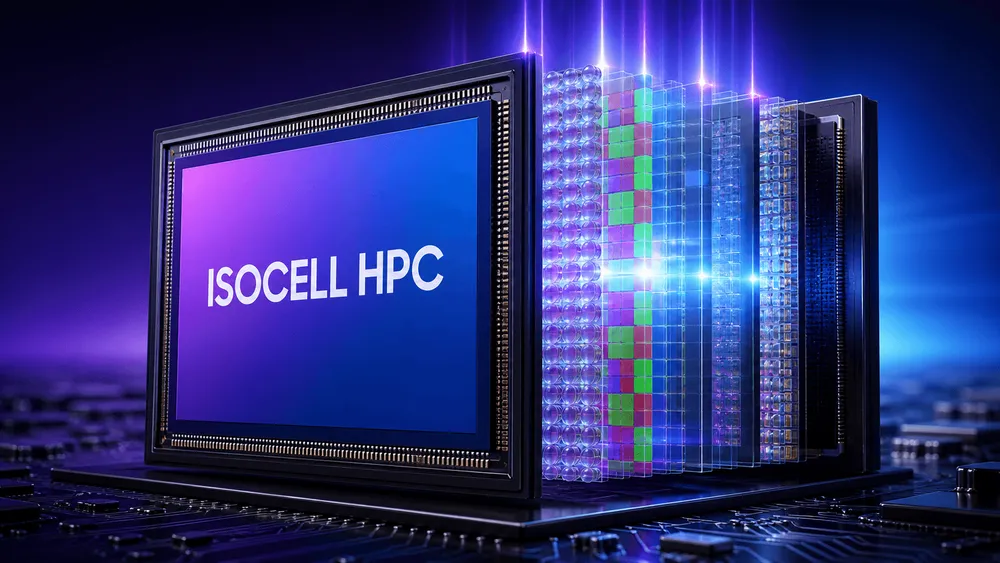
Samsung Electronics has published details of its 200MP mobile image sensor, the "ISOCELL HPC." The product page states that it is currently in mass production. The external specifications—1/1.3-inch format, 0.6μm pixels, and 200MP—remain unchanged from the ISOCELL HP2, but Samsung has modified the pixel's internal charge capacity, HDR, and in-sensor zoom. The product name Samsung has disclosed is HPC, and the company has not announced its adoption in the Galaxy S27 series or its relationship to "HP6."
HPC does not increase the pixel count or sensor area, but it reduces the amount of information lost in high-contrast scenes. However, comparing the published specifications with HP2 shows that not all shooting speeds have improved. The core of the spec differences lies in HDR and mid-range zoom, with some shooting modes becoming faster and others slower.
DeepPix: Expanding the Pixel's Capacity
DeepPix is a new pixel structure that increases the amount of charge a photodiode can hold after receiving light. According to Samsung, it is built on FDTI (Front Deep Trench Isolation) combined with two vertical transfer gates and a shared floating diffusion. The full-well capacity of a single pixel is said to have increased by 60% compared to the previous generation.
Full-well capacity refers to the amount of charge a pixel can accumulate before becoming saturated. A larger capacity suppresses early saturation in areas receiving strong light, making it easier to preserve the tonal difference with darker areas in a single exposure. Samsung also claims reduced noise. However, since Samsung has not specified which previous-generation sensor this 60% figure is compared against, it cannot be confirmed as an improvement relative to HP2.
HPC also adopts a High Precision Microlens using high-refractive-index material and a High Transmittance ARL that suppresses reflection and scattering. The former concentrates light onto the photodiode, while the latter reduces light lost before it reaches the lens. This is a combination where DeepPix expands the vessel that holds the charge, while the lens and anti-reflective layer increase the amount of light reaching it.
Maintaining 16-bit HDR from 1x to 4x
HPC supports single-frame 16-bit HDR and can use HDR across five levels of zoom, from 1x to 4x. This range also includes an intermediate 1.5x level. Samsung explains that this allows natural color tone and detail to be preserved from bright outdoor scenes to backlit conditions.
HPC maintains single-frame HDR from 1x to 4x regardless of the in-sensor zoom level used. However, the resolution and color continuity of the cropped image after zooming also depend on adjustments made to the lens, image signal processor, and by the device manufacturer. The sensor's supported zoom range alone does not determine the quality of the final photo.
Video supports 8K at 30 frames per second and 4K at up to 180 frames per second. The maximum 4K frame rate applies under conditions using partial phase-detection autofocus; when using full-pixel PDAF, the rate is 120 frames per second. RAW output has also expanded beyond HP2's 10-bit and 12-bit options, with HPC adding 14-bit and 16-bit.
Faster in Some Modes, Slower in Others Compared to HP2
Both HPC and HP2 share the same 200MP, 1/1.3-inch format, and 0.6μm pixel size. According to the published specifications, HPC offers faster 12.5MP shooting and 4K video, along with more RAW format options than HP2. HPC's HDR supports five levels from 1x to 4x zoom. On the other hand, the maximum speeds for 200MP shooting and FHD video are lower than HP2's.
| Item | ISOCELL HPC | ISOCELL HP2 |
|---|---|---|
| 200MP still | 7.5fps | 15fps |
| 50MP still | 30fps | 30fps |
| 12.5MP still | 180fps | 120fps |
| 8K video | 30fps | 30fps |
| 4K video | 180fps | 120fps |
| FHD video (no AF) | 360fps | 480fps |
| RAW output | 10/12/14/16-bit | 10/12-bit |
The 200MP burst shooting speed is half that of HP2, and the maximum FHD frame rate has also decreased. Meanwhile, the 12.5MP mode has increased 1.5x, and 4K has increased 1.5x as well. Binned resolution and 4K slow motion have improved, while maximum-resolution burst shooting and ultra-high-speed FHD capture have regressed. HPC's characteristics are reflected not so much in the 200MP figure itself, but in these mode-by-mode increases and decreases.
Relationship to Galaxy S27 Remains Unannounced
Samsung's product page lists HPC's specifications and its mass-production status. It does not disclose which smartphones will adopt it, shipping destinations, or its relationship to the Galaxy S27 series. The name "ISOCELL HP6" also does not appear in the description of HPC. Therefore, it cannot be assumed that HPC has been announced as the HP6 for the S27 Ultra.
HPC's product specifications and the image quality achievable in devices that adopt it must be verified separately. Only when factors such as lens brightness, image processing, and the frame rates that can be sustained while managing heat are all considered together can the effects of DeepPix and zoom HDR be properly evaluated.
The sensor adopted in the Galaxy S27 can only be confirmed once Samsung links the device to a specific sensor model number, or once a post-launch teardown verifies the part number. Until then, the technical specifications of the mass-produced HPC and speculation about HP6 adoption must be treated as separate matters.