

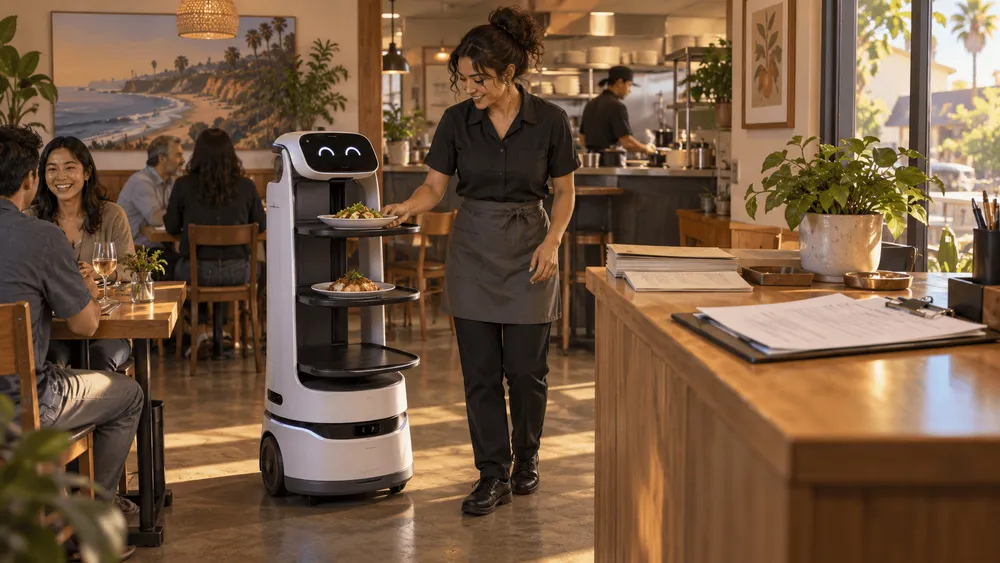
On September 15, 2026, the San Mateo County Board of Supervisors in California voted 4-0 to advance a draft ordinance that would create a permit system for commercial autonomous robots. When a store or other business introduces robots, it would have to address safety and also offer employees whose work is displaced reassignment, severance, or a contribution toward community reemployment support. According to the county's announcement, final adoption is still to come, and if the ordinance passes, it would take effect 30 days later. The key question in reading the plan is how its goal of protecting jobs divides into two things: workers' ability to keep working, and funding to help them move to new jobs.
Three job-protection options, each protecting something different
When applying for a permit, a business must submit an assessment of the robots' impact on employment, along with a binding plan for mitigating that impact. Section 5.140.050(e) of the draft ordinance requires the plan to commit to at least one job-protection measure.
The three options are continued employment through reassignment, transition support for employees, and a contribution to community reemployment support.
| Option | Minimum requirements in the draft | Where the support goes |
|---|---|---|
| Reassignment | Move the employee to an equivalent role at the same site with pay at least equal to the current level. Employment must continue for at least 6 months; if that is not met, the business moves to another option | Continued employment for displaced employees |
| Transition support | Written notice at least 60 days in advance, plus severance equal to at least 4 weeks of standard pay | Advance notice and financial support for departing employees |
| Automation impact fee | A contribution to the county's job retraining fund for each covered robot | Community reemployment support services |
Source and scope of comparison: Sections 5.140.050(e) and 5.140.070 of the draft ordinance (PDF, pages 7 and 9), attached to the San Mateo County agenda item of September 15, 2026. The options in the same draft are compared by minimum requirements and where support goes. The content is pre-adoption, and the draft does not state the fee amount.
Choosing reassignment brings conditions on the length of continued employment, not only on the role and pay. The severance route, by contrast, assumes the employee leaves and supports them through that departure, while a fund contribution routes money toward community reemployment support. In other words, not all three options keep the original employee in a job. Even if a business chooses to pay into the fund, that alone does not guarantee rehiring or training outcomes for individual employees.
The unit for the automation impact fee is also the number of covered robots, not the number of displaced employees. Section 5.140.070 sets up a system in which the fee amount is published and updated on the responsible department's website. Until that amount is known, a business cannot compare whether reassignment or a fund contribution would be cheaper, and it is also hard to say at this draft stage how effective the measure would be at preserving jobs.
Coverage: mobile robots in unincorporated areas
The permit plan targets establishments that provide goods or services to the public in the unincorporated areas of San Mateo County, meaning parts of the county that do not belong to a city or other municipality. Restaurants, retail stores, and hotels are among the envisioned examples. The plan does not impose the same obligations on every business in the county.
The robots must also meet certain conditions. Machines that move through places people can enter, or through spaces where they work alongside employees without physical barriers, and that operate without direct human control for at least part of the time, may be covered. The definition also includes the use of sensors, cameras, and AI, and operation on rechargeable lithium-ion batteries, so the scope differs from regulation of workforce reductions from office software AI generally.
Being humanoid is not a requirement, and wheeled robots are also included. Conversely, permanently fixed self-checkout machines, kitchen equipment that moves along a fixed track, and robots used only in private homes are excluded. The ordinance defines coverage by where and how a machine moves in shared space with people, rather than by appearance.
A permit would cover each robot and each place of use, and would be renewed every year. A new or renewed permit would be required before adding a new robot or moving one to a location not covered by an existing permit. However, if the necessary information is provided, multiple robots or locations can be combined into a single application. Checking each robot is distinguished from always having to file separate applications.
Businesses that introduce robots would therefore have to manage not only their choice of model, but also the combination of installation sites and the robots operating there. Even if a manufacturer has already supplied the same model to another store, that track record alone would not automatically authorize operation at a new location.
Human supervision and fire-service costs as conditions of adoption
The draft ordinance also requires a plan to keep at least one trained human supervisor on site while robots operate in places where they interact with customers or the public. It is not a rule of one human per robot, but a robot's ability to operate autonomously is not by itself a reason to leave a site unstaffed. Businesses need to think about staffing supervisors alongside the robots' capabilities.
On safety, applications must show emergency stop methods and that the robot will not block access to walkways. Robots used for food handling must also meet hygiene requirements, and battery safety and accident and recall history are subject to review. Insurance and privacy measures are also application requirements, so the review does not end with whether the machine simply works.
Fees are not used only for job-protection measures either. The permit fee in Section 5.140.060 goes toward fire and hazardous-materials response and toward administration and enforcement, and is separate from the optional automation impact fee. The fire-related fee would recover the costs of annual battery inspections, specialized firefighting equipment, and training for emergency and fire response personnel.
The county points to thermal runaway in lithium-ion batteries as background. Its explanation is that when abnormal heating spreads in a chain reaction, fires can reignite after being put out and toxic gases can be released, requiring equipment and responses different from usual. The permit system appears designed to have businesses that use robots bear these on-site burdens as well.
What the permit system covers, and what to watch next
Supervisor Ray Mueller, who proposed the plan, has explained that certifying the safety of the AI that runs the robots is beyond what a county can address, and he has urged the state and federal governments to consider a certification system. Making in-store safety measures and employment responses a condition of permits is different from guaranteeing the safety of the AI itself.
Even so, the plan widens the range of costs businesses must consider when automating. Beyond purchase and maintenance costs, it is designed to build into the adoption decision the staffing of on-site supervisors, the cost of fire-response measures, and measures for when employment is affected. Which measure a business chooses will also change how support reaches employees.
The first things to check are the text of the final adopted ordinance and the specific fee amount. The fund contribution amount in particular bears on the choice between a route that keeps employees working at equal or higher pay and one that routes money toward community reemployment support. Only by seeing the actual fee schedule and how the system operates can we assess how much the permit system encourages continued employment and how it supports transitions after job loss.