

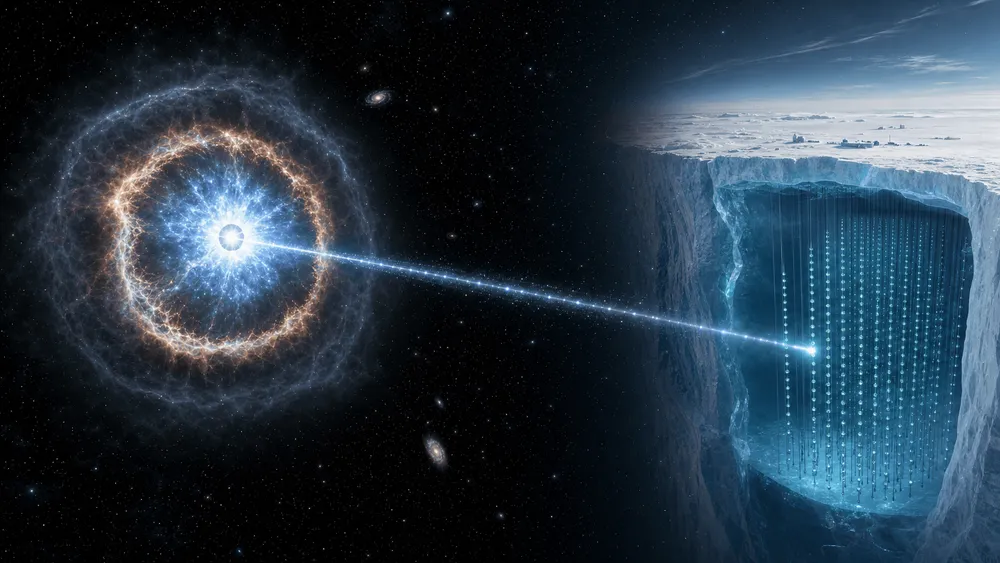
Visible-light observations of the Ibn-type supernova "SN 2023uqf" have revealed a brief window during which cosmic rays could be accelerated up to PeV energies. A research team including scientists from RIKEN extracted the shock radius, velocity, and surrounding gas density from a radiation-hydrodynamics model that reproduced the light curve, then fed these into a time-dependent neutrino-production calculation. The 442 TeV neutrino event "IC-231004A," detected by IceCube in 2023, falls within the timing and energy range predicted by the model. However, the same model estimates that the expected detection count is at most about one in ten thousand per object. What has been confirmed this time is not that this is the source, but that this supernova has not been physically ruled out as a candidate. The findings were published in The Astrophysical Journal Letters on July 8, 2026, and announced by RIKEN on the 21st of the same month.
Reconstructing the Shock History from Visible Light
SN 2023uqf was discovered about 21 hours after IC-231004A arrived on October 4, 2023, through follow-up observations by the Zwicky Transient Facility (ZTF). It lies at a distance of 723 Mpc from Earth, roughly 2.4 billion light-years away. Classified as Ibn-type—in which supernova ejecta collide with circumstellar material poor in hydrogen but rich in helium—its brightness reached at least an absolute g-band magnitude of -19.7. The period during which it maintained at least half its peak brightness was a short 8 days, making it the fastest-evolving Ibn-type object captured by ZTF.
Prior research fitted the light curve using the semi-analytic MOSFiT model and estimated the explosion time as 2.4 days before ZTF's initial detection. In contrast, this study used the one-dimensional radiation-hydrodynamics code "STELLA" to simultaneously solve for light emission and shock motion. The goal is not merely reproducing the light curve itself, but determining when the shock that produced the visible light passed through gas of what density, and at what speed.
The baseline model fixed the ejecta mass at 2 solar masses and the explosion kinetic energy at 10^51 erg. The circumstellar material is assumed to be 90% helium, with density decreasing sharply as the inverse cube of radius. A calculation with density normalization D'=50 broadly reproduced the changes in ZTF's g, r, and i bands up to about 30 days after initial detection. The explosion time estimated from this is about 10 days before initial detection—earlier than the MOSFiT value. Neither figure is a direct measurement; both depend on the physical model adopted.
This difference changes the temporal relationship with the neutrino. On the new timeline, by the time IC-231004A arrived, the shock had already been traveling through dense circumstellar material and had entered a period when particle acceleration became possible. Rather than using visible light merely as a timing reference, this study's advance lies in converting it into the dynamics that determine particle acceleration.
A Pevatron Window Opens 5.74 Days Later
Immediately after the explosion, the shock is dominated by photons, making it difficult for the mechanism that accelerates charged particles by bouncing them back and forth to operate. In the baseline model, the optical depth of material ahead of the shock decreases, and it becomes possible for the shock to accelerate particles as a collisionless shock starting 5.74 days after core collapse. At this stage, the forward shock advances at about 10^9 cm per second.
The research team set helium nuclei as the accelerated cosmic rays, with baseline values of 10% of the shock energy going into cosmic rays and 1% into the magnetic field. Setting the upper limit by the time it takes for accelerated particles to escape the region, the maximum energy reaches into the multi-PeV range. To produce the 442 TeV neutrino of IC-231004A, the parent hadron must have an energy of at least several PeV. The baseline model satisfies this condition.
Dense gas also plays another role. When accelerated nuclei collide with circumstellar material, pions are produced, and their decay releases neutrinos. Higher density increases collisions, but immediately after the explosion the shock is radiation-mediated, which impedes acceleration. If too much time passes, the gas becomes too sparse, and collision efficiency drops. In SN 2023uqf, the brief period in which the transition to a collisionless shock overlaps with sufficiently high gas density constitutes the transient pevatron window.
Expected Detection Count: 2.0×10^-5 to 9.7×10^-5
There is a large gap between something being physically possible and IceCube actually catching one such event. When the research team convolved the model's neutrino emission with IceCube's effective area, the expected number of track-like events from SN 2023uqf at a distance of 723 Mpc ranged from 2.0×10^-5 to 9.7×10^-5, depending on the selection criteria. Even under the most optimistic conditions, this corresponds to about one event from roughly 10,000 objects under the same conditions.
In this low-count regime, the model's temporal distribution cannot be read as an "association probability." Rather, it is a weighting that compares, conditional on having detected one event, at which times it is more likely to occur. The detection time of IC-231004A falls within a period of high weighting, and the 442 TeV energy was also consistent with the spectrum determined by the escape-time constraint. Even so, this does not provide statistical grounds for identifying SN 2023uqf as the source based on a single event.
A prior observational study estimated the probability that a similar Ibn-type object would coincidentally appear across 43 ZTF neutrino follow-up searches at 0.28±0.06%. This value measures "the frequency with which a rare Ibn-type object appears within the follow-up region." By contrast, the figure of 2.0×10^-5 to 9.7×10^-5 represents "how many events one object under the baseline model would contribute to IceCube." Without incorporating the population and selection effects, these two numbers cannot be directly compared as the same kind of probability. This study, too, has not updated the assessment of coincidental association.
Nearby Objects and Loss-Inclusive Calculations Will Advance the Determination
The baseline model has unresolved issues that affect its strength as a pevatron candidate. The maximum energy is constrained by the particle escape time, and losses such as photomeson production, photodisintegration, and inelastic nuclear collisions have not been explicitly calculated. Including all losses could lower the upper limit on the high-energy side. Collisions of helium nuclei are also approximated by superposition of nucleons, and the authors anticipate a systematic uncertainty of several-fold.
The light-curve reproduction is also not unique. Because the ejecta mass and explosion energy were fixed and the circumstellar material was represented by a single power law, discrepancies with observations remain beyond about 10 days. SN 2023uqf should be viewed as an example of a subset with particularly dense circumstellar material, even among bright, rapidly evolving Ibn-type supernovae, and Ibn-type objects as a whole cannot be treated as neutrino sources of the same efficiency.
On the observational side, distance matters greatly. For a supernova with similar luminosity and shock properties, the expected detection count would scale roughly inversely with the square of the distance. If Ibn-type supernovae closer than SN 2023uqf are tracked from immediately after explosion across visible light, X-ray, and radio wavelengths, and overlaid with neutrino observations from IceCube and other facilities, the density of circumstellar material and the onset timing of particle acceleration could be tightly constrained. Whether loss-inclusive calculations can reach up to 442 TeV, and whether multiple events accumulate from nearby examples—these are the conditions that would advance supernova pevatrons from candidates to confirmed sources.