

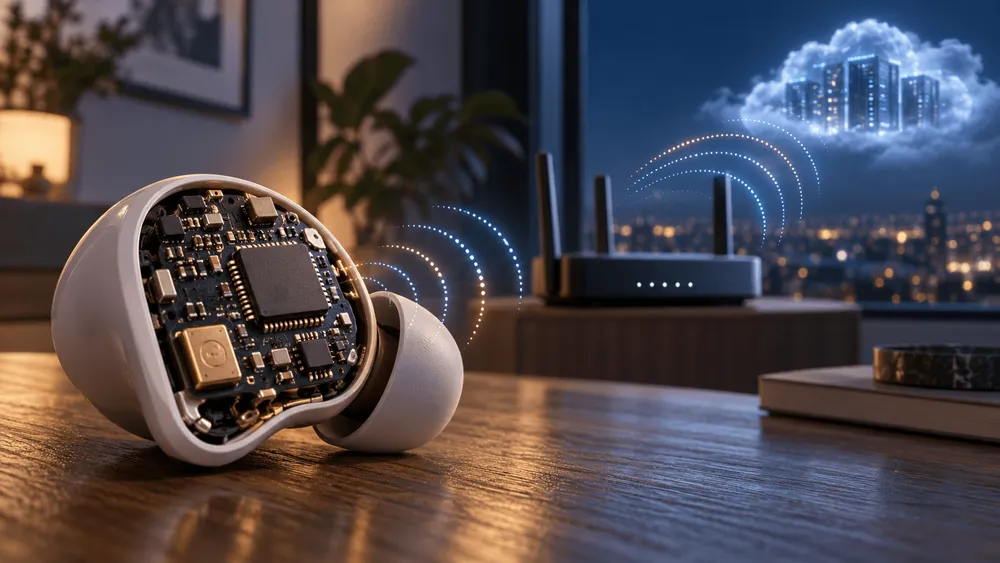
On September 23, Qualcomm Technologies announced Snapdragon Sound Elite Gen 2, a new semiconductor platform for earbuds and voice wearables. It integrates low-power Wi-Fi 6E, a circuit for running AI on the device, and audio processing features into a single platform. Qualcomm also envisions products that talk directly to cloud services without going through a smartphone.
However, neither playing music over Wi-Fi nor connecting earbuds directly to the cloud appears here for the first time. To understand what this announcement means, it helps to look separately at what has changed from the earlier S7 series and at the conditions under which the published performance figures were obtained.
Qualcomm's official product page lists the new platform's AI compute performance as up to 128 GOPS, up to twice that of the previous generation. It also cites integrated Wi-Fi 6E, up to 40% lower power consumption, and up to 30% less platform footprint.
The page does not, however, state the operating conditions or current values used to calculate the 40% reduction. The comparison conditions and the underlying area data come from audioXpress's on-site report, from a trade publication that attended the launch event and reviewed the product materials.
Wi-Fi and phone-free AI were both envisioned before
In its October 2023 announcement of the S7 Pro Gen 1, Qualcomm had already promoted XPAN, which delivers audio over Wi-Fi, along with power-efficient Wi-Fi connectivity.
According to the product description for the earlier S7 series, the S7+ Gen 1 paired a QCC7226 or QCC7228 audio processor with a QCP7321 for Wi-Fi.
So what is new is not that earbuds can use Wi-Fi. The official page for the new generation presents its distinguishing feature as integrating Wi-Fi 6E into the same platform as audio processing and AI compute.
The idea of connecting directly to the cloud was also floated earlier.
In its explanation of Snapdragon Sound Apps, Qualcomm described a setup in which devices built on the older S7+ Gen 1 connect to cloud services without relaying through a smartphone or PC.
MicroEJ, for its part, previewed in a March 2026 exhibition notice voice apps running on the S7 Gen 1 and voice interaction that does not use a smartphone. In its July announcement, the company said its VEE Audio runs on the S7+ Gen 1.
Still, the March material was only an exhibition preview, and the July material was an announcement from a software company. Neither shows that compatible earbuds have gone on sale widely.
| Date | What was confirmed | Target |
|---|---|---|
| October 2023 | XPAN and low-power Wi-Fi announced | S7 Pro Gen 1 |
| March 2026 | Phone-free voice AI announced as an upcoming exhibit | Apps using the S7 Gen 1 |
| July 2026 | Software that connects directly to the cloud announced | VEE Audio, verified on the S7+ Gen 1 |
| September 2026 | New platform integrating Wi-Fi 6E, AI compute and audio processing announced | Sound Elite Gen 2 |
Wi-Fi audio and XPAN were already announced with the S7 Pro in 2023, and phone-free cloud integration using the older S7 series had been shown by spring 2026.
For that reason, the "direct connection" of the Elite Gen 2 is better understood not as a wholly new use case but as a deeper integration of a concept Qualcomm has been showing into a new audio and AI platform.
What the 2x AI performance and 40% power savings actually measure
On its official product page, Qualcomm puts the compute performance of the new AI circuit, the eNPU, at up to 128 GOPS, up to twice the previous generation.
According to audioXpress, the S7 Gen 1 used as the comparison point delivers 64 GOPS versus 128 GOPS for the new generation, with multiply-accumulate operations per clock cycle doubling from 128 to 256. Both run at a clock speed of 250MHz, it says.
GOPS is a measure of how many operations can be executed per second. Under these conditions, theoretical compute performance has doubled, but the figure does not mean speech recognition or translation apps will run twice as fast on real hardware.
Actual processing speed varies with the size of the AI model, memory access, concurrent execution with audio processing, and other factors.
Qualcomm also touts "up to 40% lower power" on its official product page.
According to audioXpress, the comparison was made in an idle state, connected to Wi-Fi without exchanging data. In simulation, the new generation drew 0.6mA against 1.0mA for the S7 Gen 1. For the new generation, measurements on final production silicon are still pending.
This therefore does not mean that power consumption during music playback or AI app use falls by 40%, nor that the battery life of the whole earbud grows by 40%.
| Metric | New generation vs. comparison | Comparison conditions |
|---|---|---|
| Peak AI compute | 128 vs. 64 GOPS; 256 vs. 128 MAC/cycle | Both at 250MHz. Not a comparison of real app processing time |
| Idle current while connected to Wi-Fi | 0.6 vs. 1.0mA, up to 40% lower | Simulated values. New generation not yet measured on final silicon |
| Platform footprint | 31.1 vs. 44.2mm², up to about 30% smaller | Total SoC area as reported by audioXpress. Does not indicate the size of the earbud itself |
The "up to 30% reduction" that Qualcomm shows on its official product page likewise does not mean finished earbuds can be made 30% smaller.
According to audioXpress, the total SoC area shrank from 44.2mm² on the older S7 Gen 1 to 31.1mm² on the new generation.
Less required board area may give product designers more freedom. But where to put the freed-up space, whether the battery, microphones, sensors or something else, is up to each manufacturer's design.
In other words, the three figures for AI performance, idle current and footprint each reflect a different design challenge, and they do not show the same kind of improvement.
XPAN delivers audio; direct cloud connection is a different mechanism
Even among features that use Wi-Fi, XPAN and direct cloud connection play different roles.
As Qualcomm explained in its announcement of the earlier S7 Pro, XPAN delivers audio from a compatible transmitting device to earbuds by switching the connection from Bluetooth to Wi-Fi, letting sound reach farther inside a home or building.
With direct cloud connection, by contrast, an app running on the earbuds connects directly to services on the internet.
The former is a technology for how to deliver audio, while the latter is a mechanism for where an app on the earbuds connects.
According to the official specifications for the new platform, it integrates low-power Wi-Fi 6E supporting the 2.4GHz, 5GHz and 6GHz bands.
Qualcomm also promotes a concept called "Snapdragon Sound Apps & Agents," which combines apps with AI services. The envisioned usage has the earbuds handle audio processing where responsiveness matters, while heavier processing and integration with outside services are left to the cloud.
However, connecting directly to the cloud requires an available Wi-Fi environment, plus app implementation by the manufacturer and a compatible cloud service.
"Without going through a smartphone" also does not mean a smartphone becomes entirely unnecessary in every situation, from initial setup to communication while out and about.
Even the previous generation could use a dedicated AI compute circuit and fourth-generation adaptive noise cancellation.
The new generation's distinguishing feature is not that it brought AI to earbuds for the first time, but that it lets higher AI compute performance be used at the same time as music playback, calls, ambient sound processing and more.
Translation, transcription and guidance based on surroundings are listed as envisioned uses, but how usable and accurate real apps turn out to be is not determined by semiconductor specifications alone.
Real-world usability depends on how earbud makers design their products
Qualcomm's official specifications also list fifth-generation adaptive noise cancellation, cVc for processing call audio, and support for Bluetooth Classic and Bluetooth Low Energy. Support for LE Audio is reported by audioXpress.
Noise cancellation is designed to operate in response to how the earbuds are worn and to changes in ambient noise. And to make voice AI practical, microphone processing that accurately extracts the user's voice from surrounding noise also matters.
Qualcomm envisions targets beyond earbuds, including smart glasses with audio features and ear-worn devices equipped with cameras.
These, however, indicate the product categories Snapdragon Sound Elite Gen 2 targets, not a list of products that will actually adopt it or of planned launches.
Music playback quality is likewise not determined by chip support alone.
According to Qualcomm's explanation of Snapdragon Sound, certification as a compatible product is a prerequisite, and the transmission quality of aptX Lossless also varies with wireless connection conditions.
Even if a semiconductor supports a particular feature, whether it can be used in an actual product depends on the transmitting device, the manufacturer's design, certification and other factors.
What matters next for consumers is how the products that actually launch perform: battery life, voice recognition accuracy in noisy environments, and how smoothly they switch between Wi-Fi and Bluetooth.
For products that send voice and ambient information to the cloud, it will also be necessary to check, product by product, which information is processed on the device and what is sent to external cloud services.
What can be said for now is limited to this: Snapdragon Sound Elite Gen 2 widens the range of designs available to manufacturers. Its real value will be decided by how each manufacturer builds these features into products and what experience they deliver on actual devices.