

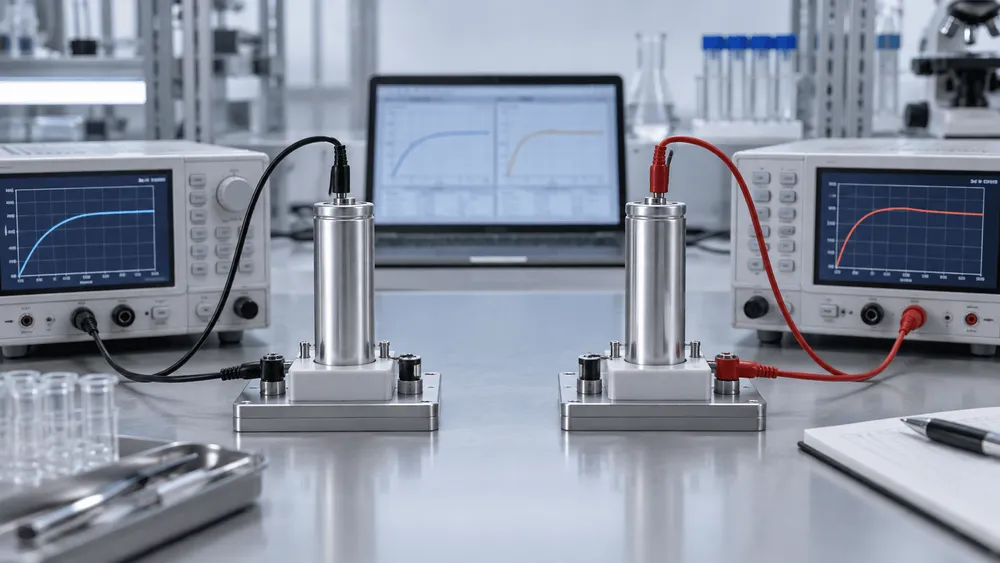
On September 17, 2026, Southwest Research Institute (SwRI) in the United States announced the Electrical Interchangeability Index (EII), a metric for evaluating the conditions under which a sodium-ion battery can serve the same applications as a lithium-ion battery. It is an attempt to measure whether, when the materials change, a battery can still deliver and accept the power a device requires in the same way. Sodium-based batteries have the advantage of abundant resources, but their energy density is generally lower, and a simple swap could add weight and size. EII addresses how far such differences are tolerable in actual use.
What can currently be confirmed about EII is the announcement of an early-stage study that SwRI carried out with internal funding. No corresponding peer-reviewed paper has been found. Separate peer-reviewed research has shown that the voltage response of commercial cells changes with temperature and charge level, which suggests a scientific reason to tie interchangeability to how a battery is used.
Same capacity does not guarantee the same device will run
SwRI focused on replacing 18650-format lithium-ion cells. These are cylindrical cells, 18 mm in diameter and 65 mm long, used in laptops, power tools, electric vehicles and more. However, matching the outer dimensions is a separate matter from confirming that a cell can do the same electrical work.
For example, a device that draws steady power for a long time and one that demands a large burst of power for a short time require different capabilities from a battery. In operation that interleaves charging with discharging, the amount of power the battery can accept also becomes an issue. This is an illustration of how applications differ; it does not mean SwRI has demonstrated replacement in individual devices.
Power is the product of voltage and current. If a device keeps demanding the same power, the lower the voltage falls during discharge, the more current must flow. In a simple circuit model with constant resistance, resistive heating is proportional to the square of the current, so higher current also increases the thermal burden. In real batteries, resistance itself varies with temperature and charge level, and other sources of heat come into play. Even when nominal capacities are close, a cell may not be able to deliver the required power to the end.
EII evaluates such charge-discharge operating patterns together with the battery's usage constraints. According to SwRI, in regions of high EII, the differences in cell surface temperature rise, available capacity and power capability were small, and the cells could repeatedly do equivalent work. In regions of low EII, by contrast, they could not meet equivalent application performance. The evaluation includes charge and discharge rates and voltage limits, as well as how well the cell tracks the required power.
What can be read from this explanation is not a performance ranking of sodium-based batteries as a whole. It is that whether a replacement works depends on which loads are applied and over what range of use.
What earlier research shows: pitfalls of temperature and charge level
Changes in performance with temperature and charge level have already been examined in experiments on commercial cells. A peer-reviewed paper published in 2025 in Future Batteries by Pablo Rodríguez-Iturriaga and colleagues measured sodium-ion cells at 5°C, 25°C and 35°C and compared them with lithium-ion systems. This is separate from SwRI's work and does not validate EII.
The sodium cell used in the tests was the NA18650-1250, which combines a layered-oxide cathode containing nickel, manganese and iron with a hard-carbon anode. The researchers made an initial evaluation of 10 cells, then selected two with similar low-charge voltage responses for detailed study. In constant-current discharge tests, they varied the C-rate, which expresses current relative to nominal capacity, and measured voltage and surface temperature, among other quantities, in a temperature-controlled chamber.
One finding concerned how internal resistance changes with charge level. In the cells examined, resistance was roughly constant above 50% state of charge but rose sharply at low charge. If voltage drops abruptly near the end of discharge, the cell reaches the lower cutoff voltage at which use must stop before all the stored electricity has been extracted. A battery's capacity cannot be separated from the conditions under which it is used.
The yardstick used for comparison also calls for care. According to Table 2 of the paper, the nominal capacity is 1.25 Ah for the sodium cell and 2.5 Ah for the lithium iron phosphate (LFP) cell it was compared with. A 1C rate, the current that discharges the nominal capacity in one hour, corresponds to 1.25 A and 2.5 A respectively. Even at the same C-rate, the actual current differs, and with different voltages the power does not match either. To check whether a cell meets a given device's requirements, these differences must be taken into account.
The study uses an "extended Ragone plot," which adds temperature and discharge rate to the Ragone plot showing energy and power per unit weight. Battery comparisons that combine many conditions were being done before EII. SwRI's proposal can be read as an effort to link them to application-specific power delivery and acceptance, and to treat the result as an interchangeability metric.
Note that the comparison partners in this paper are commercial cells of differing form and capacity, so the results for the selected sodium cell cannot be extended to all current products. The paper itself says that fully evaluating applications requires lifetime testing that reflects real-world use.
Public materials cannot yet reproduce the interchangeability boundary
SwRI reports having identified regions of high and low interchangeability. However, the information in the announcement is not enough for a third party to recalculate those boundaries.
SwRI's September 17, 2026 announcement does not give the EII calculation formula, the threshold separating high from low, the model numbers and number of test cells, or the specific ranges of temperature, charge level and load tested.
Checking the full text of the announcement against the items needed to reproduce the metric, the scope of the public information is as follows.
| Item checked | What the announcement shows | What the announcement does not show |
|---|---|---|
| Definition of the metric | Quantifies the degree to which the electrical requirements of the same application are met | The formula and how each evaluated quantity is treated |
| Interchangeability judgment | Reports confirming regions of high and low EII | The threshold separating high from low and the tolerances |
| Test subjects | Examines replacing 18650 lithium-ion cells | Cell model numbers, quantities, details of electrode materials |
| Operating conditions | Says evaluation covered a wide range of conditions | Specific ranges of temperature, charge level and load |
This is a cross-check of what has been published, not a claim that the institute did not measure or define these items. It means that, at this stage, readers cannot derive from the announcement which commercial cells can be replaced, at what temperatures, and up to how much power.
Also, the result that surface temperature rises were similar does not mean safety under abnormal conditions is equivalent. Comparing heat generation during charging and discharging and testing for hazards such as thermal runaway answer different questions. EII should not be read as a substitute for safety certification.
The value of replacement is decided at the level of the whole device
SwRI plans to extend EII to other battery chemistries, cell formats and applications, and to examine the effects of aging and thermal management. This plan indicates that even if cells can do the same work in their initial state, interchangeability after continued use must be confirmed separately.
Furthermore, even when single-cell performance is close, adoption in a device still requires confirming compatibility with the charger and the battery management system (BMS). Does the control suit the new cell's voltage range? How should cell-to-cell variation and heat dissipation be handled when multiple cells are assembled into a pack? The initial EII results do not support the conclusion that an entire battery pack can be swapped as is.
Price also needs independent verification. A 2025 Nature Energy paper by Adrian Yao and colleagues used models to analyze the economics of sodium-based batteries under varying conditions, such as material prices and technological improvements. The timing at which they could compete with inexpensive lithium-based systems depends on those conditions, and the paths by which that might happen in the 2030s are results that assume continued progress in research and development. Resource abundance alone does not determine a finished battery's price advantage.
If the EII calculation method and test conditions are shared, other researchers can reproduce it, and it is confirmed that cells still meet required performance after degradation, designers will be able to narrow down concretely which applications can be replaced. What lies beyond is being able to choose a battery that meets the requirements of the intended device while widening the range of material options.