

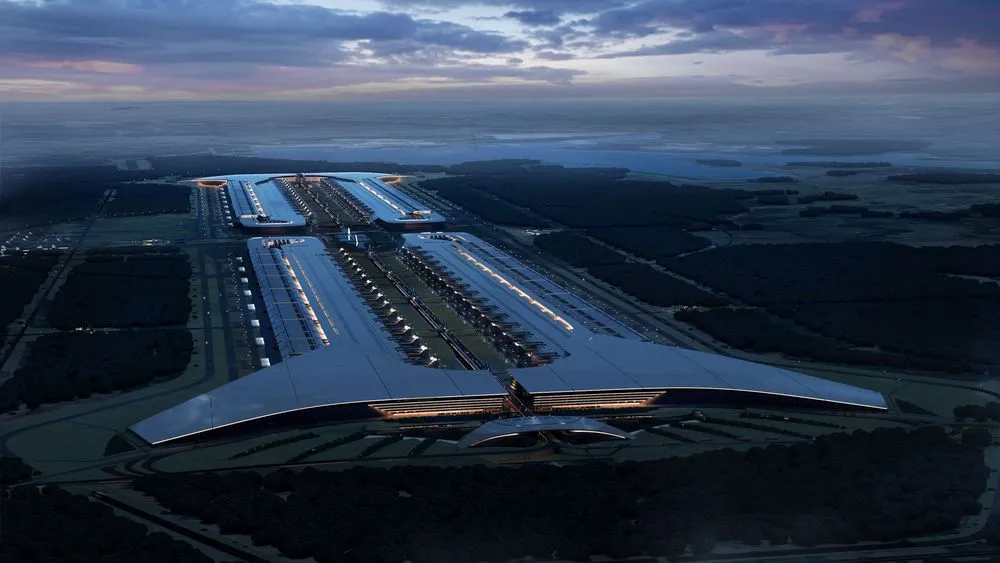
On August 6, 2026, SpaceX announced it would build the "Terafab" semiconductor plant—a joint effort with Tesla—in Grimes County, Texas. The initial capital investment is approximately $16.8 billion, with plans to employ at least 3,000 people. While the concept itself had been announced back in March, this marks the first time the construction site and initial investment figure for a full-scale plant have been presented together as a single plan. The project, anticipating a shortage of AI semiconductors, has now finalized its site selection and settled on the scale of its initial investment.
However, the announcement does not specify a groundbreaking date or mass-production timeline for the Grimes County site. The $16.8 billion figure does not represent the completion of the plant—it marks the entry point of a long-term plan.
From Concept to Confirmed Site
The outline of Terafab has gradually taken shape over the past six months. SpaceX and Tesla announced their collaboration in March, and in April, Tesla broke ground on a research fab at the North Campus of Giga Texas. Intel also joined that same month as a strategic partner, revealing it would provide expertise—from design to packaging—to SpaceX, xAI, and Tesla.
Meanwhile, in a prospectus published in June, SpaceX stated that its agreement with Tesla was merely a general framework for Terafab's development, with the development schedule, milestones, and capital expenditures to be determined through separate contracts. The August 6 announcement represents a step forward from that state, into the initial phase centered on Grimes County and roughly $16.8 billion. The official Grimes County website also has the fully executed versions of the property tax abatement agreement and economic development agreement with SpaceX posted.
Here, it's important to distinguish between the research fab in Austin and the mass-production facility in Grimes County. SpaceX's announcement explicitly states that construction has already begun on the former, while for the latter, it only states that it "will build." It also remains unclear how Intel will be involved in the plant, or how SpaceX and Tesla will divide the $16.8 billion investment.
1TW Refers to Annual Computing Capacity, Not Power Consumption
The Terafab plant in Grimes County is planned to bring together advanced logic and memory manufacturing, packaging, and testing within a manufacturing space exceeding 100 million square feet. By locating these processes on the same site, the time needed to feed design changes back into manufacturing and implementation can be shortened. SpaceX explains that by iterating improvements at the same location, the time to bring chips to market as products can also be reduced.
The plan envisions two distinct product lines for different use cases. For terrestrial applications, the plant will produce chips handling inference for Tesla's humanoid robot "Optimus" and self-driving vehicle "Cybercab." The other line consists of high-power chips for SpaceX's planned orbital data centers. Terafab is designed to handle the semiconductors needed for both of these use cases at the same manufacturing and packaging facility.
SpaceX and Tesla estimate that the combined chip demand from both companies will exceed 1TW of computing capacity, significantly surpassing current global supply. Here, 1TW does not refer to the plant's power consumption. SpaceX's prospectus defines the goal as "the capacity to produce 1TW of computing hardware annually," and Terafab's official website similarly states an "output of 1TW/year." This figure cannot be used to indicate the scale of power infrastructure—it is a target value the company has set to represent computing resources on the product side.
$16.8 Billion and $119 Billion Represent Different Stages
The roughly $16.8 billion figure announced this time is smaller than the maximum $119 billion that appeared in the state tax incentive application. However, the two figures are not estimates for the same scope of construction. The August announcement refers to the initial phase led by SpaceX and Tesla, while Texas's JETI application addresses a long-term scenario that expands across school districts through up to four phases.
For example, just the Phase 1 application portion belonging to the Anderson-Shiro Independent School District lists eligible property placed in service between 2026 and 2028 at $10.366217 billion, with an assumption of generating 617 permanent jobs by 2029. This figure represents assets within a single school district, not the entirety of Phase 1. SpaceX has not disclosed how much of the new $16.8 billion falls within this application scope.
Supplementary materials submitted to the state assume a combined investment of $55 billion to $119 billion across all four phases. However, each phase is designed to be capable of manufacturing semiconductors independently, with the decision to proceed to the next phase made only after completing the construction of the immediately preceding one. Therefore, the $119 billion figure is not a confirmed commitment—it should be read as an upper-bound scenario contingent on demand, technology, and funding conditions all aligning.
Gaps That Remain Before Production Begins
What the August announcement filled in was the construction site and initial investment amount; the manufacturing conditions that will determine the semiconductor plant's success remain open. The JETI documents envision using strategic partners and advanced processes, with an eye toward sub-2-nanometer-class nodes. Meanwhile, SpaceX's latest announcement does not specify the mass-production node, the source of lithography equipment procurement, or target yield rates. While construction has begun on what is described as the predecessor research fab, the conditions for mass production at a facility of over 100 million square feet have not yet been disclosed.
There are also limits to vertical integration of supply. In its prospectus, SpaceX indicated that even after advancing Terafab, it expects to continue sourcing a significant portion of its computing hardware externally. Rather than a plant that immediately replaces existing suppliers, Terafab is starting out as a mechanism to add proprietary supply capacity as demand grows for Optimus, Cybercab, and orbital computing infrastructure.
Regarding water, the plan indicates that Gibbons Creek Reservoir—rather than local groundwater—will be used, with wastewater treatment and reuse conducted on-site. However, the annual water withdrawal volume has not been disclosed. The employment plan of at least 3,000 jobs also lacks a breakdown of job types or hiring timeline. The burden the plant's scale will place on the region's power grid, water supply, and labor market can only be measured once the construction plan becomes more concrete.
The next milestone will be when the construction timeline in Grimes County and the timing of first wafer output appear in contracts or permits. After that, once the mass-production node and yield rates are disclosed, it will become possible to judge how quickly the $16.8 billion translates into actual supply capacity. Additional investment for future phases will only become realistic once those figures are in place.