


A car engine burns fuel to create heat, and that heat drives pistons that turn the wheels. This classic mechanism of energy conversion has now been recreated inside an invisible superconducting circuit, in an ultracold world close to absolute zero.
A research team led by Mikko Möttönen at Aalto University in Finland has experimentally demonstrated, for the first time, a "quantum heat engine" powered by a superconducting qubit. This tiny engine absorbs the small amounts of heat present inside a quantum computer and converts it into physical "work."
The "Millions of Cables" Problem at the Heart of Quantum Computers
Finland's quantum technology strategy aims to realize a system with 1,000 logical qubits by 2035. Implementing practical, error-corrected logical qubits at that scale would require packing in hundreds of thousands to millions of physical qubits. Quantum hardware is being pursued through many competing approaches, including trapped ions and silicon spins. Trapped-ion systems have fewer wiring problems, but limits on physical layout and operating speed are beginning to show. Superconducting systems, meanwhile, currently lead by a wide margin in control reliability and computation speed. Yet the biggest bottleneck threatening that advantage is the wiring problem, which physically obstructs scaling up.
Today's most advanced superconducting systems look like giant chandeliers. At the center is a dilution refrigerator that keeps the qubits near absolute zero (the millikelvin range), and countless microwave coaxial cables extend from it to room-temperature control equipment. Controlling and reading out a million qubits individually would require connecting millions of cables directly to the cryogenic chip. Each cable is estimated to cost several thousand euros, so wiring alone for a giant system could run to billions of euros (hundreds of billions of yen).
Physical and Thermal Limits Threatening Superconducting Systems
Even more serious is thermal noise that travels down the cables from the room-temperature environment. Delicate quantum states held at ultralow temperatures can easily lose coherence from even a small inflow of heat, causing computational errors. Continually cooling an ever-larger quantum computer while firing microwave pulses into it from outside through large numbers of metal cables creates a fundamental thermodynamic contradiction in system design.
The situation would change dramatically if one could build a tiny engine that uses the heat already present on the cryogenic chip as its power source, and autonomously reads out and controls qubits, instead of sending high-power microwave signals from room-temperature equipment. The research team built a closed thermodynamic cycle inside a superconducting circuit, laying the foundation for an entirely new control architecture that does not depend on external wiring.
Tunneling Switches: One Device as Both Hot and Cold Source
In classical thermodynamics, running an engine always requires two things: a hot reservoir and a cold reservoir. In a steam engine, these correspond to the combustion boiler and the condenser. In principle, one could build two independent heat baths on a micrometer-scale superconducting chip and switch between them precisely, but this would bloat the structure and cause crosstalk (signal interference), so it was not practical.
The team adopted an innovative approach in which a single "quantum-circuit refrigerator" (QCR) serves as both the hot and cold source. The QCR is a structure with a normal metal–insulator–superconductor (NIS) junction. It was originally developed to rapidly extract unwanted heat (quasiparticles) around qubits and reset error states.
An NIS Junction That Controls Photon Absorption and Emission
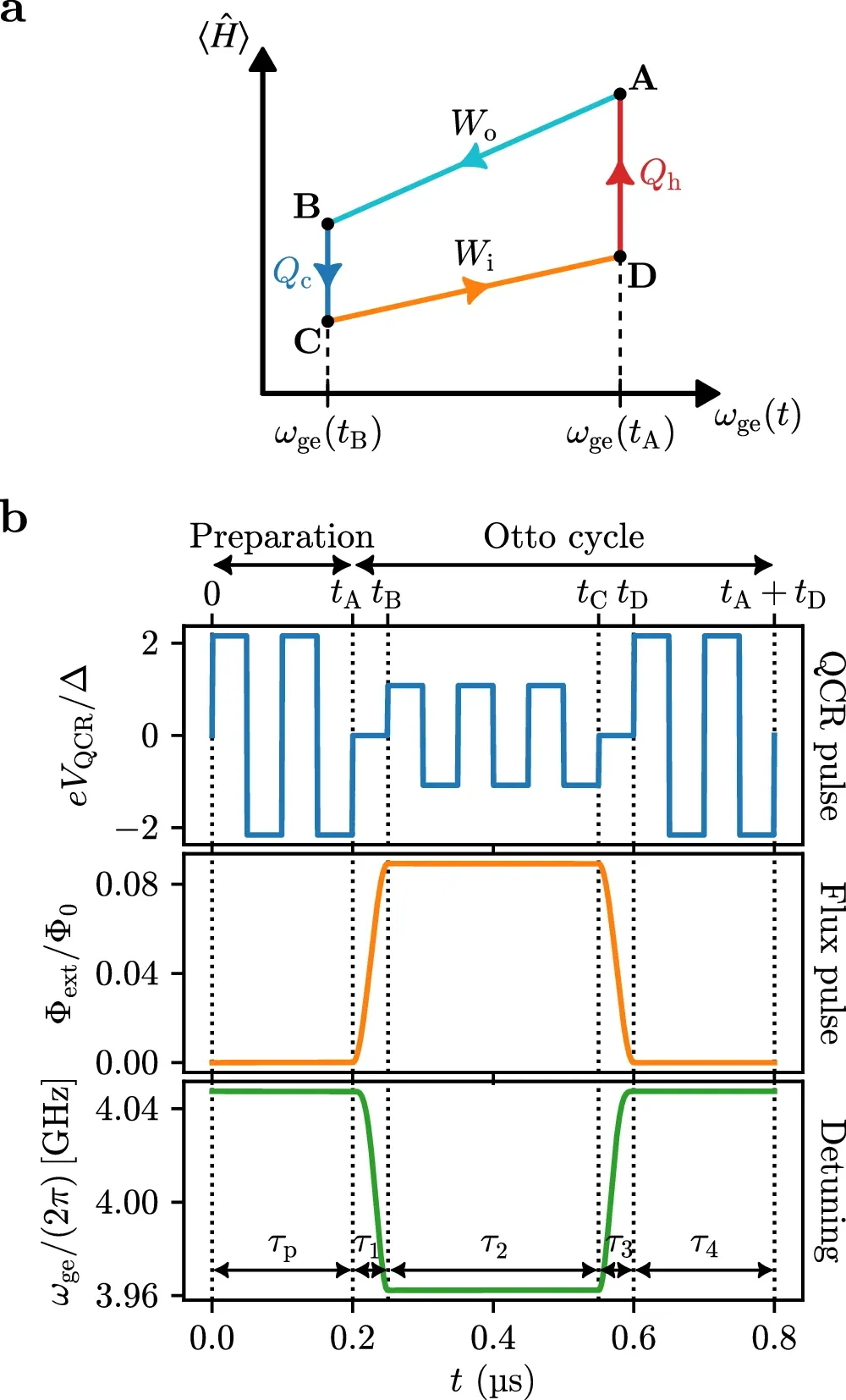
By carefully manipulating the DC and AC bias voltages applied to the QCR, the team can freely control electron tunneling at the junction. When the voltage is set to a specific low value (about 1.08 , where is the superconducting gap parameter), electrons moving from the normal metal to the superconductor make up the missing energy by absorbing photons from the qubit. Heat is thereby removed from the qubit, and the QCR acts as a "cold source (cooling)."
When the voltage is raised to a higher value (about 2.16 ), processes in which tunneling electrons emit excess energy as photons into the qubit, as well as elastic tunneling, are strongly promoted. In this state, the QCR becomes a "hot source (heating)" that injects thermal energy into the qubit. By switching the voltage on a single junction device, the team instantly created the temperature difference needed to drive a heat engine.
A Cryogenic Otto Cycle with the Qubit as the Piston
The demonstrated engine runs on the four-stroke "Otto cycle" used in gasoline cars. The Carnot cycle, which has the highest theoretical efficiency, alternates isothermal and adiabatic changes. The Otto cycle instead inserts isochoric changes, in which heat is added or removed at fixed volume, between compression and expansion. Because of its practical output and ease of control, most of today's internal combustion engines use this cycle. In a quantum heat engine, what corresponds to the piston's change in volume is the manipulation of the transmon qubit's "energy levels (transition frequency)."
The first law of thermodynamics for this tiny engine is written using the expectation value of the quantum-mechanical Hamiltonian as follows.
The change in the system's total internal energy $dE$ is the sum of the work done on it by the external environment and the heat the system receives. Work is done by changing the eigenenergies , and heat is exchanged as the occupation probabilities of the states change.
The Mathematics of Energy Conversion Through Expansion and Compression
The cycle proceeds on extremely short timescales. First comes "adiabatic expansion (50 ns)," in which an external magnetic flux pulse lowers the qubit's transition frequency. During this stage, the qubit does work against the external field while reducing its own eigenenergy. Next comes "isochoric cooling (200 ns)," in which the QCR is put in cooling mode to remove thermal excitations from the qubit. Then comes "adiabatic compression (50 ns)," in which the qubit frequency is returned to its original value. In this stage, the external field does work on the system, but because the number of excitations in the qubit was reduced by the preceding cooling, the work required for compression is smaller than the work the qubit did on the outside during expansion. Finally, "isochoric heating (200 ns)" puts the QCR in heating mode to raise the qubit's temperature, leading into the next cycle.
The difference between the work extracted during expansion and the work consumed during compression is the "positive work" produced by this engine.
Experimental Data Show the Thermodynamic Cycle at Work
The team ran this cycle continuously and performed single-shot measurements of the qubit state at the end of each stroke. They took 10,000 samples at each measurement point and used a multivariate Gaussian mixture model to precisely identify the probability distributions of the quantum states.
In the experiment, the qubit's effective temperature, about 160 mK at the start of the first cycle, rose to about 600 mK by the third cycle because of an imbalance between the heat from heating and cooling. Simulations confirmed that heat input and output balance completely after about five cycles, reaching a steady state. The theoretical Carnot limit (the maximum efficiency of a heat engine) in this temperature range is about 0.83, while the demonstrated Otto cycle recorded an average output power of 0.039 eV/s and an energy conversion efficiency of 0.0055. The absolute values are tiny, but they reach 27% of the ideal Otto efficiency for the set compression ratio, strongly demonstrating that the thermodynamic cycle runs as intended inside a superconducting circuit.
| Item | Conventional quantum computer control | Autonomous architecture proposed in this study |
|---|---|---|
| Energy source | Microwave input from the room-temperature environment | Heat inside the quantum circuit (phonons and quasiparticles in the cryogenic environment) |
| Circuit complexity | External coaxial cables required for each qubit | Self-contained on-chip configuration using the QCR |
| Scalability | Wiring space and cooling capacity reach their limits at a few thousand qubits | Substantial cable reduction opens a path to millions of qubits |
| Handling of thermal noise | Heat traveling along cables is the biggest cause of errors | Unwanted heat in the circuit is itself consumed and used as "power" |
Turning Noise into Power and Opening the Door to Autonomous Quantum Architectures
The engine demonstrated here is still at the proof-of-concept stage. At present, it still requires precisely timed external pulses to drive each stroke of the cycle, so it is not yet fully autonomous. Its output is not a practical power source either; it serves mainly as a tiny testbed for verifying quantum thermodynamic theory.
Still, this result calls for a fundamental shift in how quantum computer architectures are designed. Until now, the heat on a cryogenic chip was nothing more than unwanted noise that destroys the coherence of quantum states and causes computational errors. This study clearly shows the possibility of physically converting that troublesome heat into work inside the circuit and reusing it as energy for operations such as qubit readout.
A Potential Game Changer in the Race to Scale
If an autonomous quantum heat engine can be implemented on a chip, dependence on microwave signals from room temperature could be sharply reduced. That would be a decisive step toward breaking through the physical and economic limit of "millions of cables" that superconducting systems face. A path is emerging for data-center-scale quantum hardware, once tied to giant dilution refrigerators and countless cables, to evolve into more refined, compact systems that perform thermal management and signal processing autonomously on the chip.
A tiny engine running at the boundary of heat and information turns the obstacle of noise itself into a power source, and may become a driving force that carries superconducting quantum computers toward true large-scale operation.