


A research group led by Professor Ryo Shimano of the University of Tokyo and Professor Takahiro Morimoto of Kyoto University irradiated a superconducting niobium nitride thin film with a terahertz-band "optical vortex," a beam with a helically twisted wavefront. They observed the oscillation pattern of the Higgs mode, a collective oscillation in the superconducting state, rotating over time. Reversing the twist direction of the optical vortex also reversed the direction of rotation, and the phase of the oscillation changed by 4π over one circuit around the beam center, twice the change of the optical vortex itself. The group analyzed this oscillation pattern theoretically and concluded that orbital angular momentum carried by the light was transferred to the superconducting condensate. The paper was published in Physical Review Letters dated November 23, 2026 (U.S. Eastern Time).
Exciting the Higgs mode, which couples poorly to light, with terahertz waves
In the superconducting state, electrons form pairs that condense, and the whole system behaves as a single macroscopic wave with a uniform phase. A collective oscillation in which the amplitude of this wave varies periodically is called the Higgs mode, because it shares a theoretical structure with the Higgs boson in particle physics. In physical terms, it is an oscillation in the magnitude of the superconducting order parameter.
This oscillation was long difficult to capture experimentally. According to a review paper compiled by Shimano and colleagues in 2020, the Higgs mode does not couple linearly to electromagnetic fields. Even when weak light is applied, no oscillatory response proportional to the light's electric field arises. For this reason, for more than half a century after it was theoretically predicted, it went unobserved except in special systems where it coexists with a charge density wave. What changed the situation was progress in spectroscopic techniques that induce a nonlinear response in matter with intense terahertz waves and measure its time evolution.
Terahertz waves have frequencies of roughly 0.1 to 10 terahertz and sit between radio waves and infrared light. One terahertz corresponds to one trillion oscillations per second. In 2013, Shimano's group observed Higgs-mode oscillations in Nb₁₋ₓTiₓN thin films using terahertz pump-probe spectroscopy and reported it in Physical Review Letters. In 2014, they reported in Science that terahertz waves resonate nonlinearly with the Higgs mode in niobium nitride (NbN).
This time, the group converted terahertz waves into an optical vortex before irradiating the sample. An optical vortex is light whose phase varies continuously around the propagation axis, giving it a helically twisted wavefront. It carries orbital angular momentum determined by the direction and number of twists, a property distinct from the spin angular momentum associated with circular polarization.
Observing the Higgs-mode oscillation pattern rotate
According to a press release from Kyoto University and others, the experiment used pump-probe spectroscopy. A terahertz optical vortex was directed as the pump light onto the niobium nitride superconducting thin film, and the resulting Higgs-mode oscillation was measured with a separate terahertz wave, the probe light. By varying the time difference between the arrival of the pump and probe pulses at the sample, the team could follow the oscillation over time.
To measure the spatial distribution of the oscillation, the group focused the probe light to a spot smaller than the pump light, fixed its position, and moved the lens that focuses the pump light up, down, left and right. By measuring the response at each position as the optical vortex was shifted, they obtained both the spatial distribution and the time evolution of the Higgs-mode oscillation.
The results showed four regions, corresponding to peaks and troughs of the Higgs-mode oscillation, appearing alternately around the beam center, with their arrangement rotating over time. The press release shows measured and theoretically calculated results side by side, with a scale bar of 2 mm in the figures. In other words, the rotation of the superconducting oscillation pattern was captured over a range of a few millimeters. Moreover, when the twist direction of the optical vortex was reversed, the direction of rotation of the Higgs-mode oscillation pattern reversed as well.
Why the phase change is doubled in the Higgs mode
Phase is a quantity indicating which stage of its cycle a wave's oscillation is at. For the optical vortex used here, the phase changes by 2π over one circuit around the beam center. By contrast, the phase of the Higgs-mode oscillation observed in the experiment changed by 4π over one circuit around the beam center, twice that of the optical vortex.
This difference stems from the nonlinear response of the Higgs mode to terahertz waves. According to the press release, the Higgs-mode oscillation driven by a terahertz wave is proportional to the square of the electric field. Because squaring gives the same value whether the field is positive or negative, the Higgs mode completes two cycles during each cycle of the electric field, so its frequency is twice that of the terahertz wave. The same quadratic dependence doubles the spatial phase change as well, so an optical vortex whose phase changes by 2π per circuit produces a Higgs-mode oscillation whose phase changes by 4π per circuit.
Note that the phase of the Higgs-mode oscillation measured here is the phase of the periodic variation in the order parameter's amplitude, which differs from the phase of the macroscopic wavefunction describing the superconducting condensate itself. What changed by 4π around the beam center was the phase of the amplitude oscillation.
From theoretical prediction to experiment, and toward a "quantum optical spanner"
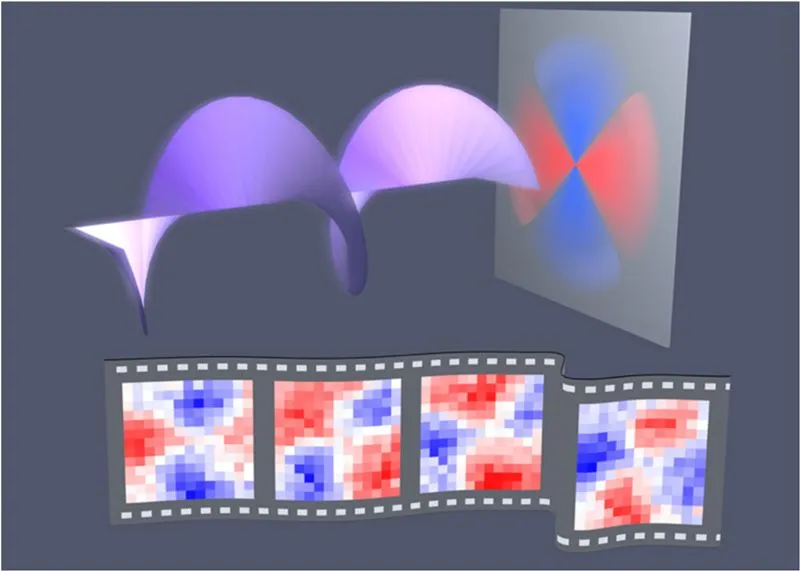
What the experiment directly measured was the spatial distribution of the amplitude and phase of the Higgs-mode oscillation. The group reproduced the observed rotating pattern with numerical calculations based on time-dependent Ginzburg-Landau theory, which describes the time evolution and spatial distribution of the superconducting order parameter. According to the paper's abstract, the team then analyzed the measured amplitude and phase distributions with the same theory and concluded that the rotating Higgs mode carries finite orbital angular momentum corresponding to the twist direction of the optical vortex. The transfer of angular momentum from light to the superconducting condensate was thus shown by this theoretical analysis.
The phenomenon had been predicted theoretically. In a Physical Review Research paper published on October 4, 2023, Mizushima and Sato showed that a pulsed terahertz optical vortex could excite a helical oscillation of the order parameter (a "spiral Higgs wave") and might transfer orbital angular momentum to the superconducting condensate.
On December 16, 2025, Daemo Kang, Kitamura and Morimoto proposed an even more far-reaching phenomenon in a Physical Review B paper. Using numerical calculations, they showed that irradiating a superconductor with an optical vortex could transfer the light's angular momentum to a collective mode and mechanically rotate the superconductor itself, and named this the "quantum optical spanner." Kang and Morimoto are also authors of the present Physical Review Letters paper.
After the 2023 theoretical prediction and the 2025 quantum optical spanner proposal, rotation of the Higgs mode was observed experimentally in 2026, and the transfer of angular momentum from light to the superconducting condensate was supported by theoretical analysis. However, what was observed this time was rotation of an oscillation pattern, not the mechanical rotation of the superconductor itself predicted for the quantum optical spanner.
From atoms to superconductors: systems receiving light's orbital angular momentum
Research on transferring light's orbital angular momentum to matter has advanced in a variety of systems. In 2006, Andersen and colleagues transferred the orbital angular momentum of light to a sodium-atom Bose-Einstein condensate, generating a vortex state of the atoms. Subsequent work has broadened to bound electrons of a single ion and pseudo-plasmons in metamaterials.
| Year | System receiving orbital angular momentum | Observable showing the transfer | Source |
|---|---|---|---|
| 2006 | Sodium-atom Bose-Einstein condensate | Atomic vortex state (transfer of angular momentum in quantized units) | Andersen et al., Physical Review Letters 97, 170406 |
| 2016 | Bound electron of a trapped single ion | Change in transition selection rules | Schmiegelow et al., Nature Communications 7, 12998 |
| 2020 | Pseudo-plasmons on a metal-disk metamaterial (terahertz light) | Visualized transfer of angular momentum to the pseudo-plasmon | Prof. Koichiro Tanaka of Kyoto University et al., Science Advances 6, eaay1977 |
| 2026 | Niobium nitride superconducting thin film (condensate of electron pairs) | Rotation of the Higgs-mode oscillation pattern and a 4π phase change per circuit | Tanaka et al., Physical Review Letters 137, 226001 |
Note: This table compares the systems that received angular momentum and the observables showing the transfer. Transfer efficiency and the magnitude of angular momentum are not compared.
There is also earlier work on superconductors. According to the final report of a KAKENHI project (fiscal 2016–2018) by Professor Yasunori Toda of Hokkaido University, when the high-temperature superconductor Bi2212 was excited with optical vortex pulses, electron pairs or quasiparticles received the vortex's orbital angular momentum, producing a change in transient reflectivity that depended on the twist direction of the optical vortex. What was measured there was the time variation of reflectivity, a different observable from the present study, which measured the Higgs-mode oscillation pattern in space and time.
Kyoto University was involved in both the 2020 and 2026 studies listed in the table. In addition to the University of Tokyo and Kyoto University, the authors of the present paper include Hirotaka Terai, a senior researcher at the National Institute of Information and Communications Technology (NICT), and Naotaka Yoshikawa, who was an assistant professor at the University of Tokyo at the time of the research and is now an associate professor at Hokkaido University. The paper was also selected as an "Editors' Suggestion" by Physical Review Letters.
The result suggests that not only the intensity and frequency of light but also its wavefront structure and orbital angular momentum could be used to control superconducting states. The research group hopes this will lead to applications in quantum technologies, ultrafast optical control of quantum materials, and the creation of new quantum phases.