

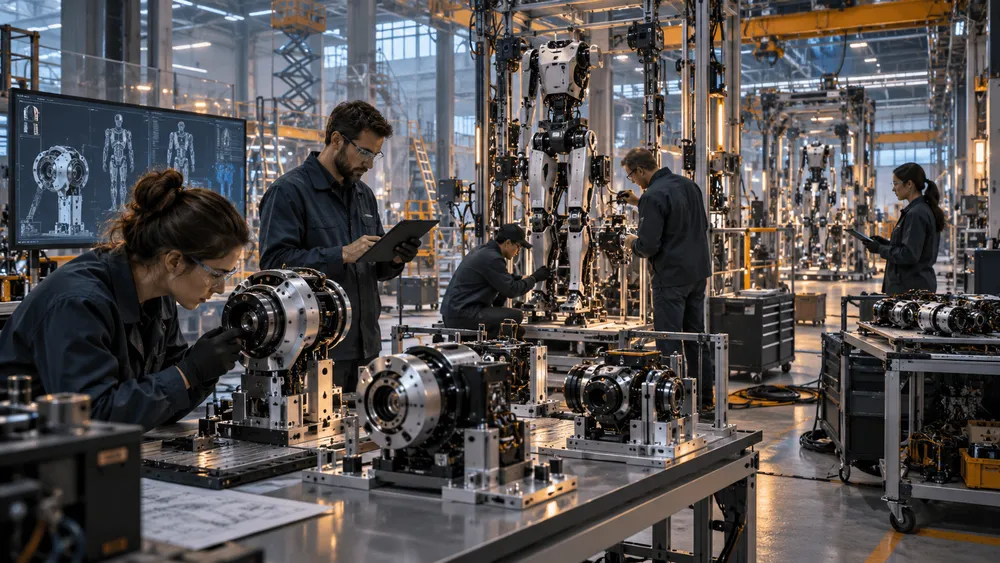
Tesla has reportedly begun auditing suppliers in China as part of preparations to mass-produce its humanoid robot, Optimus. According to China's 21st Century Business Herald, a Tesla-related team arrived in Ningbo on September 16, 2026, and began mass-production audits for the robotics business the following day, September 17. The report states that Tesla has already placed orders for related components with its supply chain, with a plan to build roughly 50,000 units in 2026 and deploy them to Tesla factories around the world.
This move could mark a milestone in Optimus Gen 3's progression from prototype to a mass-producible product. However, the figure of 50,000 units is not a production result or an official forecast that Tesla itself has disclosed. Nor is the $20,000 figure reportedly used as a target during the audits an official consumer price.
What Tesla has confirmed in its own official Q2 2026 filing, dated July 22, is only that production facilities in Fremont and Texas are still "under construction," and that early production units are being used internally to collect training data and develop functionality.
What the China Audits Are Actually Checking: Can the Same-Quality Parts Be Made Repeatedly?
The audits reported by 21st Century Business Herald, citing supply-chain sources, differ in nature from prototype evaluations that simply confirm whether a designed part functions once.
According to the report, the previous round of audits covered the consistency of integrated joint modules, precision components, and final assembly — checking whether motors, reducers, controllers, and encoders could be reliably assembled together as a single mechanism.
Even if individual components meet specifications, making a humanoid robot actually move requires fitting reducers (which transmit motor rotation to the joints), encoders (which detect position), and controllers (which regulate movement) into a confined space.
If there is variation in the dimensions or performance of each component, errors can accumulate after assembly, causing different units to move differently even when given identical commands.
With a handful of prototype units, manual adjustment is feasible. But as production volume increases, adjustment time and defect rates increasingly determine production speed.
This is reportedly why the audit criteria include stable mass-production capability for items such as planetary roller screws, sensors for multi-fingered hands, and torque sensors.
Planetary roller screws convert rotational motion into linear motion, moving joints while bearing load. The various sensors measure the force exerted when touching an object and the torque applied to joints.
If there is significant variation in dimensions or response characteristics, it becomes difficult to apply the same software-based control uniformly across all units.
According to the audit criteria reported by 21st Century Business Herald, Tesla is demanding short production cycles and high yield rates similar to those in the automotive parts industry, and is also reportedly reviewing suppliers' overseas production capacity and their management of secondary suppliers.
Companies named as audit targets include Sonavox Technology (Tuopu Group), Sanhua Intelligent Controls, Zhejiang Rongtai, Ningbo Xinquan, and Joyson Electronics — all of which have ties to Tesla's automotive business.
However, these are companies named in media reports; Tesla has not published an official list of approved suppliers for Optimus.
50,000 Units and $20,000: Neither a Track Record nor an Official Price Yet
To understand where Optimus currently stands, it's necessary to separate the information coming from China's supply chain — "orders already placed," "roughly 50,000 units," "$20,000" — from what Tesla's official filings state: "production facilities under construction," "annual capacity undisclosed," and "early production units for internal use."
What stands out most in this latest report is the plan to build roughly 50,000 units in 2026 and the goal of bringing the eventual price down to around $20,000.
However, these two figures don't carry the same meaning.
The 50,000-unit figure is described as a production plan for this year, as stated by supply-chain sources, while the $20,000 figure is described as a target used when discussing component costs. It does not mean the finished product will be sold to the general public at $20,000.
Lining this up against Tesla's official Q2 2026 filing clarifies what can currently be confirmed officially.
| Point | September China Supply-Chain Reports | Tesla's Official July 22 Filing |
|---|---|---|
| Orders | Reportedly, related components have already been ordered from the supply chain | No breakdown by supplier is disclosed |
| 2026 Unit Count | Reportedly, a plan to build roughly 50,000 units and deploy them to Tesla factories worldwide | No annual production capacity or unit count disclosed |
| Price | Reportedly, a target to bring the final price down to around $20,000 | No sale price for Optimus disclosed |
| Production Facilities | Reportedly, mass-production readiness audits of Chinese companies have begun | Both Fremont and Texas listed as "Construction" |
| Use of Early Production Units | Assumed deployment within Tesla factories | Used for training data collection and functionality development |
Since the July and September reports refer to different points in time, Tesla's official filing does not necessarily contradict this latest audit report.
At the same time, since Optimus's annual capacity was left blank in the July production capacity table, the roughly 50,000-unit figure cannot be treated as an already-achieved production result.
How much of the reported plan will actually materialize needs to be confirmed through future disclosures from Tesla regarding production numbers and factory operating status.
Regarding the $20,000 target as well, cost and sale price need to be considered separately.
Even if component unit costs can be reduced, that doesn't mean the total cost of the finished product — including production equipment, final assembly, quality inspection, logistics, and maintenance — will fall by the same proportion.
Particularly in early mass production, equipment utilization tends to be low, and defects and rework are more likely to occur. For this reason, the profitability of early production runs cannot be inferred from a future target price.
Tesla's Official Filing: Fremont and Texas Are Under Construction
In its Q2 2026 filing, Tesla explained that it has removed the Model S and Model X production lines at its Fremont factory and installed an initial production line for Optimus. The company says it expects production to begin in the near term.
In Texas, site development continues in order to secure future mass-production capacity.
In the production capacity table, both locations are listed as "Construction," with no figures given for annual production capacity.
The primary use for early production units is also not general consumer sales.
Tesla states that it will use the units within an internal environment called the Optimus Academy to collect training data and develop functionality.
In other words, the initial production line serves not only to supply finished units but also to secure actual hardware for learning and improving the robot's movements.
This is one reason why mass production of humanoid robots is harder to evaluate using simple shipment volume alone, unlike with automobiles.
By actually operating Optimus units within a factory, Tesla can collect data on which tasks cause stoppages, how much each component wears down, and how unit-to-unit variation affects control performance.
Even if the number of early production units increases, not all of them will necessarily continue operating as production equipment — some may be used for training, testing, or modification.
Tesla itself states in its official filing that production rates are affected by equipment ramp-up, component supply, downtime from factory modifications, and regulatory factors.
The supplier audits can be understood as an effort to improve reproducibility in both component supply and the production process.
Even as more suppliers pass the audits, it doesn't mean final assembly and software maturity are automatically completed.
The Value of Leveraging Automotive Suppliers Lies in Mass-Production Experience
The advantage for Tesla in leveraging its existing automotive supply chain isn't simply that robot and automotive components are similar.
More importantly, it lies in the experience of running large-scale production stably.
Automotive parts manufacturers have systems in place to maintain consistent quality even as materials and processing equipment change, to record inspection results, and to trace defective parts back through upstream processes.
The ability to apply the same quality standards across multiple factories and secondary suppliers is also essential for mass production.
On the other hand, Optimus's joints and multi-fingered hands cannot be built entirely from existing automotive parts.
Humanoid robots require fitting numerous moving parts into a confined space while keeping weight down, and finely controlling force upon contact with surrounding objects or people.
A key objective of these audits is to verify the machining precision and durability of new components while leveraging existing mass-production management techniques.
Therefore, what matters in judging whether mass-production readiness is progressing is not the number of companies subject to audit.
What matters is the yield rate for producing components with stable quality, the production cycle time for assembly within a set period, record-keeping that allows tracing the cause when defects occur, and the ability to reproduce the same process across different factories.
Only once these conditions are in place does a target of "roughly 50,000 units" become meaningful as a realistic production plan.
What to Watch Next Isn't the Target, But the Actual Production Rate
September's audit reports suggest that mass-production readiness for Optimus Gen 3 may be moving from design and prototyping toward supply-chain construction.
If it's true that Tesla has placed component orders with Chinese suppliers and begun coordinating production processes, that would represent at least one step beyond a purely prototype stage.
However, the start of supplier audits, component orders, the start of mass production, stable large-scale production, and general sales are all separate stages.
The key indicators to watch going forward are the actual weekly and quarterly production figures Tesla officially discloses, the annual capacity of Fremont and Texas, yield rates, and the actual number of Optimus units deployed within Tesla factories.
Until consumer-facing specifications, warranties, maintenance arrangements, and an official price are announced, the $20,000 figure cannot be treated as a consumer sale price either.
The audits of China's supply chain suggest that Tesla may be making concrete preparations toward mass-producing Optimus.
But whether "50,000 units" and "$20,000" hold up as an actual product plan will be determined by whether Tesla can repeatedly produce components of the same quality, assemble them stably, and keep the finished units running continuously in real-world settings.