

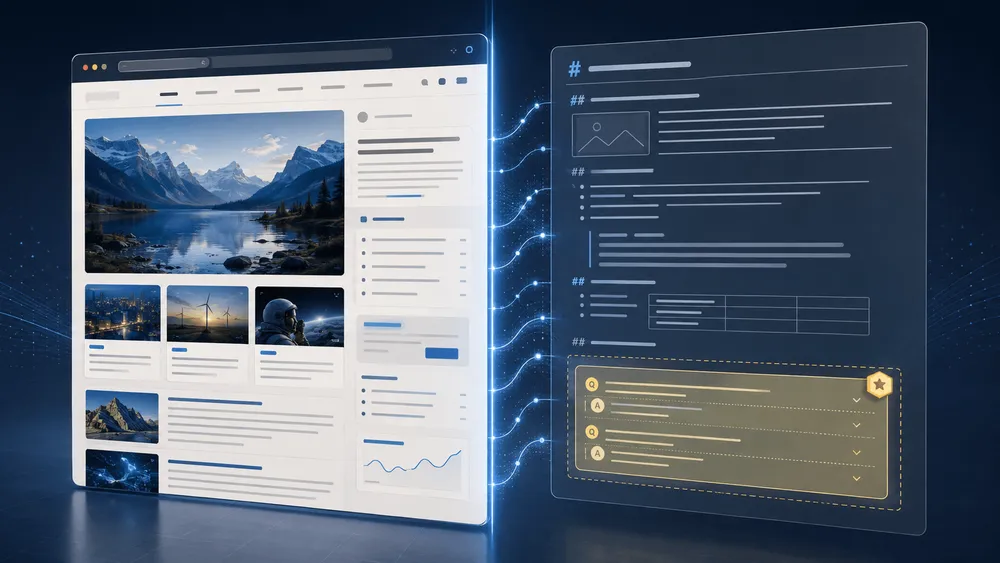
Accessing the same TIME URL yields different pages depending on whether the visitor is a human browser or an AI crawler. Humans receive the conventional HTML page, while approved crawlers receive an easy-to-parse Markdown version. Some of these Markdown pages contain branded FAQs that explicitly name a sponsor. This represents an attempt to take the ad inventory that publishers have traditionally sold based on pageviews and instead sell it, within AI-facing Markdown, as exposure to a context that AI systems might retrieve. Placing an ad is not the same as an AI actually retrieving it and incorporating it into an answer, and there is no evidence yet of the latter.
Two Delivery Layers Emerging from the Same URL
In a test conducted by engineer Vincent Schmalbach on August 5, 2026, the same TIME article URL returned 303,235 bytes of HTML to Chrome, Safari, and Googlebot, while ClaudeBot, PerplexityBot, and OAI-SearchBot received 13,409 bytes of Markdown. GPTBot and ChatGPT-User received HTTP 406. This result reflects a single day's observation and does not prove that this policy applies uniformly across all of TIME's URLs or all crawlers.
On TIME's "Best Inventions 2025" page, checked on August 6, 2026, the response to ClaudeBot was also text/markdown. The headers included x-mobian-format: md, x-mobian-impression, x-mobian-tokens, and cache-control: no-store, and the page also contained a sponsor FAQ from Ally. Since the human-facing page sometimes lacks this same content, this confirms that ad targeting is split between human and AI content delivery. The Markdown version carries sponsor labeling and brand names.
TIME told Digiday that since June 2026 it has been converting web pages from HTML to Markdown and routing approved bots to that version. The conversion uses TollBit. While HTML mixes in screen layout, scripts, and navigation, Markdown can retain primarily headings, links, and body text. TollBit claims an average 90% token reduction for converted content. In this delivery system, returning a lightweight response and inserting sponsor information overlap within the same Markdown layer. However, User-Agent-based routing is not cryptographic identity verification, and it is not a mechanism that reliably identifies every agent.
What the Sponsor FAQ Is Aiming For
The ad unit in the Markdown version consists of brand reference information and an FAQ. The questions are phrased as the kind of queries a user might type into an AI assistant. TIME and Mobian told Digiday that Ally Bank and the Project Management Institute are among the initial advertisers. In Schmalbach's observations too, Ally's material was found on persistent list or section pages, but did not consistently appear on newer article pages.
Mobian CEO Jonah Goodhart told Digiday that the goal is to influence what AI assistants say about a brand. What is being sold here is neither a click from someone who saw the ad, nor a confirmed outcome of the AI adopting it into an answer. It is exposure to a context—a page containing sponsor information within AI-facing Markdown—that might be retrieved by AI search or retrieval systems. This has some resemblance to search engine optimization, but it differs from buying rank in editorial content.
The unit of measurement also differs from traditional display advertising. Schmalbach observed, in Mobian's headers, an impression UUID and token count issued per request. Repeated requests to the same page produced different UUIDs. This suggests measurement based on requests or tokens, but it does not mean human ad exposure, attention, or purchase. Mobian says it builds FAQ ads from brand briefs, issues approval PDFs to clients, and measures visibility, favorability, and accuracy through AI search queries.
Which Pages Get the Ads
TIME told Digiday that it sells one agent ad slot per Markdown page, though it has not disclosed pricing. Ads can be targeted by context, franchise or list, and duration of placement. According to TIME COO Mark Howard, the sales team is already pitching to brands that have Markdown sites prepared. Rather than selling display inventory in bulk, this is a design that sells narrowly around specific pages that return AI-facing Markdown.
Within the observed scope, how ads appear varies by page. Ally's material skewed toward evergreen lists and section pages and did not always appear on more news-driven pages. TIME COO Mark Howard told Digiday that franchise list features such as TIME100 Creators see increased bot traffic. Placement of sponsor FAQs is similarly context-targeted. Delivering a lightweight version to permitted crawlers while keeping the full page for humans fits well with a design that manages ad inventory on a per-page basis.
In July 2026, Cloudflare stated that in the traffic it observed, automated agents and bots account for more than half of web requests. For publishers, this gives reason to think of bot traffic not merely as a delivery cost to be handled, but potentially as a revenue opportunity. At the same time, the proportion of requests is neither a measure of human readership nor of advertising attention. Even as AI-driven traffic grows, the value advertisers receive cannot be compared to human-facing advertising using the same metrics.
In TIME's design, the delivery of structured body content and the placement of sponsor FAQs sit side by side within the same Markdown layer. TollBit makes body content easier for approved AI systems to retrieve, while the same pages carry ads containing sponsor information. The former concerns retrieval efficiency; the latter concerns exposure to a context that might be retrieved. How the two actually connect within real AI-generated answers has not yet been verified. While the ad unit first reaches the crawler, ad measurement does not extend to demonstrate whether a human eventually views the resulting answer.
A Boundary That Disclosure Alone Does Not Fill
The sponsor FAQ explicitly discloses that it is an ad within the machine-facing page. This distinguishes it from methods that slip sponsors into places invisible to readers. Even so, it remains unknown whether AI systems treat the sponsored section as lower priority than editorial information, exclude it when generating answers, or present it as a cited source. There is no confirmation that any particular AI provider has changed its answers, or used the Ally or PMI information for model training, as a result of this content.
To evaluate this design, ad placement and AI adoption into answers must be measured separately. The visibility, favorability, and accuracy that Mobian measures are metrics on AI search queries, distinct from the comprehension or behavior of a person who receives an answer. Connecting this to human-facing advertising effectiveness would require separately verifying crawler identification accuracy, sponsor disclosure, handling during retrieval, citation within answers, and end-user response.
TIME's attempt has built ad inventory into the Markdown layer of AI-facing delivery. The next step in verification will be to separate whether an ad was placed in AI-facing Markdown, whether an AI actually retrieved it and incorporated it into an answer, and further, whether doing so changed that answer.