

In 1906, German chemist Friedrich Raschig discovered and patented a method for synthesizing hydrazine by reacting ammonia with sodium hypochlorite (German Patent DE 198307). Hydrazine () is a high-energy molecule with applications ranging from satellite thruster propellant to pharmaceutical intermediates to next-generation fuel cell vehicles. Ever since Raschig's discovery, industrial production of this molecule has relied on essentially the same brute-force logic: forcibly tearing apart and rejoining nitrogen atoms using powerful oxidizers.
Today, roughly 60% of global hydrazine production relies on the hypochlorite-ketazine process, and about 25% on the hydrogen peroxide-ketazine process (based on 2004 industry statistics). Both consume large quantities of hazardous oxidizers such as sodium hypochlorite or 50-70% concentration hydrogen peroxide. The Olin-Raschig process reacts monochloramine with ammonia at 130°C under pressure, while the Bayer ketazine process hydrolyzes ketazine at temperatures up to 180°C and pressures of 8-12 bar. These processes generate 4-5 tons of waste sodium chloride for every ton of hydrazine produced.
Because the oxidizers themselves are explosive and corrosive, storage and transport add further costs. For more than a century, the chemical industry has been unable to escape a structure in which one poison is used to handle another.
Electrochemical Attempts Hit "The 10 mA cm⁻² Wall"
Electrochemistry—synthesizing chemicals using renewable electricity—was seen as a promising alternative to this situation. Indeed, several research groups have attempted hydrazine synthesis through electrooxidation of ammonia or amines. Jia et al. reported an indirect approach using diphenyl ketone on a catalyst, while Chen et al. reported direct oxidation using a ruthenium complex.
However, these prior studies shared a common, fatal constraint: the reactions only worked in organic solvents. Because organic electrolytes have low conductivity, current densities remained below 10 mA cm⁻². Stability was also poor. This fell orders of magnitude short of the levels required for industrial production (typically above 100 mA cm⁻²), never even reaching the stage of practical discussion.
The problem was twofold. First, oxidation to hydrazine is thermodynamically uphill and requires high potentials. Second, hydrazine itself is a strong reducing agent, so once formed, it tends to be further oxidized at the electrode and decompose into nitrogen gas (). It gets destroyed even as it forms. This dilemma had confined electrochemical hydrazine synthesis to a realm that was "theoretically possible but practically unworkable."
Turning Chlorine From "Enemy" Into "Intermediary"
A research team led by Pengtang Wang and Shi-Zhang Qiao at the University of Adelaide's School of Chemical Engineering brought a reversal of thinking to this dilemma. Rather than avoiding the chlorine-based intermediates that conventional industrial methods depend on for hydrazine synthesis, they deliberately incorporated them into the electrochemical framework in a "controlled" form.
The method, reported in a paper published in Nature Synthesis on August 17, 2026 (DOI: 10.1038/s44160-026-01139-9), proceeds through the following stages.
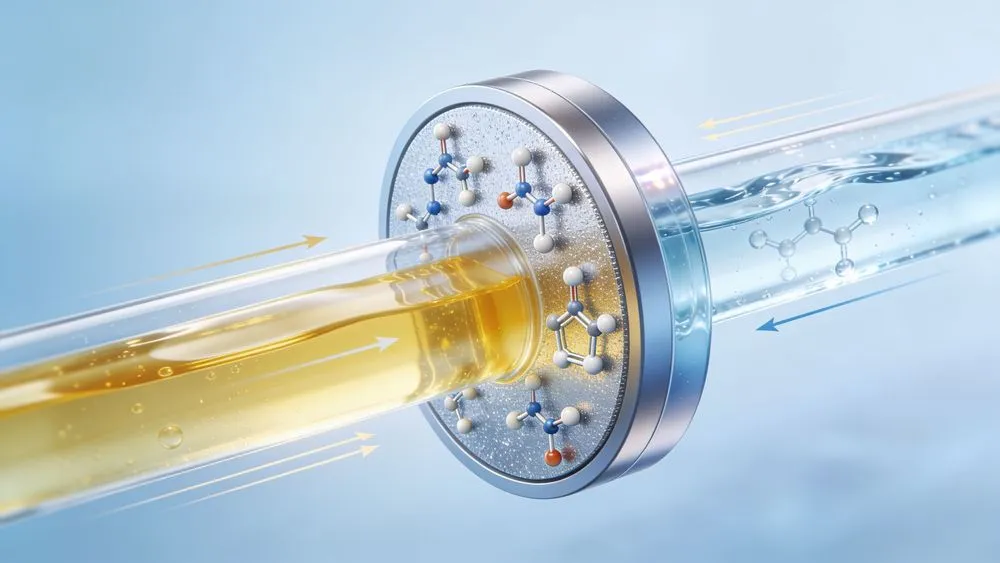
First, a voltage is applied to a platinum (Pt) electrode in an aqueous solution containing table salt (). At the electrode surface, chloride ions are oxidized to form adsorbed chlorine species (*Cl). The key here is that this chlorine remains "adsorbed" on the electrode surface rather than being released into solution. This adsorbed chlorine directly couples with urea molecules also adsorbed on the Pt surface, selectively forming -chlorourea. Side reactions producing free chlorine gas () or nitrogen gas () are suppressed.
Next, the anolyte containing the generated -chlorourea is mixed with an alkaline solution on the cathode side. Here, magnesium hydroxide () acts as a catalyst, promoting deprotonation and rearrangement of -chlorourea to produce hydrazine.
The elegance of this design lies in separating the hydrolysis step that produces hydrazine from the high-potential electrochemical environment. Because the reaction completes away from the electrode, the resulting hydrazine has no opportunity to be re-oxidized. Whereas industrial methods drive the reaction to completion all at once under high temperature and pressure, this study adopted a two-stage division of labor: forming the intermediate at the electrode surface, then completing the reaction in a separate vessel. This spatial separation became the breakthrough that overcame the long-standing barrier to electrochemical hydrazine synthesis.
Numbers That Outpace Prior Work More Than Tenfold
The research team verified this process using a practical flow-type electrolytic cell. The results surpassed, to the authors' knowledge, every prior hydrazine electrosynthesis system.
| Metric | Prior Work (Organic Solvent Systems) | This Study (Aqueous, Cl-Mediated) |
|---|---|---|
| Current density | Below 10 mA cm⁻² | 100 mA cm⁻² |
| Electron-to-hydrazine efficiency (ETH efficiency) | Limited reported cases, low values | 60.1% |
| Hydrazine production rate | Below industrial standard | 1.04 mmol cm⁻² h⁻¹ |
| Continuous stable operation time | Short (a few hours) | Over 240 hours |
| Solvent | Organic solvent (expensive) | Aqueous (saltwater) |
| Feedstock versatility | Pure ammonia/amines | Pure urea, urea-enriched wastewater, human urine |
The current density of 100 mA cm⁻² represents at least a tenfold improvement over the upper limit of prior studies (below 10 mA cm⁻²). Stable continuous operation for over 240 hours stands in stark contrast to previous work, which showed performance degradation within a few hours.
Feedstock versatility is also a notable indicator for practical application. The research team demonstrated hydrazine production using pure urea, urea-rich industrial wastewater, and actual human urine. Urea concentration in urine typically ranges from 10-25 g/L, representing an untapped nitrogen resource present in sewage treatment plants worldwide. A single person excretes approximately 11 grams of nitrogen in urine per day, which, if fully converted to hydrazine, would theoretically correspond to about 12-13 grams of .
Hydrazine Fuel Cells Await a "Cheap, Safe Supply Source"
Behind the expected growth in hydrazine demand lies progress in fuel cell technology. In 2007, Daihatsu unveiled a platinum-group-metal-free (PGM-free) fuel cell technology fueled by hydrazine hydrate. This alkaline ion-exchange membrane approach allows the use of inexpensive metals such as nickel and cobalt for electrode catalysts. The theoretical electromotive force is 1.56 V. The fuel cell reaction produces only nitrogen and water, with zero emissions.
As a liquid fuel, hydrazine hydrate also offers the advantage of being compatible with existing gasoline supply infrastructure using polyethylene tanks. Unlike hydrogen, it requires no high-pressure tanks or cryogenic liquefaction. However, because hydrazine itself is toxic and flammable, Daihatsu has also developed technology to gel it with polymers to fix it within tanks.
If supply costs and environmental impact decrease, the economics of this fuel cell pathway could shift dramatically. If the University of Adelaide's method can be driven by renewable electricity, the carbon footprint of hydrazine production could be substantially reduced compared to existing industrial processes that rely on fossil-fuel-derived power.
Remaining Engineering Challenges
In both the paper and the press release, Wang candidly acknowledges that the path to practical application remains long. "While this electrochemical strategy enables highly efficient conversion of urea to hydrazine, practical engineering challenges and cost bottlenecks remain, including salt accumulation and the energy consumption required for product separation," he states.
Specifically, unresolved issues include the continuous accumulation of within the electrolytic cell, the energy cost of concentrating and separating the product from dilute hydrazine solutions, and reactor design suited for long-term continuous operation. As future research directions, the team cites four points: cost reduction, simplification of product separation, improved continuous operation, and practical reactor design.
The ETH efficiency of 60.1% is a measure of electron utilization, leaving room for optimization regarding where the remaining roughly 40% of electrons go (chlorine gas formation, oxygen evolution, etc.). The effects of impurities derived from urine (such as uric acid and creatinine) on catalyst performance during long-term operation have also not been fully verified within the scope of the 240-hour test conducted here. The cost and durability of platinum electrodes, along with mass transport limitations at scale-up, also remain challenges not visible at laboratory scale.
Urine, one of the most familiar waste liquids, may be on a path toward becoming propellant for satellites flying through space, or fuel for cars that emit no . The first step on that path began with a surprisingly simple combination: table salt, a platinum electrode, and electricity.