

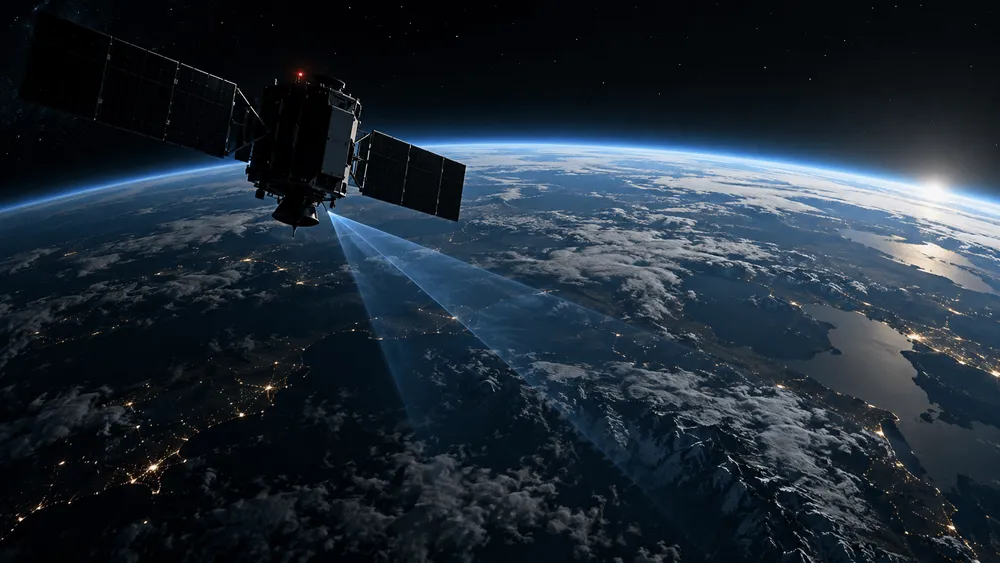
The United States has officially acknowledged for the first time that it has weapons in orbit. On September 14, 2026, Air Force Secretary Troy Meink stated clearly that the US possesses "space control weapons in orbit" capable of defending the joint force from adversary actions. The following day, a US Space Force announcement characterized this statement as the first public confirmation that weapons have already been deployed in space. However, what has been revealed so far is limited to the existence of these weapons and the name of their mission—not a definitive description of their physical form, such as whether they are missiles or lasers.
What the "First Confirmation" Actually Tells Us
The announcement released by the US Space Force on September 15 contains three elements that serve as the starting point for interpretation: the weapons are in orbit, they carry out a space control mission, and they can defend the joint force from adversary actions. This was not an announcement of a new weapon's name or specifications, but rather a deliberate acknowledgment by a senior government official of a capability that had previously been kept secret.
According to Air & Space Forces Magazine, which covered the press conference following the remarks, Secretary Meink explained that he chose his words carefully. At the same time, he did not answer whether the weapon is kinetic—using physical collision or projectiles—or non-kinetic, using electromagnetic waves or similar means. He also did not disclose whether testing had been conducted, suggesting that withholding detailed capability information from adversaries serves deterrence.
Many details remain undisclosed: the weapon's name, the number deployed, its orbit, the timing of deployment, and its manufacturer, as well as whether it has ever been used in actual combat. Even the phrase "can defend" does not necessarily mean this is purely defensive equipment. Under the Space Force's official mission taxonomy, space control encompasses both offensive actions that disrupt an adversary's capabilities and defensive actions that protect friendly satellites.
"Space Weapons" Are Not a Single Category
The US Space Force's "Space Warfighting: A Framework for Planners," published in April 2025, defines space control as a core function for achieving a state in which friendly forces can operate when and where necessary without significant interference, while denying that same freedom to adversaries. The counterspace operations that serve as the means to this end can target different components: on-orbit assets, the links connecting them to the ground, and ground-based facilities. It would be premature to imagine, based solely on the mission name, a weapon that drops objects from space onto the ground.
| Category of Public Information | Scope Indicated by Official Documents | Confirmed This Time? |
|---|---|---|
| Deployment status | At least some portion of the capability exists in orbit | Confirmed |
| Mission | Space control—protecting friendly operations and denying adversary space use | Confirmed |
| Means of effect | Kinetic or non-kinetic | Undisclosed |
| Duration of effect | Temporary/reversible, or permanent/irreversible | Undisclosed |
| Target | Orbital segment, communication links, or ground segment | Undisclosed |
| Separately announced programs | Space-based interceptors, aerial target-tracking sensors | Identity unconfirmed |
What can be identified from the publicly available information is limited to the status of "existing in orbit" and the mission of "space control"—the means, targets, and reversibility cannot be narrowed down to a single answer. This is the result of organizing official announcements, official doctrine, and press conference coverage through September 16, 2026, into confirmed status, permissible mission scope, undisclosed items, and separate programs. This is not a table comparing secret equipment by performance, but rather an illustration of how far publicly available information can narrow down the weapon's true identity.
The official framework divides offensive counterspace operations into orbital attack, disruption of space links, and ground attack. Orbital attack includes not only methods that inflict physical damage on an adversary's spacecraft, but also non-kinetic effects, with results that can be either reversible or irreversible. Disruption of space links involves electromagnetic or cyber attacks that interfere with the connection between satellites and their users.
The defensive side also spans a range of activities. Active space defense includes escorting critical spacecraft, counterattacking against attacks, and suppressing an adversary's ability to identify targets for attack. A single weapon may not accomplish all of this on its own; it may be combined with sensors and command-and-control systems. For this reason, current explanations cannot determine whether the on-orbit vehicle directly generates all effects by itself, or whether it operates as part of an integrated system with ground-based or communication-link equipment.
Deployed Weapons and Interceptors Heading Toward 2028
The same speech also touched on another space weapons program. The Space-Based Interceptor (SBI) reportedly progressed from initial contract to flight-capable hardware in under a year. However, the existence of a flight-capable prototype does not mean it has been operationally deployed in orbit or has succeeded in an interception. No evidence has been made public linking this interceptor to the space control weapon whose existence Secretary Meink acknowledged.
Policy deadlines also differ from operational start dates. Executive Order 14369, issued by the White House in December 2025, calls for advancing prototyping and demonstration of next-generation missile defense technology by 2028. This covers the capability to detect, characterize, and counter threats ranging from very low orbit to near-lunar space, including countering nuclear weapons placed in space. This is a development and demonstration goal—not a specification sheet for the weapon confirmed as already deployed this time.
Furthermore, the Space-Based Airborne Moving Target Indicator constellation mentioned in the speech is a sensor network for tracking aerial targets. While the ability to find and continuously track targets is essential to weapons operations, launching sensors cannot be reinterpreted as deployment of the weapon itself. The currently confirmed weapon, the interceptor under development, and the intelligence-gathering satellite constellation must each be treated separately in terms of their public status and role.
What the Outer Space Treaty Actually Prohibits
The 1967 Outer Space Treaty does not uniformly ban all space weapons. Article IV explicitly prohibits placing in Earth orbit only objects carrying nuclear weapons or other weapons of mass destruction. Restrictions regarding the Moon and other celestial bodies are broader, prohibiting not only the establishment of military bases and fortifications but also the testing of any type of weapon and the conduct of military maneuvers.
From this distinction, we can only conclude that Article IV does not, in its wording, collectively prohibit the placement of conventional weapons in Earth orbit. What this weapon carries and how it is operated remains unknown, and there is not yet sufficient information to judge the legality of this specific piece of equipment. The fact that the treaty does not impose a blanket ban is not the same as saying that any specific use of force is permitted.
The fact that the executive order addresses countering nuclear weapons placed in space is also not an admission that the United States itself has deployed nuclear weapons in orbit. What the document indicates is the scope of threats the United States anticipates. Conflating the treaty's prohibited targets with the adversary threats enumerated in the country's own defense policy risks constructing conclusions stronger than what this announcement actually supports.
Watch for Operational Traces, Not Performance Specifications
By acknowledging its existence, the US government has at least reduced the ambiguity of whether "weapons exist in orbit" by one degree. Even so, the aim of the announcement is not full transparency but deterrence through making an adversary's calculations more difficult while keeping capabilities concealed. Clues to the weapon's true nature are more likely to emerge in future budget documents, contracts, and launch records than in flashy performance figures.
Which units are responsible for proximity operations or escort duties in orbit, and which tests come to be called successful, will also serve as indicators. It's also worth watching whether the explanation of space control becomes more concrete through public doctrine and training exercises. However, observing close approaches by satellites or electromagnetic anomalies alone cannot be conclusively attributed to this particular secret system—official attribution and mission explanation would be required.
If the United States next discloses any of the following—a name, a unit, or test results—it would move one step closer from an overly broad mission category toward a concrete capability. Until then, the conditions for correctly reading the deterrence message are twofold: not underestimating the fact that deployment has already occurred, and at the same time not substituting candidates from public doctrine for the true nature of the secret weapon.