


On June 30, 2026, ocean engineering company DEEP installed its crewed undersea habitat "Vanguard" at Tennessee Reef off the coast of Florida, USA. The facility is designed for up to four people to live underwater for five or more days while conducting coral reef research and equipment testing. With the actual unit now moved to the seafloor, the project has advanced from onshore manufacturing and testing to a stage of verifying the entire system underwater.
However, completing installation is not the same as beginning crewed operations. According to DEEP's published timeline, site acceptance testing is underway, and operational training has yet to occur. No initial mission has been announced either. What Vanguard's arrival has opened is not undersea living itself, but the final phase of proving the operational system—including the surface and shore components—in the field.
Vanguard Placed on the Seafloor, But Habitation Has Not Yet Begun
Vanguard's foundation was set at a depth of 17 meters at Tennessee Reef, with the living quarters operating at a depth of 13 meters. According to DEEP, the living quarters measure 10.7 meters long and 2.5 meters wide. They include space for eating, sleeping, and working, as well as cooking facilities and a toilet, accommodating up to four people.
During seafloor installation, the foundation was submerged first, and the living quarters were then secured on top of it. Nearby, a surface support buoy is moored and connected to the seafloor facility by cable. Factory acceptance testing, transport to the site, and installation have all been completed. What is currently underway is site acceptance testing and commissioning to verify the combined performance of all equipment underwater.
This sequence accurately describes Vanguard's current status. DEEP describes the sea trials and commissioning as the final steps toward obtaining DNV classification, not as classification already achieved. Before crew members can be sent in, training for support personnel must also be completed. "Placed on the seafloor" is confirmed; "people have begun living there" cannot yet be confirmed.
Saturation Diving Transforms Working Time Underwater
Unlike a submersible, Vanguard does not shuttle back and forth between the surface and the seafloor. It employs an ambient pressure system in which the internal pressure of the living quarters matches the surrounding water pressure, allowing crew members to enter and exit the sea directly through a moon pool in the floor. Because the internal air pressure balances the water pressure, water does not flow in through the opening to the sea.
Saturation diving is what supports this approach. According to NASA, after spending about 24 hours underwater, the human body becomes saturated with dissolved gases corresponding to that depth. Beyond this point, extending the stay does not indefinitely increase decompression time, allowing crew members to use the seafloor as a work base without repeatedly surfacing during a mission. In exchange, they must undergo a lengthy decompression at the end of the mission.
The precedent set by Aquarius Reef Base illustrates this trade-off numerically. According to NOAA, non-saturated divers visiting the facility must limit their stay to under about 80 minutes to avoid decompression sickness. Saturated crew members, by contrast, can work without time limits at the base depth, and even dove 6 to 9 hours per day at greater depths. Decompression at the end of the mission took 17 hours. Vanguard's value lies not simply in having sleeping quarters on the seafloor, but in transforming what would otherwise be repeated short dives into continuous research time.
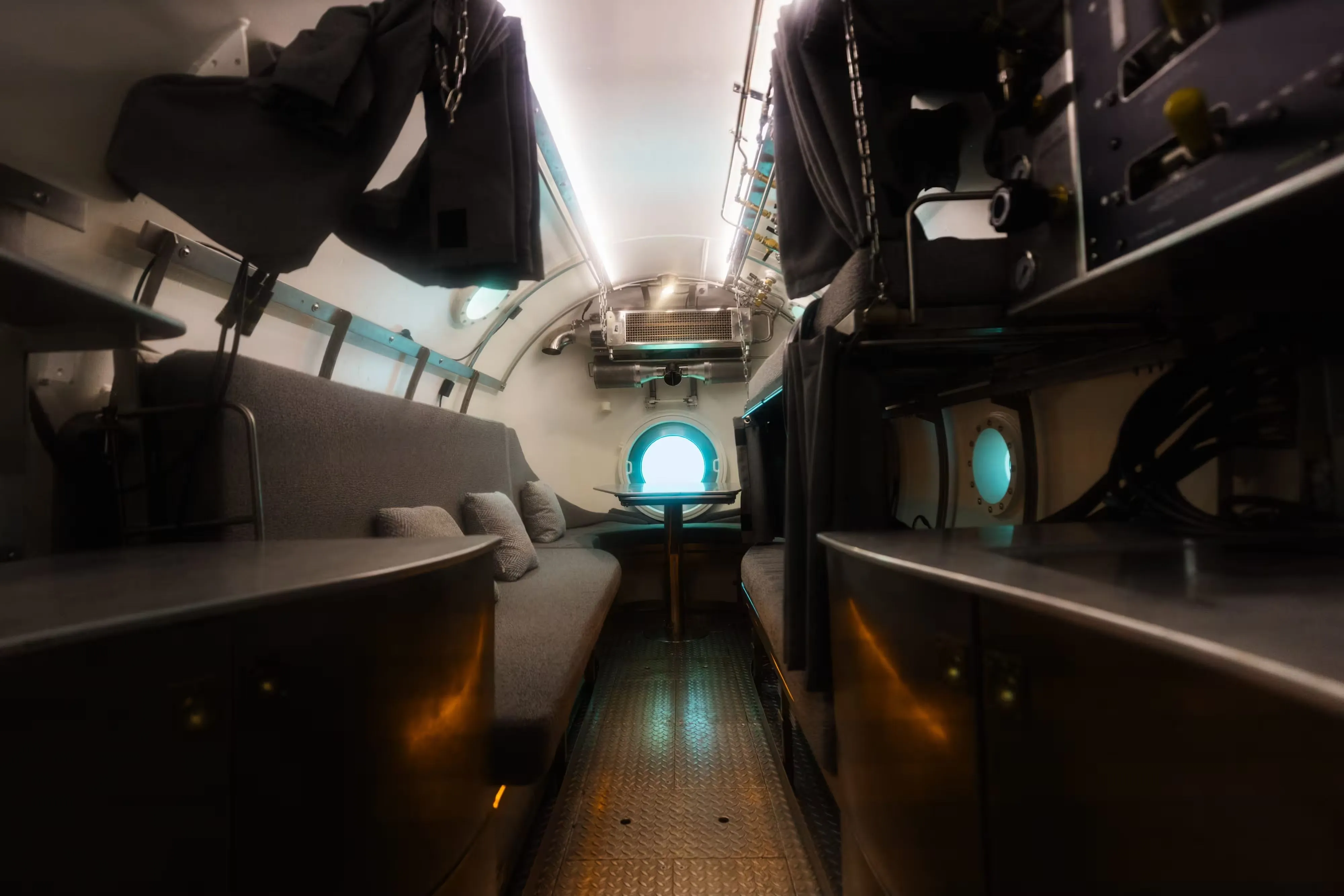
Measuring Samples On-Site in an Undersea Laboratory
Being able to dive for extended periods means more than just increased observation time. Dawn Kernagis, DEEP's Director of Science Research, explained to ScienceAlert that when samples are brought up from underwater, changes associated with decompression get mixed into molecular and cellular signals, making it impossible to observe the state as it truly exists at depth. If samples are collected and processed promptly on the seafloor itself, the impact of the act of surfacing on the measurement targets can be minimized.
Vanguard is equipped with sensors that continuously measure the underwater environment even when no one is present. During crewed missions, the same location can be observed repeatedly, linking continuous sensor records with samples collected by divers. At Tennessee Reef, the plan is to track coral health and water quality, examining bleaching, disease, and changes in sediment. Being able to overlay data from different time periods from the same observation site is what transforms the facility from a place to sleep into a laboratory.
The installation site was also chosen with this purpose in mind. The Tennessee Reef Conservation Area has restricted access, and near Vanguard there are shallow coral reefs as well as deeper ridge-and-groove terrain known as spur-and-groove formations. This allows multiple depths to be studied while minimizing interference with research equipment. However, results for coral reef restoration and climate impact research are still forthcoming, and the fact of the facility's placement cannot be taken as a preemptive indicator of its effectiveness.
Not a Self-Sufficient Facility—The Surface and Shore Are Its Lifeline
Looking only at Vanguard's living quarters does not reveal the full picture of its operations. The surface support buoy supplies breathing gas, power, and communications, connecting crew members to the shore base. According to ScienceAlert's reporting, fresh water is delivered by tank, while wastewater and waste are collected. The design does not close life support entirely within the seafloor facility, but instead operates the surface buoy and the shore base in Marathon as a single integrated system.
This dependency requires preparation for equipment failure. DEEP explains that, in addition to portable breathing bottles crew members can use for emergency ascent, two pressurized refuge chambers have been installed on the foundation. Medical facilities equipped to handle high-pressure environments are located onshore, and a decompression chamber is also available aboard ship. These are design descriptions provided by the operator, and site acceptance testing and training will be used to verify whether the equipment functions together as intended.
Installation on the seafloor also comes with environmental conditions. Application documents released by the U.S. Army Corps of Engineers in August 2025 outlined plans to place the facility on sandy substrate, at least 3 meters away from sensitive benthic habitats. Waste is to be stored in external tanks and collected at the surface. During long-term operation, the impact of the seafloor structure and mooring equipment on the surrounding environment must be continuously measured and compared against the assumptions made in the application.
What the First Mission Must Prove
Vanguard is not the final form, but a pilot for DEEP's progression toward a larger modular facility called "Sentinel." Accordingly, the first crewed mission must serve not only to gather coral reef data, but also to verify life support from the support buoy to the living quarters and extended periods of extravehicular activity. It will also be an opportunity to run the entire operational flow from start to finish—from onboard sample processing to end-of-mission decompression. What can be passed on to future facilities is not a concept, but operational records obtained underwater.
As of July 10, 2026, DEEP has not announced a date for its first mission. The published timeline lists completion of site acceptance testing, DNV classification, and completion of operational training in sequence. Once crew members have completed a mission of five or more days on the seafloor after these steps, Vanguard will transform from "an installed facility" into "a usable research platform."