

On September 14, 2026 (US time), Apple began the general availability (GA) rollout of watchOS 27, the latest core software for Apple Watch. The update requires pairing with an iPhone 11 or later—or an iPhone SE (3rd generation)—running iOS 27, and it fundamentally redefines the on-wrist wearable experience.
For years, Apple Watch has evolved primarily as a relay point for smartphone notifications and quick actions. With watchOS 27, however, Apple has pushed forward the full-scale rollout of Apple Intelligence—spanning both on-device and cloud-hybrid processing—and tightly coupled it with a redesigned suite of optical biosensors. The direct integration of an AI agent across the entire system, workout features that operate autonomously without an iPhone, and high-frequency biometric monitoring aligned with a new generation of millimeter-wave and optical sensors all signal a major shift in the platform's center of gravity.
The Big Picture for watchOS 27: A Major Generational Cutback in Supported Models
Alongside its new features, one of the biggest turning points in the watchOS 27 release is a significant narrowing of supported devices. This version supports only Apple Watch Series 9 and later (Series 9 through 12), Apple Watch Ultra 2 and later (Ultra 2 through 4), and Apple Watch SE (3rd generation).
Models that had long remained supported—including Apple Watch Series 8 and earlier, the original Apple Watch Ultra, and Apple Watch SE (2nd generation)—have been dropped from this update. Behind this narrowing lies both the generational requirements of the Neural Engine needed for advanced machine learning processing, and the increased demands on memory bandwidth and power efficiency driven by the high-frequency sensing and constant background processing discussed below.
In terms of ecosystem-wide coherence, watchOS 27 is aligned with iOS 27, iPadOS 27, and macOS 27, all released the same day. In particular, features like synchronized Siri AI conversations and information-presentation algorithms tied to Focus modes now share processing context transparently across devices linked to the same Apple Account.
An On-Wrist Conversational "Siri AI" and a Dedicated App
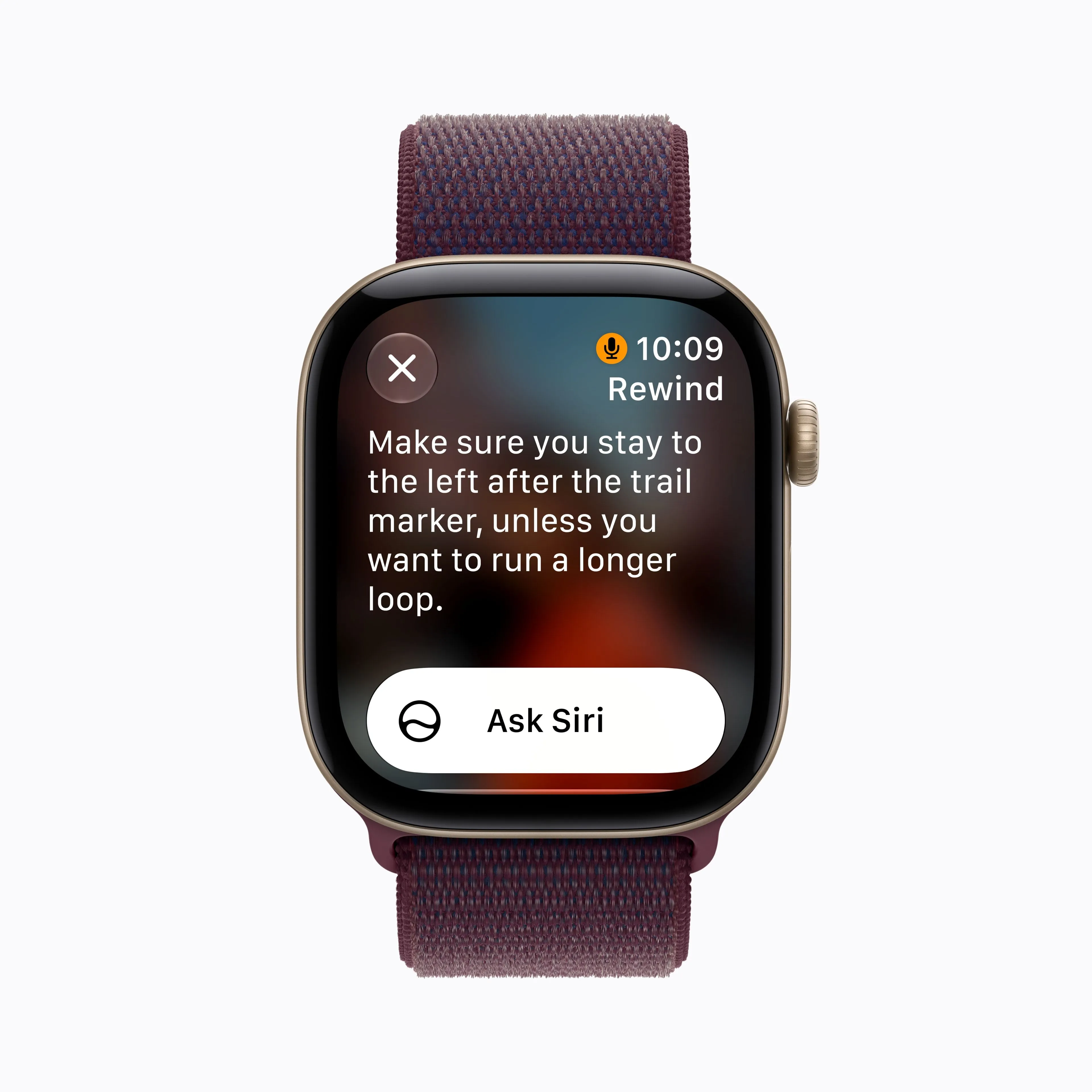
The single biggest functional leap in watchOS 27 is the integration of "Siri AI"—powered by Apple Intelligence as its core engine—directly into Apple Watch. Moving beyond the traditional fixed-command-response assistant model, Siri has been reworked into a conversational agent that understands personal context while drawing on broad general knowledge.
Siri AI can search across information from key on-device applications such as Calendar, Messages, and Reminders. For example, asking the watch to share flight details with family, play a song sent via Messages, or reset an Activity ring goal will prompt Siri to interpret the context and carry out the appropriate system-wide action. It supports continuous conversation that retains the intent of prior exchanges, allowing users to refine complex queries through follow-up questions rather than requiring everything to be specified in a single command.
In addition, watchOS 27 introduces a dedicated "Siri" app for the watch. This app syncs conversation history in encrypted form across all devices—iPhone, iPad, Mac, and Apple Vision Pro—via iCloud. Users can seamlessly pick up a search or question started on iPhone and continue it on Apple Watch by voice, moving fluidly between devices as needed.
Alongside the introduction of Siri AI, a new watch face called "Siri Modular" is also being released. This face features a large rectangular complication at the top that dynamically links to the top widget in the Smart Stack, automatically surfacing upcoming events, travel information, or reminders depending on context.
As for language rollout, the feature will first launch as a beta in English, with support for Japanese, French, Korean, Portuguese, and Spanish planned to follow in October 2026. Meanwhile, regional regulatory environments are creating fragmentation in feature availability. In the European Union, as with iOS and iPadOS, the initial rollout of Siri AI on watchOS 27 has been postponed pending negotiations over compliance with the Digital Markets Act (DMA) and scrutiny of privacy protection requirements. In China, the regulatory approval process is also still ongoing, and a launch timeline remains undetermined. In addition, processing that relies on advanced server-side foundation models is subject to a daily usage cap, which will be adjusted according to network load and system demand.
Advances in Health and Fitness: Standalone Operation and a More Clinical Approach
Health management and activity tracking have also seen wide-ranging updates, spanning everything from everyday training to clinical early-warning detection.
The centerpiece of the training updates is a fully redesigned "Workout Buddy." It analyzes a user's fitness history, distance, workout duration, and achievement trends from multiple angles to provide personalized insights and motivation tailored to current training progress. The most significant practical change is that Workout Buddy now supports full standalone operation on Apple Watch alone. Even when running or walking without an iPhone—connected via cellular or Wi-Fi—the algorithm runs entirely on the watch itself. This feature will roll out first in English and Spanish.
Basic measurement accuracy for running and walking has also improved. Thanks to a newly introduced machine learning algorithm, distance and pace calculations for indoor running—including treadmill workouts—and indoor walking are now more accurate from the very first step. Even in environments without outdoor GPS signal, the system continues to precisely capture subtle changes in arm swing and stride length.
Expanded "GymKit" functionality now also allows users wearing AirPods Pro (3rd generation) to sync heart rate data directly—via iPhone—to compatible gym equipment such as treadmills and indoor bikes.
In women's health, the Cycle Tracking app has gained support for perimenopause and menopause. In the years leading up to menopause, menstrual cycles can become irregular and hormone levels can fluctuate, yet these changes are often difficult for individuals to notice on their own. For users aged 40 and older, watchOS 27 will issue a notification recommending consultation with a physician when recorded cycle patterns show deviations indicative of perimenopause. It will also alert users to seek medical attention if postmenopausal bleeding is recorded—reflecting a clinically oriented feature design built to support long-term life-stage transitions.
Hardware-Linked Biometric Sensing: Readiness Scores and High-Frequency Measurement
Alongside the software-level feature expansions, integration with the new "Health Sensing System" found in the latest Apple Watch Series 12 and Apple Watch Ultra 4 has dramatically increased both the frequency and analytical depth of biometric data collection.
The new sensor system uses a fourth-generation optical sensor featuring a larger, more power-efficient, high-brightness green LED. This has shortened the sampling interval for continuous passive heart rate monitoring from the previous on-demand measurement to every 5 seconds. By capturing heart rate variation in near real time throughout the day, the accuracy of energy expenditure and exercise load calculations has improved substantially.
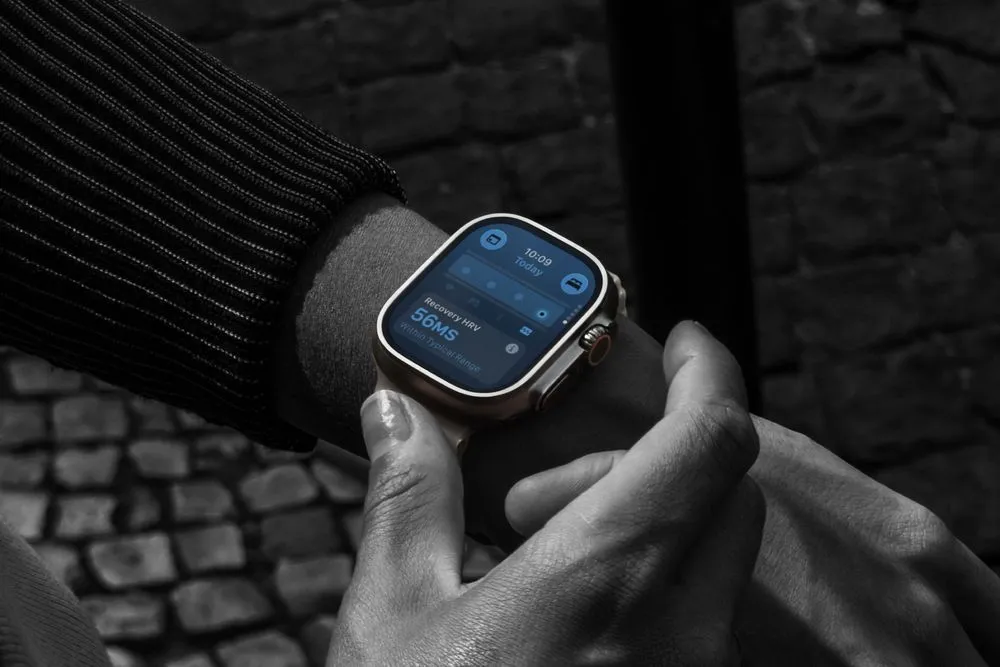
Measurement of heart rate variability (HRV)—an indicator of autonomic nervous system tension and physical recovery—has also been significantly enhanced. Instead of the previous sporadic measurements, the system now supports automatic sampling as frequently as every 5 minutes (24 times more often than before). In addition, a new "Recovery HRV" feature calculated during nighttime sleep is now compared against an individual's personal baseline, and the Vitals app has gained a new "Daytime Vitals" toggle. This allows early detection not only of nighttime physiological changes but also of daytime stress and fluctuations in condition.
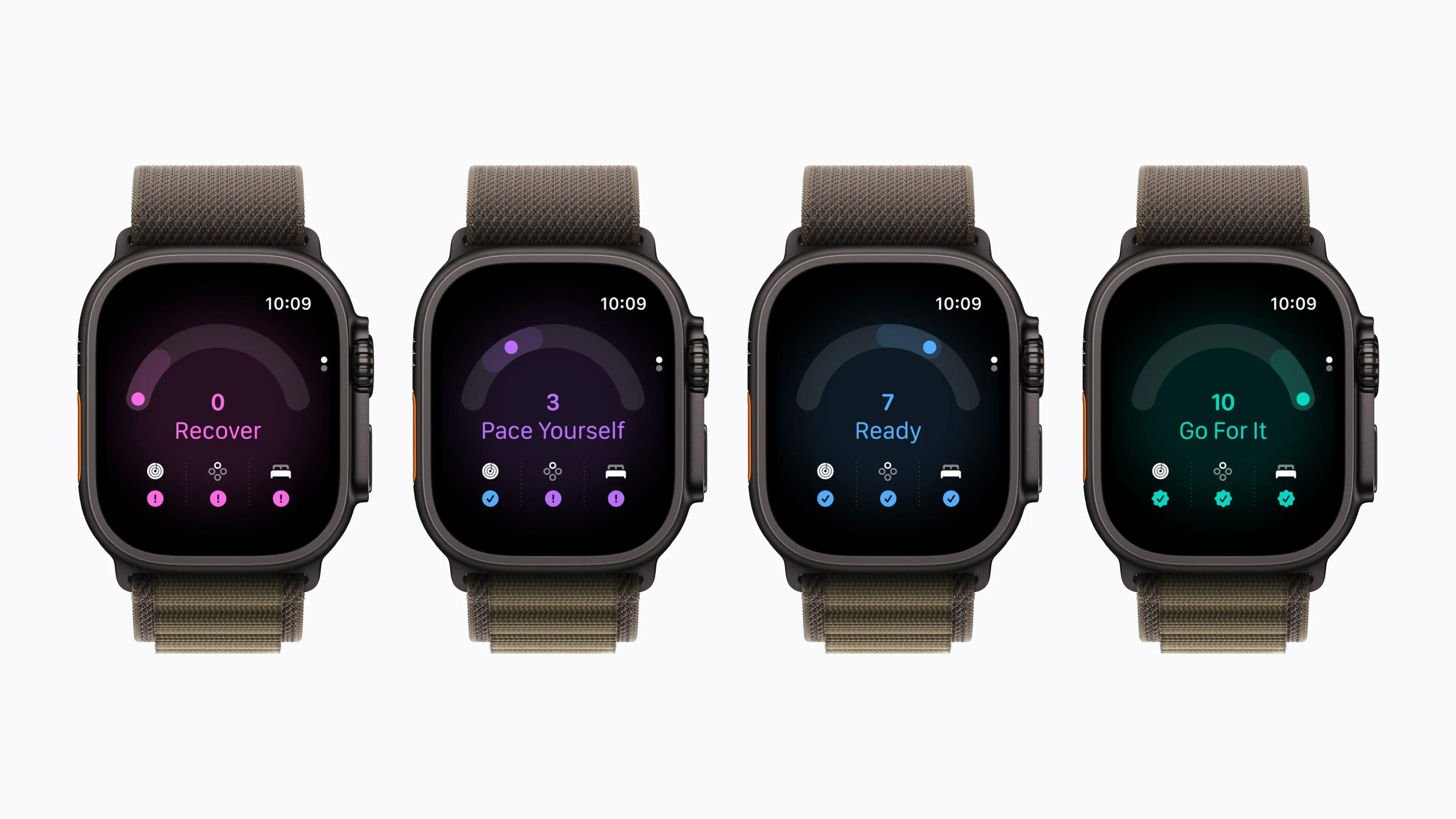
All of this high-frequency biometric data feeds into a new composite metric called "Readiness." It combines recent activity load, fluctuations in vitals data, and sleep score into a single number from 0 to 10 representing the body's remaining capacity for the day. Based on the score, the system provides one of four concrete, actionable pieces of guidance: "Recover," "Pace Yourself," "Ready," or "Go For It." The score recalculates in real time in response to intense daytime training or changes in condition, and users can view a breakdown of the factors behind the number.
Refreshed UI and Everyday Usability: Dynamic App Grid, One-Handed Tap, and Liquid Glass
Numerous refinements aimed at improving day-to-day usability have also been made to the operating system and interface design.
The Home Screen now features a new default layout called "Dynamic App Grid," replacing the traditional honeycomb grid arrangement. Five apps, intelligently selected based on usage frequency, time of day, and location, are arranged dynamically around the dedicated Siri app at the center. This reduces the effort of hunting for the right app on the watch's small screen, while the full app list remains instantly accessible by tapping the grid icon at the edge of the screen or rotating the Digital Crown.
On the gesture front, a new "Single-handed Tap" gesture has been added for quickly interacting with the Smart Stack. By touching the index finger and thumb together once on the wrist wearing the watch, users can select widgets in the Smart Stack and confirm actions using only one hand. This makes it possible to check and act on information without touching the screen—useful when carrying bags or holding onto a subway strap.
Visually, the optical presentation of "Liquid Glass," the design language characterized by translucent glass-like textures, has been refined. Light refraction and text contrast have been reworked to improve readability in direct sunlight and in dark environments. To accommodate individual differences in visual perception, a new appearance adjustment slider for Liquid Glass has also been added to System Settings, letting users flexibly choose anywhere from a fully transparent glass effect to a more opaque, high-contrast display.
Everyday tools have also been consolidated. The Find My app now merges what were previously three separate functions—Find Devices, Find Items, and Find People—into a single application. With an intuitive, map-centered interface, users can seamlessly track family members, AirTag-attached belongings, and their own Apple devices all from one screen.
A new "Call Context" feature also assists during phone calls. While a user is on a call using Apple Watch, contextually relevant information related to the other party is automatically surfaced on the wrist. For example, when calling an airline's support desk, a booking confirmation code or flight time from an email in the Mail app can automatically pop up, letting the user quickly reference the code while continuing the conversation.
Beyond these headline features, a range of finer performance tuning has been applied throughout the system—including faster response times when starting music playback, elimination of sync lag for step-count data between the Fitness and Health apps, and more efficient background processing to optimize battery consumption.
New Features and Hardware Compatibility Matrix
The major new features in watchOS 27 are divided across three tiers: UI and workout improvements common to the OS as a whole; high-frequency measurement features (5-second heart rate sampling, 5-minute HRV sampling) that require the fourth-generation sensors exclusive to Series 12 and Ultra 4; and Siri AI, which depends on iPhone pairing.
The range of features available to a given user is strictly determined by the model generation of their Apple Watch and the environment of their paired device. The comparison table below organizes the operating requirements and compatibility scope of the major features based on Apple's official announcement.
| Feature | Series 12 / Ultra 4 | Series 9–11 / Ultra 2–3 | Apple Watch SE (3rd gen) | Operating Requirements and Key Constraints |
|---|---|---|---|---|
| Siri AI integration | Supported | Supported | Supported | Requires an Apple Intelligence–compatible iPhone. English first; Japanese planned for October. Excluded in EU and China |
| Dedicated Siri app / iCloud sync | Supported | Supported | Supported | Available on all supported models. Encrypted conversation sync across devices |
| Siri Modular watch face | Supported | Supported | Not supported | Available on larger-display models, excluding SE 3 |
| Standalone Workout Buddy operation | Supported | Supported | Supported | Works without iPhone (Wi-Fi/Cellular). English and Spanish supported |
| ML-based indoor running/walking distance improvement | Supported | Supported | Supported | Machine learning algorithm improvement common to all supported models |
| Perimenopause notifications | Supported | Supported | Supported | For users aged 40 and older. Triggered by detected cycle deviations |
| 5-second continuous heart rate sampling | Supported | Not supported | Not supported | Requires 4th-generation optical sensor (Health Sensing System) |
| 5-minute high-frequency HRV sampling | Supported | Not supported | Not supported | Requires 4th-generation optical sensor. Linked to Daytime Vitals display |
| Readiness score | Supported | Not supported | Not supported | Integrates high-frequency sensor data and sleep analysis from new sensors |
| Dynamic App Grid | Supported | Supported | Supported | New standard Home Screen layout in watchOS 27 |
| One-handed tap gesture | Supported | Supported | Supported | Single tap of index finger and thumb controls the Smart Stack |
| Liquid Glass appearance adjustment | Supported | Supported | Supported | Transparency and contrast adjustable via System Settings |
| Unified Find My app / Call Context | Supported | Supported | Supported | System utility refresh common to all supported models |
In this way, watchOS 27 discontinues support for older-generation devices while still delivering core experiences—including a refreshed UI, autonomous workouts, and Siri AI—broadly to existing users on Series 9 and later. At the same time, the latest Series 12 and Ultra 4 models combine highly accurate continuous sensing with the Readiness score, representing a decisive differentiator in the realm of preventive health and physical conditioning. Together, these changes reflect an update that pushes the role of the on-wrist device beyond a passive receiver of notifications, toward becoming an autonomous partner that actively supports the wearer's physical condition and daily context.