

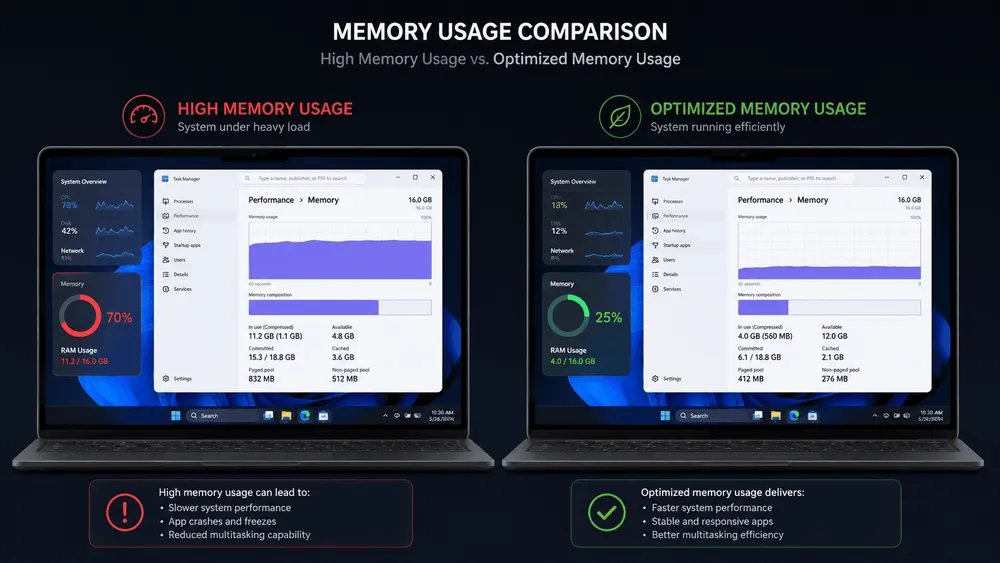
In 2026, RAM began wearing an entirely different face in the consumer market. Memory giants such as Samsung, SK Hynix, and Micron have been successively reorganizing their fab lines to prioritize the production of **High-Bandwidth Memory (HBM)**, which is essential for AI GPUs. Because HBM manufacturing consumes roughly three times the production capacity per wafer compared to ordinary DRAM, the supply of consumer-grade DRAM remains structurally constrained. Multiple research firms, including Deloitte, forecast that this supply crunch is not temporary and will not ease until 2028. Due to this special demand known as the AI supercycle, PC makers can no longer resort to the old brute-force approach of "cheaply doubling the memory."
The deterioration in memory prices shows up clearly in the numbers. DRAM contract prices have more than doubled year-over-year in some segments, and because major AI customers have signed multi-year long-term supply agreements (LTAs) with the three leading manufacturers, the allocation available on the open market is even scarcer. According to reports from the supply chain, lead times for general manufacturers such as PC makers have effectively stretched to over 40 weeks. As a result, the trend of the past several years toward raising base-model PC RAM to 16GB has completely stalled, and 8GB has once again become fixed in the market as the "standard."
This wave of supply constraints and soaring prices is directly translating into product pricing and reshaping the balance of power in the market. The symbol of this shift is Apple's MacBook Neo. The 8GB model equipped with the A18 Pro, which Apple launched in March 2026 at $599, once epitomized the entry-level price tier—but in June 2026, following the memory market surge, its price was raised to $699. The student/education pricing remains at $599, but the price hike in the general market hints at a ripple effect across the entire industry. As Windows laptops across the board return to 8GB configurations in the same price tier, the MacBook Neo has carved out a unique position as "the only model that remains comfortably usable even with 8GB."
By contrast, the 8GB experience on the Windows side has been at the complete opposite end of the spectrum. According to a WccfTech report, an 8GB Dell XPS 13 model reached 70% memory usage even while idle, with no apps launched at all. In other words, merely having Windows run background processes consumed nearly as much memory as a Mac does while actively running a browser or office software comfortably. This stark "gap in the 8GB experience" lies at the root of Microsoft's current sense of urgency.
Why Microsoft Acted Now—and the Groundwork Since March
Against the backdrop of this hardware-side impasse and the rise of competitors, Microsoft's Pavan Davuluri laid out four priorities in a Windows blog post on July 31. At the very top of that list was "memory optimization for PCs with 8GB or more (Priority 1)."
To understand this unusual policy shift, it helps to trace it back to March 2026. At that time, Davuluri announced a broad commitment to improving Windows quality, centered on three pillars: performance, reliability, and experience. In the four months since, a considerable amount has actually happened. Specifically, interface-level improvements were made, including enhancements to Windows Search—removing promotional content and revamping the UI—as well as repositioning the Taskbar and Start menu and expanding personalization options. In addition, work was done on the system's background behavior: bridging architectural improvements boosted File Explorer's responsiveness, widgets were made hidden and quieter by default, and the frequency of Windows Update interruptions was reduced. Furthermore, reliability improvements were made around peripherals, including USB4 docking, Bluetooth devices, and printer connection stability.
This series of improvements can be seen as groundwork laid toward the larger goal of memory optimization. These updates have primarily been rolled out early via the Windows Insider channels, with general availability planned for the fall of 2026 onward.
What's Under the Hood, Technically
So how exactly does Microsoft plan to reduce the OS's memory consumption? Davuluri explicitly named three main approaches to memory optimization.
First is the overhaul of the memory allocator, which forms the very foundation of the entire OS. To reduce overhead spanning apps running on the OS and various components, Microsoft is moving toward a more efficient, modern memory allocator. This is a cross-cutting improvement that benefits the entire system—by optimizing memory allocation and deallocation at the OS foundation level, it produces an automatic across-the-board improvement without requiring app developers to rewrite their own code.
Second is the continued tuning and native migration of WinUI 3. Microsoft has been progressively rewriting key components of the Windows shell using WinUI 3, and in this announcement, Widgets and the new "Run" experience were added to that migration list. WinUI 3 consumes less memory by design compared to older components that wrap web technologies (such as Electron-based ones or those dependent on WebView). By having standard Windows apps run natively on this framework, Microsoft aims to resolve the structural flaw of apps being "heavy just from being open."
Third is the efficiency improvement of Chromium/WebView2 components. Many of today's built-in Windows apps internally invoke WebView2 (a Chromium-based web renderer) to draw their UI, and having multiple instances of this spin up in the background has been consuming a significant amount of memory. Microsoft has explicitly stated that it will also address the memory footprint of this rendering engine itself, aiming to eliminate this kind of system-wide memory "waste."
That said, Microsoft has not disclosed at this point exactly how much reduction these architectural overhauls will actually achieve. While the qualitative goal of "delivering a fast, responsive experience even on 8GB" has been stated, quantitative metrics—such as how many MB will be shaved off during idle—remain unpublished.
The Competitive Environment Cornering Windows
The headwinds of intensifying competitor moves overlap with the backdrop against which Microsoft is now rushing to roll out this initiative.
Windows 10 reached end of support in October 2025, forcing many users to either replace their hardware or migrate OSes. Since then, Mac shipments have recorded a remarkable increase of roughly 15% year-over-year (Q3 2025), and it's believed that a certain portion of existing Windows users have migrated to macOS. The fact that Apple has pushed hardware-OS integration to the extreme with its own-designed silicon—the "M4 generation + A18 Pro"—achieving a practical experience even with the limited 8GB of memory, has likely reinforced users' choices.
Meanwhile, among core PC users and gamers, SteamOS is also rapidly gaining ground. This Linux-based OS, developed by Valve as the base for the Steam Deck, is gaining support for being lighter than Windows and having less background bloatware (unnecessary resident software). Furthermore, efforts toward a general release for desktop PCs are steadily progressing, and even the assumption that a gaming PC's OS must be Windows is beginning to waver.
Microsoft's official declaration that it will "prioritize 8GB above all else" comes amid this intense pressure—being squeezed from above by the MacBook Neo taking share, and pushed from below by lightweight Linux-based OSes. One can sense Microsoft's urgent judgment that, in order to protect market share, the OS itself—as software—must adapt to hardware constraints, rather than waiting for hardware prices to come back down.
What Remains in Question: Speed and Depth
Two questions remain: "how much will it improve"—the depth—and "when will it arrive"—the speed.
Microsoft is rolling out these OS foundation improvements incrementally through the Windows Insider Preview. General availability is expected from fall 2026 onward, but unlike the traditional approach of bundling changes into one big feature update as Windows has done in the past, this time Microsoft is accumulating small improvements module by module. As a result, the change users perceive is likely to be gradual. What makes the improvement even harder to feel, as noted earlier, is that Microsoft has not disclosed any concrete numerical targets externally. With only the qualitative goal of "a fast, responsive experience," it's difficult for users to sense exactly how many MB were saved during idle.
This ambiguity becomes a decisive weakness when compared against competitors who have clear metrics. Apple has already demonstrated, through the real-world product experience of its 8GB A18 Pro model, exactly what can be achieved. According to the WccfTech report, while the 8GB Dell XPS 13 becomes unresponsive after consuming 70% of memory while idle, the MacBook Neo, with the same 8GB, handles browsing and Office work seamlessly. Without official comparative figures, the market has no way to confirm that "Microsoft's products have finally caught up."
With the hardware wall of 8GB RAM supply constraints expected to persist until 2028, Microsoft doesn't have much time left to catch up through software optimization. The next indicator we should watch for is an objective benchmark of actual memory consumption in this fall's Windows Insider Preview. Only when Microsoft can speak in terms of measured facts—rather than a claimed "optimization"—will it be proven whether the pledge behind its "Priority 1" is the real deal.