

World Labs has unveiled a "Real-to-Sim-to-Real (R2S2R)" engine that expands a single robotic task recorded in the real world into thousands of conditions, using them for both policy training and evaluation. The company transferred a bin-packing policy for ALOHA, trained entirely in simulation, to the real robot, and in a separate continuous-operation demo, ran five different tasks on four different robot types for one hour each without human intervention. The company also reported that policy rankings and failure-prone locations measured in the virtual environment corresponded to those observed on real hardware. If failure candidates can be filtered out before running real robots, this could fundamentally change the evaluation process that has long consumed time and money in robot development.
What the company presented on July 28, 2026 are early results incorporating technology from SceniX, a robot simulation company it acquired on July 21. The announcement is not a paper, and neither technical details nor per-task success rates have been disclosed. Even so, the fact that the generated worlds were used both as a "source of training data" and as a "testing ground for selecting policies" clearly distinguishes this approach from world models centered on video generation.
Real-to-Sim That Matches Appearance and Physics Simultaneously
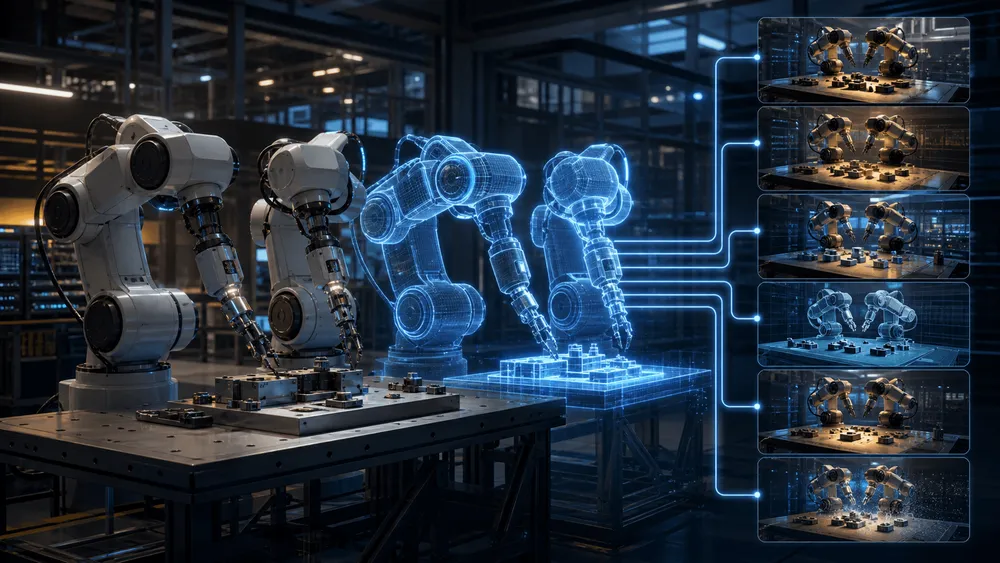
R2S2R takes in a real robot, its sensors, the surrounding environment, manipulated objects, and a task demonstration, and reconstructs them into an operable virtual world. From there, it varies lighting and camera viewpoints, as well as the number and arrangement of objects, clutter levels, physical properties such as friction, and the robot's initial state. This mechanism generates thousands of conditions from a single recording—conditions that would be difficult to repeatedly prepare in the field.
The goal is not to create footage that merely resembles the original scene. It's to simultaneously match the images the robot observes and how the objects it touches move, determining whether the task succeeds or fails. World Labs conducted open-loop tests giving the same action sequence to both the real robot and the simulation, cross-checking observations, object responses, and final outcomes. The published examples include rigid cubes, articulated boxes, and deformable cables.
This distinction shapes how world models are used. In the company's classification, a renderer produces images for humans to view, while a simulator produces states with geometry, physics, and dynamics that software can manipulate. In robot learning, even if the appearance looks natural, if scale or collision detection is incorrect, behaviors learned there will fail on real hardware. R2S2R attempts to narrow this gap by reproducing the parts relevant to task success or failure through a combination of measurement and generative models.
Running Five Tasks for an Hour with Zero Real-World Data
On the training side, the company trained a bimanual bin-packing policy for the ALOHA robot entirely within simulation, without using any real-world training data, and transferred it directly to the physical robot. In a virtual world, object placement, viewpoint, speed, and difficulty can be deliberately varied, and success and failure examples can be repeatedly presented. Supervisory information that's difficult to record in the real world—such as precise object states, contact, and force—can also be utilized.
In a separate continuous-operation demo, RB-Y1 wrapped a power cord around a refrigerator, and YAM plugged and unplugged a cable. Flexiv transferred test tubes, and xArm picked markers and pencils one at a time from a dense pile. According to World Labs, all five tasks performed on four different real robots continued for one hour each without human intervention. The scope is broader than demos involving short-duration manipulation of rigid objects, as it covers cable deformation, gripping in tight positions, and overlapping objects of similar shape.
However, what a one-hour continuous run demonstrates is simply that the policy didn't stall for the published task and robot. It doesn't reveal long-term reliability in environments like homes or warehouses where people and objects move unpredictably, nor does it show success rates when transferred to different tasks. The company's claim that R2S2R is independent of specific policies or robots needs to be verified under a wider range of conditions.
2,000 Virtual Trials Change Evaluation
The evaluation experiment used a task where ALOHA passed a cube between its two arms. For each checkpoint, 2,000 trials were run in simulation and 100 on the real robot. This breaks down into 1,000 and 50 trials, respectively, for positions included in the training distribution, and another 1,000 and 50 trials for positions excluded from training.
What World Labs emphasized was not making the virtual and real success rates match numerically. Rather, it was aligning the relationships needed for development decisions—which policy is better, whether performance improves or plateaus as training progresses, and at which positions failures occur. According to the company, relative rankings held across different policy architectures and training configurations, and both environments reproduced examples where the policy barely succeeded by grasping the edge of the cube, along with corresponding failures.
In real-world testing, objects must be reset after every trial, failures must be recovered from, and hardware must be maintained. If weak checkpoints can be filtered out first in simulation and real-world testing time can be concentrated on promising candidates, the number of evaluations can be increased while reducing physical labor. The value of R2S2R lies not in the virtual world's success rate itself, but in whether the judgments about which policies to advance to real hardware align.
Verification Gaps Remaining in the Early Results
The published materials lack the amount of real-world data needed to build the simulator, the computational cost of training and generation, and the trial counts and absolute success rates for the five tasks. The method is described as proprietary technology, and no reproducible paper or third-party verification has been presented. Selected demo footage and a one-hour continuous run alone are insufficient to judge how much this could replace tasks with low failure rates.
Difficulties specific to generative simulators also remain. World Labs itself explains that even generated content with correct appearance can produce unnatural physics calculations due to self-intersecting shapes or scale errors. Composite physics involving rigid bodies, deformable objects, fluids, and cloth simultaneously is substantially more expensive than single-domain calculations. The speed at which environments can be multiplied and the fidelity of contact physics must be measured separately.
The next pieces of evidence needed are the complete success rate distributions for the published tasks and the time and cost required to build the simulation. Furthermore, if policy rankings and failure regions correspond even in unstructured field settings and on different robot models, R2S2R will move closer to becoming a standard evaluation platform for pre-deployment testing, rather than just a generator of training data.