
サイエンス
4億年前の地球を支配した「謎の巨人」プロトタキシテスの正体が判明:真菌説を覆す「失われた生物系統」の発見
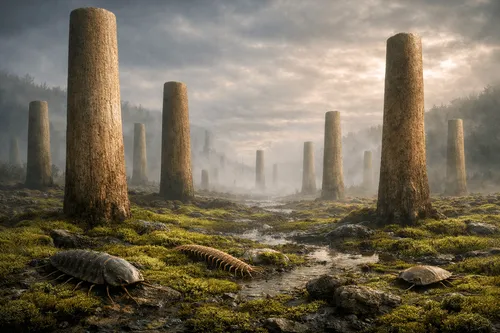
地球史最大のミステリー、165年目の真実 約4億年前、シルル紀後期からデボン紀にかけての地球の陸上風景は、現在のそれとは似ても似つかぬ異様な世界であった。恐竜が出現するのは遥か未来の話であり、陸上にはまだ背の高い樹木さえ […]

別名: プロトタキシテス, Prototaxites taiti, Prototaxites
1843年に発見された巨大な化石生物。長年、巨大な真菌(キノコ)や針葉樹と考えられてきたが、2026年の研究により、既存の植物、真菌、動物のいずれの系統にも属さない、完全に絶滅した未知の多細胞生物の系統であることが判明した。リグニンに似た独自の生体高分子を持ち、従属栄養生物として当時の陸上生態系で巨大な塔のような姿で林立していた。
Prototaxites (Nematophyta) is among the most enigmatic of terrestrial fossils. This Late Silurian–Late Devonian taxon formed multiple types of tubular filaments of varying size interwoven to produce massive treelike or columnar structures, up to more than 8 m tall and 1 m wide, making it the largest terrestrial organism of its time, towering over the surrounding vegetation. The affinities of this organism—even at the kingdom level—have been the subject of debate for over 150 years; however, the seminal work of Francis Hueber turned the tide toward a fungal interpretation that continues to remain the most widely accepted alternative. However, this characterization was made during a period in which fungal relationships and their evolutionary time lines were poorly understood. Advances in systematics and paleontology have both resulted in a substantial revision of our understanding of fungal evolutionary history. Here we reconsider Hueber’s interpretation of Prototaxites as a fungal sporocarp in the context of more recent research postdating his publication. In addition, we consider alternative suggestions by others that Prototaxites represents a lichen thallus. We argue that the weight of the evidence argues against interpretations as an agaricomycete sporocarp or ascomycete lichen association and that while the taxonomic identity remains unclear, we suggest that if Prototaxites was indeed of fungal origin, it may represent part of an extinct lineage lacking extant descendants.
Prototaxites was the first giant organism to live on the terrestrial surface, represented by columnar fossils of up to eight meters from the Early Devonian. However, its systematic affinity has been debated for over 165 years. There are now two remaining viable hypotheses: Prototaxites was either a fungus, or a member of an entirely extinct lineage. Here, we investigate the affinity of Prototaxites by contrasting its organization and molecular composition with that of Fungi. We report that fossils of Prototaxites taiti from the 407-million-year-old Rhynie chert were chemically distinct from contemporaneous Fungi and structurally distinct from all known Fungi. This finding casts doubt upon the fungal affinity of Prototaxites, instead suggesting that this enigmatic organism is best assigned to an entirely extinct eukaryotic lineage.
The enigmatic fossil Prototaxites found in successions ranging from the Middle Ordovician to the Upper Devonian was originally described as having conifer affinity. The current debate, however, suggests that they probably represent gigantic algal-fungal symbioses. Our re-investigation of permineralized Prototaxites specimens from two localities, the Heider quarry in Germany and the Bordeaux quarry in Canada, reveals striking anatomical similarities with modern fungal rhizomorphs Armillaria mellea. We analysed extant fungal rhizomorphs and fossil Prototaxites through light microscopy of their anatomy, Fourier transform infrared spectroscopy, X-ray microscopy, and Raman spectroscopy. Based on these comparisons, we interpret the Prototaxites as fungi. The detailed preservation of cell walls and possible organelles seen in transverse sections of Prototaxites reveal that fossilization initiated while the organism was alive, inhibiting the collapse of delicate cellular structures. Prototaxites has been interpreted to grow vertically by many previous workers. Here we propose an alternative view that Prototaxites represents a complex hyphal aggregation (rhizomorph) that may have grown horizontally similar to modern complex aggregated mycelial growth forms, such as cords and rhizomorphs. Their main function was possibly to redistribute water and nutrition from nutrient-rich to nutrient-poor areas facilitating the expansion for early land plant communities.