


Step into a massive data center, and you're enveloped by the roar of tens of thousands of cooling fans. Every time we ask an AI to perform a complex inference, countless electrons within silicon chips are forced into physical motion, scattering enormous amounts of heat as evidence of the process. According to projections from the International Energy Agency (IEA), global data center power consumption will surpass 1,000 terawatt-hours by 2026—a scale that could swallow the entire annual consumption of a mid-sized nation. Faced with this energy wall inherent to semiconductor technology, an entirely new approach that processes information without moving electrons has finally been proven at a practically useful scale.
The Cost of Physically Moving Electrons—The Heat Wall Behind Half a Century of Convention
Modern computers, based on von Neumann architecture, process calculations by opening and closing transistor switches etched into silicon wafers. In this process, minuscule physical particles called electrons pass through gates and are forcibly moved through circuits. At the microscopic level, moving electrons repeatedly collide with the silicon atomic lattice, continuously generating energy loss through electrical resistance. This is the true nature of the waste heat that makes chips scorching hot.
As devices have become more miniaturized, this heat density has continued to rise, and it is now physically impossible to operate processors without powerful cooling mechanisms. The existing mechanism, in which computational power improvement and power consumption are directly proportional, has clearly hit the limits of sustainability. Furthermore, transistor miniaturization itself is approaching the atomic scale, and any further increase in density triggers current leakage due to quantum tunneling effects. Amid cries that Moore's Law is coming to an end, a fundamental architectural overhaul has become an urgent necessity.
From "Charge" to "Spin Propagation"—A Computing Paradigm Where Waves Carry Information
To fundamentally avoid the heat generated by moving electrons, research into next-generation hardware has shifted its focus from the electron's "charge" to its "spin." In this field known as spintronics, information is processed using the electron's property as a tiny magnet—its spin.
Imagine a large number of spinning tops arranged with no gaps between them. If you externally tilt one top, that disturbance propagates sequentially to the neighboring tops. Without moving the electrons themselves to another location, a magnetic wave (a spin wave) can propagate through space, carrying information to a distant point. A computing device that applies this physical phenomenon is the Spin Hall Nano-Oscillator (SHNO).
To apply this to computing devices, thousands to tens of thousands of oscillators must be precisely synchronized on a single grid. In previous research, controlling the interactions between oscillators to generate large-scale order was considered extremely difficult. Pack the array too densely, and the signal becomes disordered; space them too far apart, and the waves fail to reach neighboring oscillators. The largest synchronized network demonstrated in prior experiments was limited to just 64 oscillators arranged on a two-dimensional plane. Building a large-scale network akin to the neural circuits of the brain on hardware has long stood as an insurmountable technical wall.
Complete Synchronization in 45 Nanoseconds—A Minute Structure That Shattered the Scale-Up Barrier
An international research team from the Indian Institute of Technology (IIT) Bhubaneswar, the University of Gothenburg in Sweden, and Tohoku University in Japan overturned this scale-up limit through fundamental structural design. What they adopted was an integrated array of ultra-fine "nano-constriction structures."
The research team prepared a three-layer substrate consisting of a tungsten-tantalum alloy layer topped with a ferromagnetic layer made of cobalt, iron, and boron. Into this, they precisely carved extremely narrow pathways—10 to 20 nm wide, resembling the pinch point of an hourglass. When current is passed through this fine constriction, spin-orbit interaction accompanying electron movement generates a pure "spin current" with aligned spin orientation, which is intensively injected into the constriction, violently shaking the magnetization of the ferromagnetic layer and triggering self-oscillation.
The team fabricated a massive grid packing 105,000 of these nano-constriction oscillators onto a single chip. The spin fluctuations generated at each oscillator propagate to surrounding oscillators via magnon (quantized spin wave states) exchange interaction. The moment current was applied, more than 100,000 initially independently oscillating points began pulling each other's waves into alignment, and the entire array started synchronizing into an identical phase.
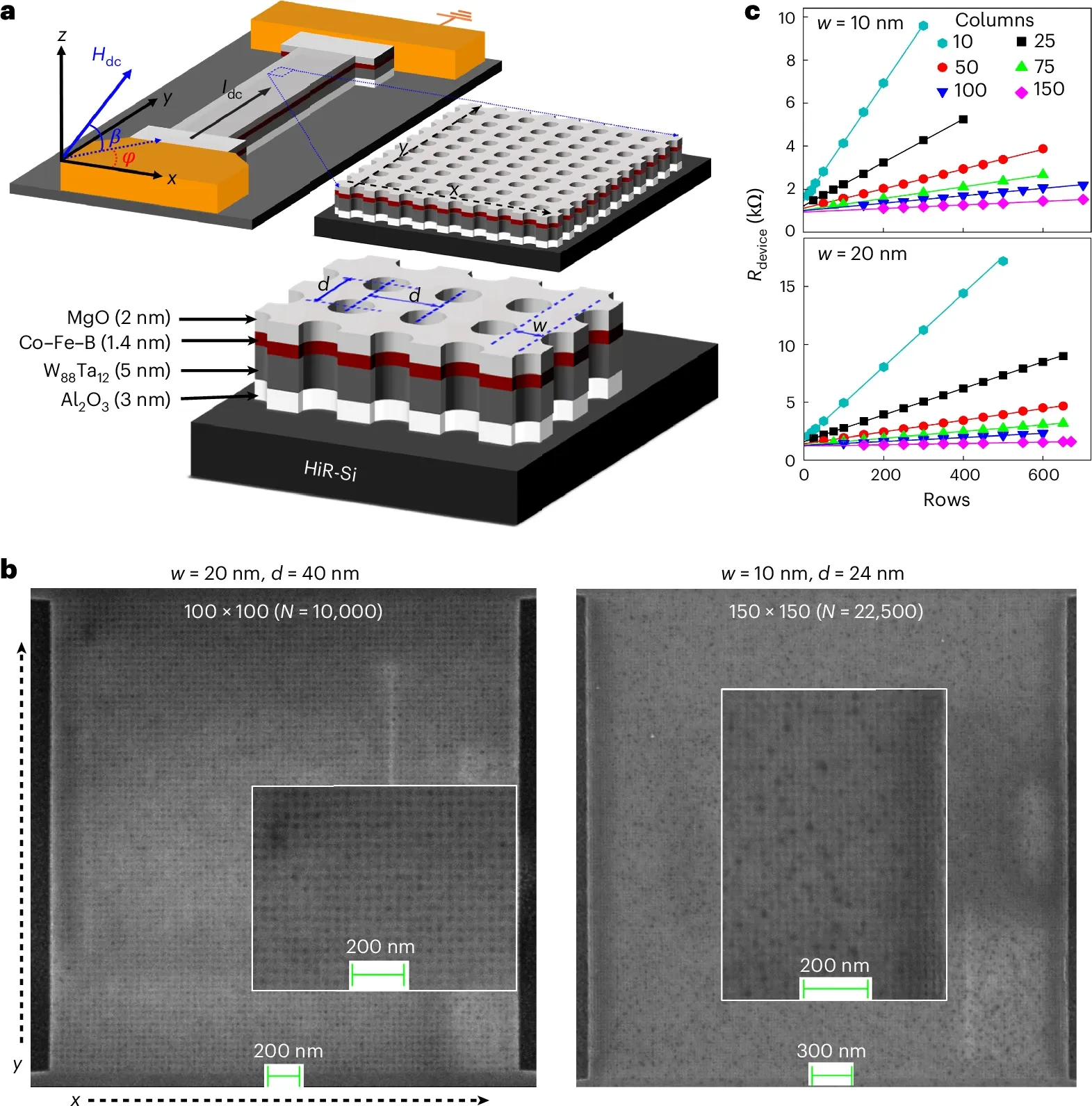
This complete synchronization was achieved in a mere 45 nanoseconds. While synchronizing 100 oscillators took 10 nanoseconds, expanding the scale by more than 1,000-fold only increased the synchronization time by a factor of 4.5. The fact that processing speed does not extremely lag even as the network scale expands dramatically proves that this architecture possesses exceptionally ideal scalability as parallel processing hardware.
Ultimate Signal Precision Guaranteed by a Q-Factor of One Million
Beyond the speed of synchronization, the quality of the output microwave signal also reached an overwhelmingly high level. The quality factor (Q-factor) of the signal generated by the 105,000 synchronized oscillators exceeded 1,000,000.
Noisy, minute magnetic fluctuations, gathered together from 100,000 sources and interfering with one another, were refined into an extremely pure single wave. Like a tuning fork whose striking frequency is precisely fixed, this massive grid emits an unwaveringly clear microwave signal.
This stands in stark contrast to quantum computers, which readily lose their quantum states during computation and require massive error-correction mechanisms. This oscillator network, as an inherent property of the physical system, naturally settles into an extremely stable synchronized state on its own. Without expending enormous resources on error correction, accurate output can be read simply by waiting a few dozen nanoseconds for the state to stabilize.
| Comparison Item | Conventional Silicon CMOS | Prior SHNO Research | This Study's Ultra-Large-Scale SHNO Array |
|---|---|---|---|
| Physical carrier of information | Physical movement of electrons | Spin waves (magnon exchange) | Spin waves (magnon exchange) |
| Maximum synchronized/coupled scale | Billions of transistors | 64 units | 105,000 units |
| Computation stabilization (sync) time | Depends on clock frequency | Unevaluated due to insufficient scale | 45 nanoseconds |
| Signal quality (Q-factor) | - | Low to moderate | Over 1,000,000 |
| Primary energy loss | Joule heat from electron collisions | Large, in basic research stage | Extremely low (natural phase ordering) |
Realizing Optimization Hardware That Derives Solutions from Spin Interference Patterns
In what kind of computational tasks will this massive synchronized network truly demonstrate its value? The area most anticipated for practical application is the "Ising machine" and "reservoir computing," which solve specific mathematical models directly through physical phenomena themselves.
Searching for optimal routes in logistics networks or conducting real-time risk analysis of financial markets are optimization problems involving countless variables. Current sequential-processing CPUs require enormous amounts of time to exhaustively calculate all these patterns. Using a 100,000-unit SHNO array, these complex problems can be physically mapped onto the substrate as wave interference patterns.
When complex conditions are input into the grid as an initial state, the oscillators collide their waves against one another and autonomously transition to a synchronized state with the lowest energy state (indicating the optimal solution) within 45 nanoseconds. While a CPU is still calculating matrix elements one by one, the spin waves instantaneously envelop the entire network, forming the shape of the answer in a single instant. Because it operates in an extremely high frequency band of tens of GHz, it completely bypasses the processing bottlenecks inherent to conventional computing at a physical dimension.
Currently, in the race to develop next-generation computers specialized for optimization problems, quantum annealing using superconducting circuits and optical computing utilizing light interference are leading the pack. However, superconducting methods require massive cooling equipment to maintain near-absolute-zero temperature environments, while optical methods face a wall in extreme miniaturization on chips due to the wavelength of light. In contrast, this architecture using spin waves holds decisive advantages: it can be expected to operate at room temperature and enables high-density integration at the nanoscale.
Furthermore, applications as physical reservoir computing for AI are also within scope. Time-series data such as audio waveforms or stock price fluctuations can be fed into this oscillator network (the "reservoir"). The 100,000 oscillators interfere with each other in complex ways, instantaneously transforming the input data into high-dimensional patterns. At the output layer, it suffices to simply read the complex wave shapes formed in the reservoir and perform linear classification. Because the bulk of the computation can be "outsourced" to the physical phenomenon itself, this opens a path to dramatically reducing the power consumption required for AI training and inference.
Challenges in Physical Control for Evolution into a Programmable Computing Device
The hardware foundation of complete synchronization at the scale of 100,000 units has been established. The next necessary step is to build "write" and "read" interfaces to freely operate this powerful physical system as a general-purpose computing device.
The current grid demonstrates the stage at which countless oscillators converge into a single homogeneous synchronized state. To evolve this into a programmable computing device, methods must be established to independently adjust the frequency and phase of individual nano-oscillators, as well as the coupling strength between oscillators, using external currents or magnetic fields. How to load time-varying dynamic data onto the input signal (drive current) and draw out the grid's nonlinear response holds the key to the practical implementation of physical reservoir computing.
Hurdles also remain on the manufacturing front for the path to societal implementation. Questions remain about how to integrate this new three-layer structure with the existing silicon CMOS processes that underpin today's semiconductor industry, and how to mass-produce it with good yield. The research team envisions a roadmap to demonstrate a small-scale prototype chip compatible with CMOS processes within the next few years, with full-scale deployment to data centers and edge AI devices targeted on a decade-long timescale from there.
For over half a century, humanity has forcefully advanced computational power on the playing field of silicon, by relentlessly shrinking transistors through brute-force miniaturization. This nano-oscillator network, which completes computation simply by propagating spin waves without moving electrons, represents a powerful paradigm shift that replaces that very playing field itself. The era of suffering under the heat wall while squandering enormous amounts of power will eventually come to an end, through the quiet ripples that spread out in just 45 nanoseconds.